
Every couple of months somebody corners me after the Sunday service with the same question. Which eighty-eight-key piano should I buy for a small room and a budget I have to defend at home? For a few years now my answer has come down to two instruments, the YAMAHA P71 and the Casio CDP-S160. Both are full size, both have weighted keys, both arrive with a sustain pedal and a power supply, and both will sit in the corner of a living room without turning the place into a studio. The differences are real, though, and they tend to show up in the second month rather than the first week.
Here is the short answer. If the piano is going to be played most days, sat down at the way you sit at a piano, and used to accompany a room full of singing, the YAMAHA P71 is what I would buy with my own money. The touch is graded, heavier at the bottom of the keyboard and lighter at the top, the grand piano voice sits under a singer without any fiddling, and the whole instrument is uncomplicated in the way a good piano should be. If the piano has to move, has to live somewhere the power is unreliable, or has to fit into a room that is already crowded, the Casio CDP-S160 is the more sensible buy and I would not argue with you.
| YAMAHA P71 | Casio CDP-S160 | |
|---|---|---|
| Piano tone | A grand piano voice that sits naturally under a singer and needs no adjusting | Brighter and more forward, which suits pop and band work better than solo playing |
| Key action | Weighted and graded, heavier at the bottom of the keyboard | Weighted and graded too, with a slightly firmer landing under the finger |
| Cabinet footprint | Deeper front to back, so it wants a proper stand or a sturdy table | Noticeably slimmer, so it slides back against a wall |
| Weight | 25 pounds, carryable by one person but not something you tuck under an arm | Lighter, and the easier of the two to carry to a rehearsal |
| Power | Corded only, so it needs to sit near an outlet | Will run on AA batteries when there is no outlet handy |
| Voices | Ten voices, plus a Duo Mode that splits the keyboard into two matching halves | Ten tones as well, so no disadvantage on the count |
| Sustain pedal | A sustain pedal and a power supply come in the box | A sustain pedal comes in the box as well |
| Headphone practice | 3.5mm jack, so the earbuds you already own will work | Has a headphone out for silent practice as well |
| Price | The higher asking price of the two | The lower asking price |
Where the YAMAHA P71 Wins
Start with the sound, because that is where this one earns its keep. The grand piano voice is what I use for the prelude, the offertory and the closing hymn, and I have never once felt the need to stop and adjust anything in the middle of a service. There are ten voices in total, and the ones that matter for church work, the grand, the electric piano and the strings, are all usable exactly as they come. Dual Mode lets you lay two of them together, piano under strings or piano under a pad, which is a trick I lean on during the slower hymns when the room is half empty and the piano is carrying the whole thing by itself.
The key action is the other half of it. The keys are weighted and graded, so the bottom of the keyboard pushes back a little more than the top, and a student who learns on this will not be shocked the first time they sit at a real upright. My granddaughter Kaia is nine and has been learning for about a year. The thing I watch for with her is whether an instrument lets her make a soft note on purpose. On a light, springy keyboard she either plays loud or she plays nothing at all. On the YAMAHA her hands can find the middle, and that is a lesson you cannot teach by talking about it.
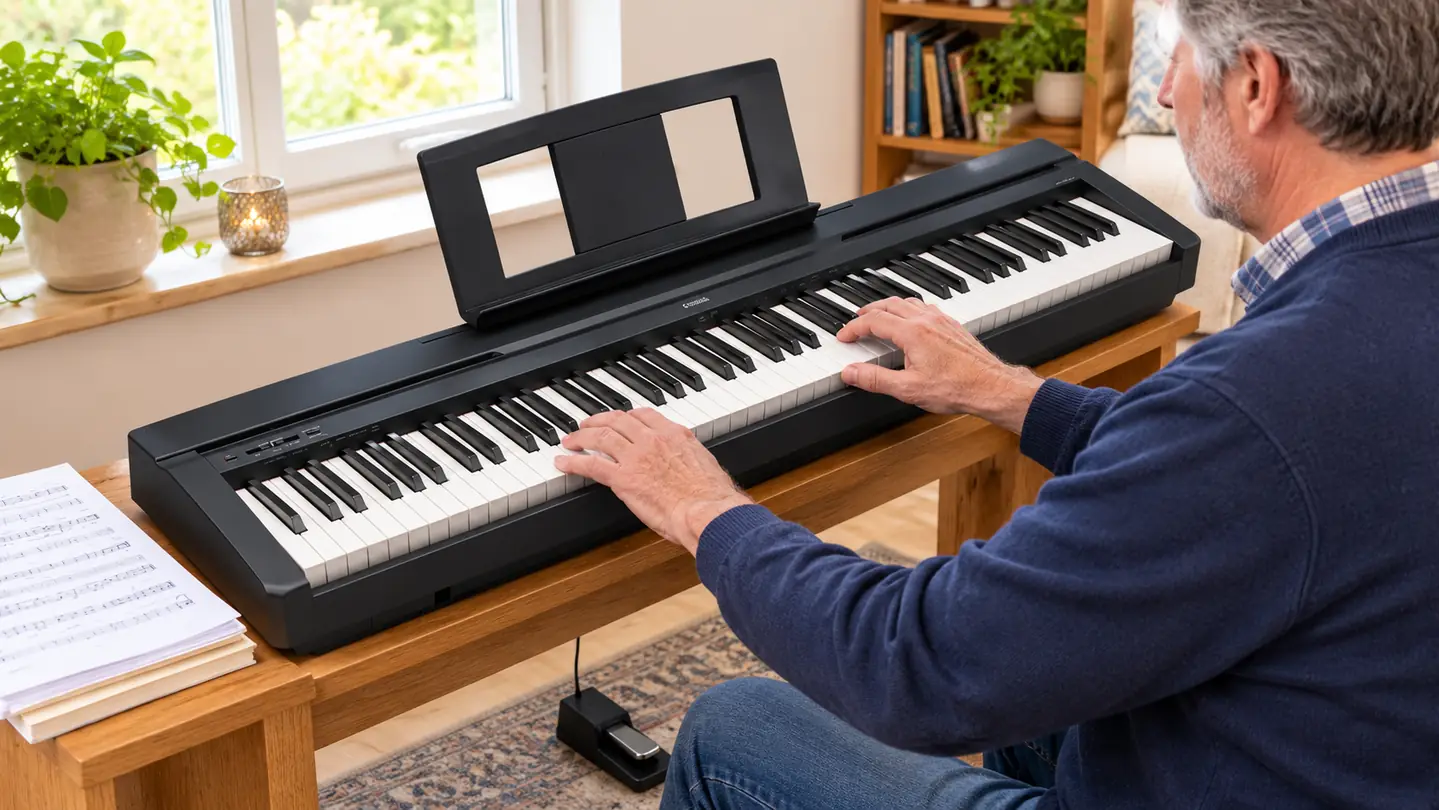
It is also refreshingly simple, and I mean that as a compliment. There is essentially one button to deal with. You turn it on, you choose a voice, you play. Nothing on this piano wants to be updated, and nothing on it is going to pull a nine year old toward a screen. It measures 52.25 inches wide, 11.5 inches deep and 6 inches high, and it weighs 25 pounds, which means one person can carry it and one person can also knock it off a stand if they are careless. The 3.5mm headphone jack has been the most useful feature in my house, because it lets me practise after Leilani has gone to bed without waking the street.
Where the Casio CDP-S160 Wins
The Casio's first advantage is the one you notice before you play a note. It is slimmer front to back than the YAMAHA, and it is lighter. In a small house that sounds like a small thing and it is not. My music room is the spare room off the lanai, and the floor space in there is spoken for by an old upright that belonged to my mother. A piano that slides back against the wall when it is not being played is a piano that actually gets played. The Casio does that a little more easily, and if the only place a piano can live in your home is a hallway or the end of a couch, that difference decides the purchase.
Then there is power. The Casio will run on AA batteries when there is no outlet within reach. I have played a family gathering under a tent where the nearest socket was forty feet away and behind a plate of food, and an instrument that does not care about that is worth something. Storms knock the power out here more often than people on the mainland expect, and a keyboard that keeps working through the first hour of an outage is a genuinely useful object rather than a piece of furniture. For a church that meets in a hall, or a family that plays outdoors, that one detail matters more than a slightly better piano sample.
And it asks for less money. I am not going to quote figures at you because they move around, but the gap between these two is enough to cover a proper stand, a bench at the right height and a heavier pedal than the one in the box. If you are buying a first piano for a child and you are not certain the interest will still be there in a year, putting less into the instrument and more into the setup around it is the decision I would make. The Casio's tone is brighter and a little more forward than the YAMAHA's, which suits pop and band work and suits a young player who wants to hear themselves clearly.
The one I would put in my own music room
After years of playing both, the YAMAHA P71 is the instrument I keep coming back to. Graded weighted keys, ten voices to draw from, and a grand piano tone that needs no coaxing to sit under a singer. The sustain pedal and the power supply are in the box, so there is nothing left to buy before you can sit down and play.
Amazon Check Today's Price on Amazon →How I Tested Both
I am not a gear reviewer. I am a retired middle school music teacher who plays for a church and teaches a granddaughter, and I judge a piano by whether it gets in the way of the music or stays out of it. I had both of these in the music room for several weeks at a time, played the same service repertoire on each, and used them for the same practice routine, which is scales, hymns and whatever Kaia happens to be working on that week.
The honest test for me is a hymn at tempo with somebody singing over it. A digital piano can sound lovely on its own and then vanish the moment a voice joins in. The YAMAHA holds its place in that mix. The Casio is brighter and cuts through, which helps in a loud room and wears on you a little in a quiet one. Neither is going to fool a trained ear into believing there is a concert grand in the corner, and both are good enough that a congregation will not be thinking about the piano at all, which is the actual goal.
I also paid attention to the things that quietly break a practice habit. Can I play with headphones at night? Yes on both. Does the pedal stay where I put it? The included pedals on both are the light switch type and they slide on a hard floor, so plan on a pedal with some weight to it or a strip of grip underneath. Does the instrument survive humid island air? Neither has given me trouble in a room off the lanai, though I keep a cover on whatever sits out there and I never leave a keyboard pressed against an outside wall.
A hymn at tempo with somebody singing over it will tell you more about a piano in ten seconds than an hour of playing alone ever will.

Who Should Buy Which
Buy the YAMAHA P71 if this is going to be the household piano. If it sits in one place, if it gets played most days, if somebody in the house is learning properly, and if you want a touch and a tone that will not need apologising for at a recital, this is the one. It is also what I would choose for an adult coming back to the instrument after thirty years away, because a graded action is forgiving of a rusty hand and honest with it at the same time.
Buy the Casio CDP-S160 if the piano has to earn its space. A small apartment, a shared room, a lot of moving, power that comes and goes, or a budget that also has to cover the stand and the bench. It is a real weighted eighty-eight-key instrument and nobody at a singalong is going to complain about it. What you give up is a little of the body in the piano tone and a little refinement in the action, and if you have never played seriously, you may not notice either one.
What Neither One Will Do For You
Let me be straight about the ceiling on both of these. The pedals are switches, so the half pedalling and the feathering that a good acoustic does are not really there. The speakers are modest, so a room much bigger than a living room will want some reinforcement. Neither has Bluetooth, so do not plan on using either as a speaker for your phone. And the action, good as it is, is not the action of a well regulated upright. If the plan is to sit a conservatory exam on a grand, these are stepping stones and not the destination.
The other thing neither one does is feel like furniture. They are slabs. If what you actually want is something your mother would have recognised as a piano, with a lid and a music desk and a bench that matches, buy the old upright and pay the tuner. I say that as a man with an old upright in the next room that I would not trade for anything. But an upright that is out of tune is worse than a digital that is always in tune, and most of the uprights people give away are out of tune.
If you want the touch to teach you something, start here
The YAMAHA P71 is the one I would hand a returning adult or a serious beginner, because the graded action tells the truth about your hands and the grand voice holds up under a congregation. Full 88 keys, ten voices, sustain pedal and power supply included.
Amazon Check Today's Price on Amazon →