
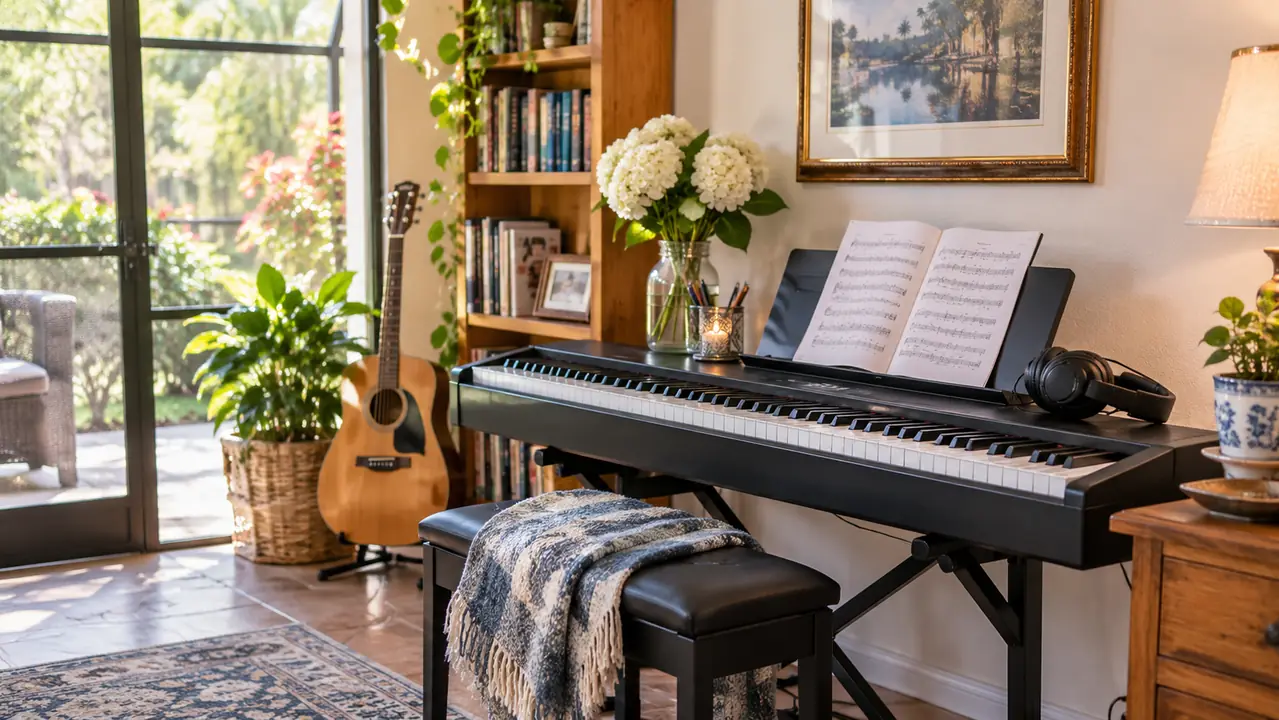
The first thing I noticed about the YAMAHA P71 was not a feature. It was how quickly I stopped thinking about the instrument and started thinking about the music. I am 63, a retired middle-school music teacher in Kaneohe, and I play piano for the Sunday service at my church. My mother's old upright lives in the living room, and it needs tuning more often than I like to admit. The spare room off the lanai is where I practice now. It is small, humid, and quiet enough to hear my own mistakes. That room is why I wanted a digital piano with 88 weighted keys, not a keyboard that feels like a toy.
I had tried a few inexpensive keyboards before this one. They were fine for picking out a melody, but the keys bottomed out with a plastic click and my fingers had to work around the instrument instead of through it. I wanted something plain: a piano I could sit at after dinner, play through a hymn, and not fight. The P71 is that. It is an Amazon-exclusive version of YAMAHA's entry-level 88-key piano, and the listing is honest about what it is: weighted action, 10 voices, a sustain pedal, a power supply, and not much else.
The Quick Verdict
A plain, sturdy 88-key piano with a key feel that encourages daily practice. The built-in speakers are small and there is no stand in the box, but for a living room or a small music room, it does the job.
Amazon Check Today's Price →The piano I keep coming back to after dinner
If you want weighted keys and a simple instrument that does not need a screen, the YAMAHA P71 is the one I would point you toward first. Check the current listing and see if it fits your room.
Amazon Check current availability on Amazon →How I've Used It
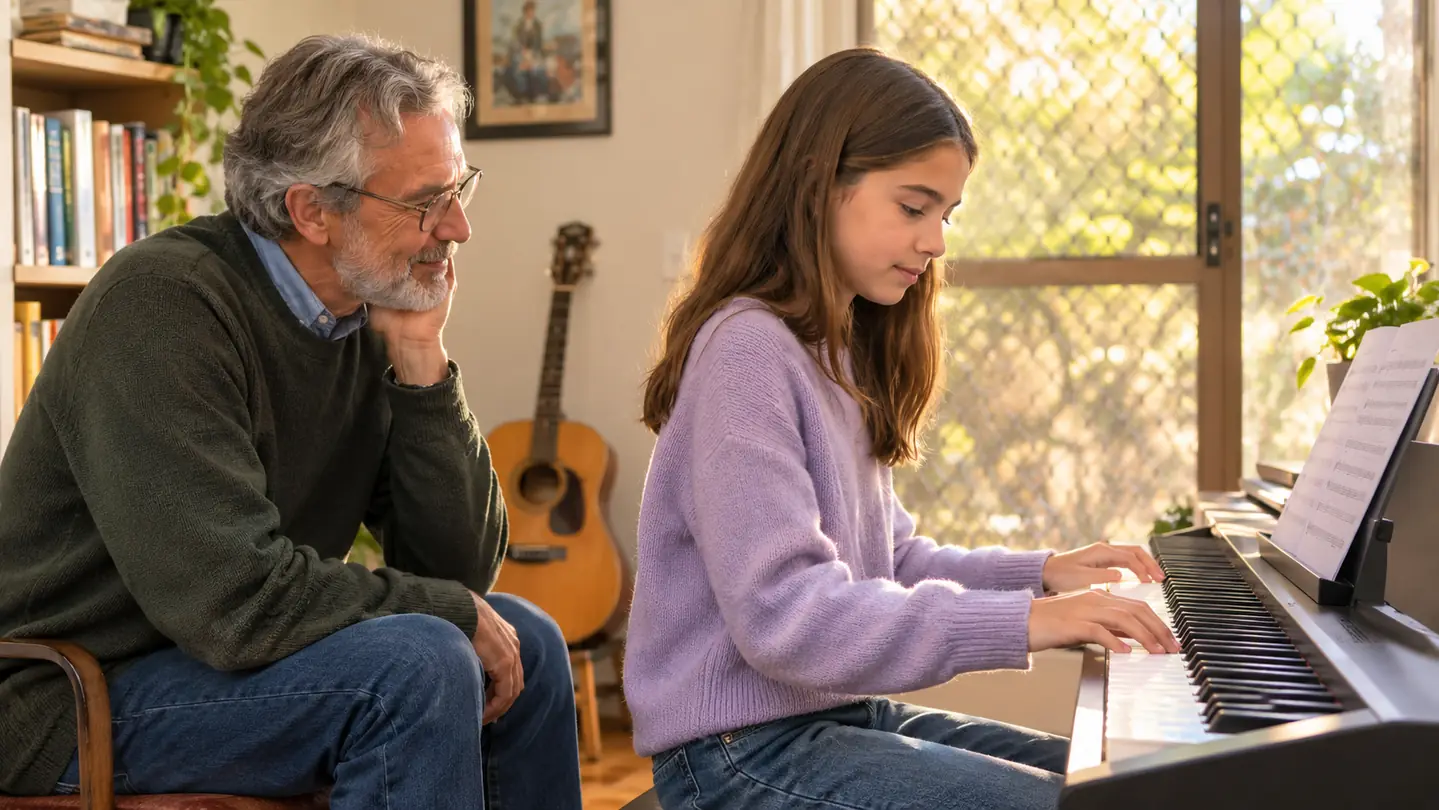
I have used the P71 for several months now, usually 30 to 60 minutes a day. I started at the end of spring, when the trade winds were steady and the room was at its driest, and I kept a small notebook on the bench to write down what I worked on each night. That notebook turned out to be useful. When I flipped back through it after a month, I could see the scales getting faster and the same two measures of a hymn stopping giving me trouble. Sunday mornings are different; I run through the gospel set twice, once slowly and once at tempo, then I stop before my hands get tired. Weekday evenings are for scales and the old lesson-book pieces I play to keep my fingers honest. My granddaughter Kaia, who is 9, practices her lesson books on it when she visits. She likes that she can plug in headphones, and I like that I can still hear the room. The piano sits on a stand I already owned, near the window that looks out toward the lanai. The bench is a plain wooden one my wife Leilani found at a swap meet years ago, and it sits a little low, so I fold a towel under me for the long sessions.
The room is humid. That is not a small detail in Hawaii. I drape a cloth over the P71 when I am not playing, and I wipe the keys after Kaia's visits because children have sticky hands. Once a week, usually Saturday morning, I take the cloth off, dust the top, and check that the cables are still tucked behind the stand where nobody steps on them. I have not had a key stick or a button fail. The power supply and sustain pedal that came in the box are still the ones I use. At 25 pounds, the piano is light enough for me to slide it a few inches when I want to clean behind it, but it stays put when I play.
I am not a gigging musician. I do not haul this piano to church; the church has its own instrument. The P71 stays in the music room. If you need a keyboard for a band, this is not the thread to pull. If you need a piano for a small room, a church practice room, or a student's bedroom, the size is reasonable. The listing gives the dimensions as 52.25 inches wide, 11.5 inches deep, and 6 inches high. Measure your wall before you buy. I did, and it fits under the window without blocking the screen door. I measured twice, because the first number I wrote down was wrong and I nearly ordered a stand that would not have cleared the baseboard.
The Key Feel Is the Reason to Buy It
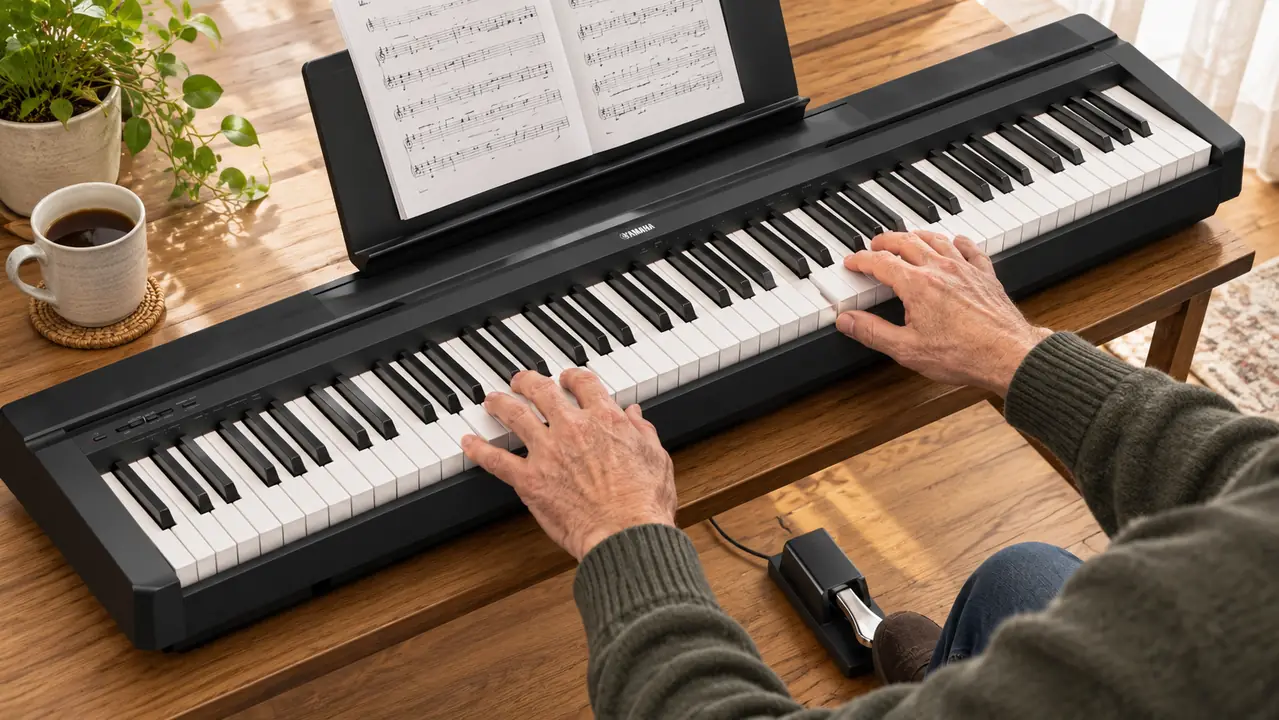
The P71 has 88 weighted keys with a hammer action. That is the whole reason I chose it over the smaller, lighter keyboards I tried. The keys have resistance. When I play softly, the sound is soft. When I dig in, the sound opens up. That touch-sensitive response is what makes the piano feel like an instrument instead of a set of buttons. My mother's upright still has a heavier action, but the P71 is close enough that I do not have to relearn how to play when I sit down at either one.
I notice the difference most in hymns and gospel songs that need a wide dynamic range. A quiet verse should not sound like a chorus. There is a gospel arrangement we do at church that begins with one soft verse and then opens up on the repeat. On a spring-action keyboard, that chorus sounds like the verse played louder. On the P71, I can bring the left hand down and let the right hand sing, and the lift feels like it comes from my arm instead of from a volume knob. The action is not silent; there is a soft mechanical sound when the keys return. In a small room, I hear it. With headphones, I do not. That is a fair trade for the feel. When I practice early in the morning before the house is up, that small sound is the loudest thing in the room, and the headphones take care of it.
YAMAHA does not market this as a high-end action, and it is not. The repetition is not as quick as a grand, and a very fast trill can feel a little blunt. I spent a few weeks on a two-part invention and had to slow the ornaments down before they came out evenly. Once they did, they stayed even. For a returning pianist, a church pianist, or a student learning scales, it is more than enough. I would rather have this action than a lighter keyboard with more sounds.
Ten Voices, One Button, and a Small Speaker
The P71 has 10 voices, including a grand piano sound. I use the grand piano most of the time. For the church set, I sometimes use the dual mode to layer piano and strings, which fills out a slow song without a second player. The operation is simple: one button does most of the work. I did not have to read a manual to change voices. That matters at 63, when I want to practice, not troubleshoot. My evening routine is the same every night: five minutes of scales, ten minutes on whatever piece is giving me trouble, then a hymn or two for the pleasure of it. Because there is no screen to wake up and no menu to walk through, I am playing within a few seconds of sitting down. I have not used all 10 voices. I found the two I like and I stayed there, and I do not feel like I am missing anything.
The built-in speakers are honest. They are fine for a small room, a lesson, or a quiet run-through. They are not going to fill a fellowship hall. If you need volume, use the 3.5mm headphone jack for headphones or connect to a larger system through the auxiliary connection. I use headphones after dinner so I do not wake the house. The sound in the headphones is clean, and the pedal responds the way I expect. The listing also lists USB connectivity and Logic Pro as supported software. I have used the USB connection to a laptop, and it worked without a fuss.
The speakers will not give you the body of a real upright. The low end is small, and the highest notes can sound thin at low volume. I noticed it most when I played a piece that uses the bottom octave. In headphones, the same passage sounds fuller, and through the auxiliary connection into a small powered speaker, the low end comes back enough to be satisfying. This is a small-room piano. If you want a piece of furniture that fills a living room with sound, look at a console piano. If you want a practice instrument that fits in a spare room, the speakers are adequate.
What Several Months in Island Air Has Done
The spare room off the lanai gets humid. I keep a hygrometer on the shelf, and I run a small dehumidifier when the reading climbs. August was the real test. The reading sat high for a stretch of days and I ran the dehumidifier every afternoon, then checked the keys the way you check a car after a long drive, one end to the other, listening for anything that did not come back up cleanly. Nothing did. I am careful with the P71 because it is electronic, not because it has shown any weakness. So far, nothing has drifted. The keys have not stuck. The buttons still click. The top has stayed clean with a dry cloth. I do not leave the piano in direct sun, and I do not put a drink on top of it.
The 25-pound weight makes it easy to move, but it also means the piano is not a heavy piece of furniture. It sits on a stand. If a child leans on it, it will move. That is true of most keyboards in this class. I keep the stand against the wall and the cables tucked behind it. The sustain pedal that came in the box is light, and it slides on the wood floor. I put a square of grippy shelf liner under it. That is not a defect; it is a small thing to fix.
I have not had to service the P71. I have not had a dead key or a scratchy headphone jack. That is not a long-term guarantee. It is a report after several months of daily use in a climate that is hard on instruments. The old upright in the living room goes out of tune on its own schedule and I pay to have it brought back. The P71 needs a dry cloth and a little care. That is one reason I play it more than the upright now, and it is the reason my evening practice has not slipped the way it used to.
The Parts That Are Not for Everyone
The P71 does not come with a stand or a bench. The box includes the sustain pedal and the power supply. That is it. If you do not already have a stand, you need to add one to your setup. I used a stand I already owned. A friend bought the same piano and set it on a dining table for a week before he ordered a stand. That is not the piano's fault, but it is part of the real setup.
The one-button operation is simple, but it is also limited. You are not getting a deep control panel. You are getting a piano with a few sounds and a dual mode. If you want to split the keyboard, adjust the touch sensitivity, or record multiple tracks, this is not that instrument. I did not need those things. I needed a piano. But if you are shopping for a studio keyboard, be honest with yourself about the difference.
The built-in speakers are the biggest compromise. They are small, and they sound small. The piano is at its best with headphones or with an external speaker system through the auxiliary connection. I would not buy the P71 to be the only sound system for a party. I would buy it to practice, to teach, and to play for a quiet room. That is what it does well.
What I Liked
- 88 weighted keys with a hammer action that feels close to an upright
- Touch-sensitive response makes soft and loud playing possible
- 10 voices including a grand piano, plus dual mode for layering
- Simple one-button operation, no screen or app to manage
- 3.5mm headphone jack for quiet practice
- 25 pounds, easy to move in a small room
- Includes sustain pedal and power supply
Where It Falls Short
- Built-in speakers are small and thin at low volume
- No stand or bench in the box
- One-button design limits deeper control
- Sustain pedal is light and can slide on smooth floors
- Not a gigging keyboard for a loud band
The P71 does not try to be a studio. It tries to be a piano you will actually sit down at after dinner.
Who This Is For
This piano is for the person who wants 88 weighted keys and a sound they can practice on without a computer. It is for a returning pianist who wants to rebuild finger strength. It is for a church pianist who needs a quiet instrument at home. It is for a parent whose child is taking lessons and needs a full-size keyboard with a real pedal. It is also for a small music room, a lanai room, or an apartment where an acoustic piano is too loud or too much to maintain. If that sounds like your week, the P71 fits.
Who Should Skip It
Skip it if you need a keyboard for gigs. The speakers are small, the pedal is a single sustain pedal, and the piano is not built to be hauled around. Skip it if you need a deep control panel, a split keyboard, or built-in recording. Skip it if you want a piece of furniture that looks like an upright. And skip it if you are not willing to buy a stand. The piano is only part of the setup. The rest is on you.
A piano for the room you actually practice in
The P71 has stayed in my music room because it does the plain work: weighted keys, a clean piano sound, and no screen to distract me. If that is what you need, check the current listing.
Amazon See the YAMAHA P71 on Amazon →