
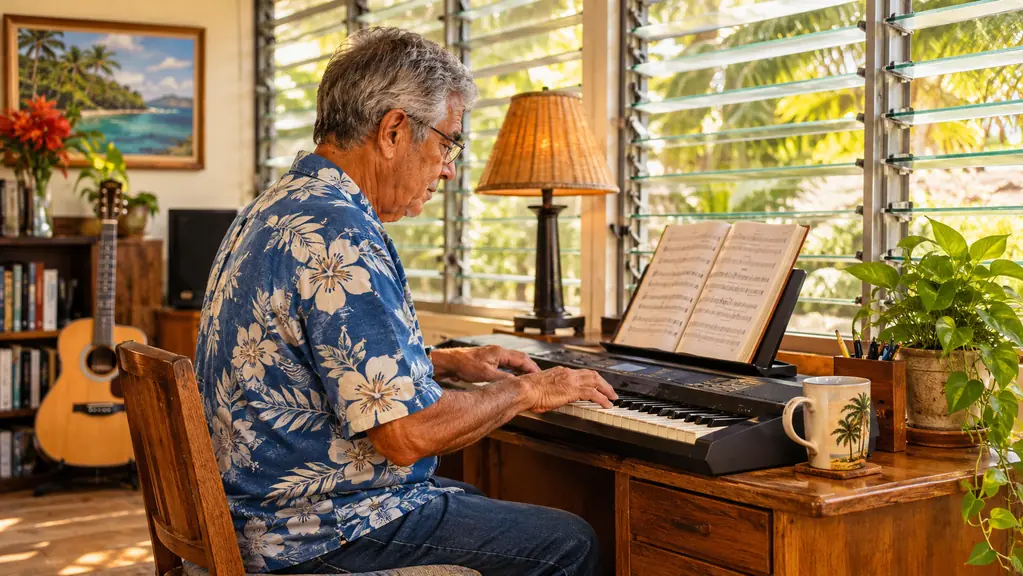
I bought the RockJam RJ361 for a nine-year-old, not for myself. My granddaughter Kaia had been picking out melodies on my mother's old upright in the front room, the one that needs tuning twice a year in this air, and she could not reach the pedals and could barely see over the music desk. So the keyboard went into the small spare room off the lanai, the room with the jalousie windows that never quite shut, and it has been in there for months now, played most days by one of us, and sometimes by both of us at once with her on the right hand and me on the left.
That room is the reason this review exists. Kaneohe humidity gets into everything. I have watched a ukulele go soft in its case and an upright go sharp by August. A beginner keyboard that lives in that room and still works in the same month it arrived is worth talking about, and one that does not is worth warning people off. So this is not a spec sheet read back to you. It is what months of daily use did to a RockJam RJ361, and who I would hand it to.
The Quick Verdict
A light, honest starter keyboard that survives damp island air and a nine-year-old. The keys will not teach touch, but it starts a beginner the same day and keeps working.
Amazon Check Today's Price →The keyboard my granddaughter stopped asking to borrow my mother's piano for
61 keys, 200 sounds and 200 rhythms, a headphone jack for night practice, note stickers and Simply Piano lessons in the box. Months in a humid room and every key still sounds.
Amazon Check Today's Price on Amazon →How I've Used It
It sits on a low desk under the window in that spare room. At 31.5 inches wide and a little over 3 inches deep, it takes up less room than the sheet music stacked beside it, and at 2.84 kg I can pick it up with one hand and carry it to the dining table when the family comes over. That sounds like a small thing. It is not. An instrument you can move with one hand is an instrument that gets played, and an instrument that lives in a case in the closet does not.
Our routine settled fast. Kaia plays twenty minutes after school, sometimes longer when the rhythms keep her going. I sit with her for the first ten and then leave her alone with it. At night, after Leilani has gone to bed, I plug headphones into the 3.5mm jack and work out gospel voicings for Sunday without waking the house. That is most of what this keyboard does for us, and it does it every day without complaint.
My first plan was simpler than buying anything. I was going to clear the corner of the front room, ease the upright off the wall a little, and put a cushion on the bench with a stool under her feet so Kaia could reach the pedals. That lasted one afternoon. An upright is loud in a way that fills the whole house, and she practices with the enthusiasm of a nine-year-old, which means the same eight bars over and over with a pause in the same place every time. By four o'clock Leilani had closed the bedroom door and I had started looking at what a small keyboard would actually cost. The spare room was the answer. Once the keyboard went in there, practicing stopped being a household event and started being hers.
I am not gentle with it either. The room takes dust off the lane, the windows stay open when the trade winds are good, and the keyboard has been knocked off the desk once by a running nine-year-old. It still plays. I will get to the details of that further down, because that is the part I care most about after this many months.
The Feel of the Keys, and What 61 Keys Leaves Out
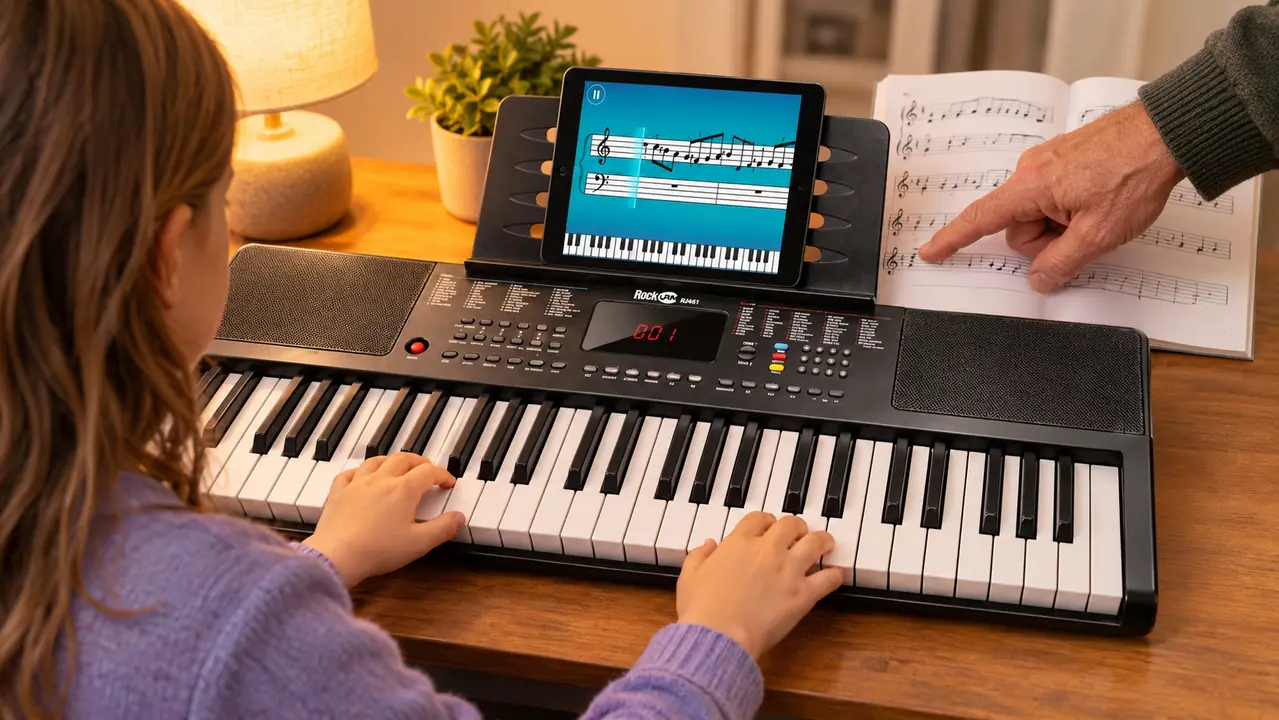
Here is the honest part. The keys are light. They come back up fast and they do not push back at you the way the old upright does, so a child can play for half an hour without her hands getting tired, and she will not build much finger strength doing it. I have watched Kaia play a scale on the RockJam and then play the same scale on my mother's piano, and the second one sounds different. Heavier. More deliberate. That is not a fault in the keyboard. That is what this kind of instrument is, and pretending otherwise would not help anybody.
The other thing I noticed, and it took a few weeks to put my finger on, is that the keys are quieter than I expected. On the upright, the mechanism itself makes a sound, the hammers and the felt, and you hear all of that under the note. Here there is almost none of it, so a light touch produces a note with nothing underneath it. For Kaia that is fine, because she is learning where the notes are and what they are called. For me it took adjustment. I found I was playing heavier than I needed to, the way you do on an instrument that makes you work for it, and the RockJam did not ask me to. Once I stopped pushing, my hands were less tired at the end of a Wednesday rehearsal than they are after the same hour on the acoustic.
Sixty-one keys means five octaves. On the upright she has the whole range, and on this she does not. Twice now she has brought home a piece that wants the low end and had to move it up an octave, which changes how it sounds but does not stop her learning it. For the method books she is working through, and for the hymns I play, 61 is enough. The key spacing felt close enough to the upright that she did not have to relearn anything when she sat down at the real piano, and that is the first thing I check on a beginner instrument.
200 Sounds and 200 Rhythms, and the Four I Actually Use
Two hundred sounds is a number that sells keyboards and mostly goes unused. Kaia cycled through all of them in the first week, found the one that sounds like a music box, and moved on. I use four. The acoustic piano for practice, an electric piano for evenings when I want a softer tone, strings underneath the piano for the slower hymns, and one organ sound that fills the room better than the piano does on a Saturday rehearsal. The digital display makes it quick to find them again, and the record and playback has been more useful than I expected, mostly because Kaia can hear what she actually played instead of what she thought she played.
The rhythms I am less fond of. They keep a beginner steady, and that is real value for a child learning to count, but the styles lean toward pop and dance and there is not much in there for a gospel shuffle or a plain hymn. Kaia loves them. I turn the volume down and let her have them after she has done her scales. The sustain and vibrato effects sit in the same area of the instrument. I leave both off except when she is playing something that actually wants them, because a beginner who learns to lean on sustain stops lifting her fingers.
Months in a room with jalousie windows that never quite close, and every one of the 61 keys still sounds.
What It Sounds Like in a Small Room
The room is about ten feet by twelve with one wall of glass louvers, and the built-in speaker fills it without strain at half volume. The acoustic piano sound is bright and clear through the middle of the keyboard and gets thin at the bottom. It will not fool anyone into thinking there is a real piano in the room, but it does not sound like a toy either, and on the hymns I keep the volume low so it sits under the singing the way it should.
I have played it at three volumes in that room and each one tells you something. At a whisper, sitting right at the desk with the windows shut and the fan off, you can hear the speaker working, a faint hiss under the note that a bigger room would swallow. At half, which is where I keep it for hymns, the tone is even across the middle two octaves and the hiss disappears. At full, which Kaia uses about once a week until I ask her to bring it down, it gets loud enough to fill the room and carry out onto the lanai, and it starts to sound boxy in the low end. None of that is a complaint. It is a small speaker in a compact body, and it behaves the way a small speaker in a compact body behaves.
Through headphones the tone is better and warmer, probably because I am not fighting the room. That is where most of my own playing happens now. I use the sustain effect sparingly, one hymn at a time, and never during scale work. The vibrato I genuinely do not like on the piano sounds, though it is fine on the organ, and Kaia thinks it is funny on the strings, so it stays available. There is a USB connection on the back that I have not touched in all these months. I play it through the speaker or the headphones and have never needed anything else.
The Stickers, the Lessons, and Starting the Same Day
The box came with the power supply, a sheet music stand, a set of note stickers, and Simply Piano lessons included. The stickers are the thing I did not expect to matter. Kaia put them on herself, badly, crooked, and then spent an afternoon naming every key she had labelled. Two weeks later she peeled half of them off because she did not need them anymore. That is exactly how it should go, and I would not have thought to buy stickers on my own.
The lessons run on a phone or a tablet, and she used them for the first month before she got bored and went back to her book. I think that is the right arc. The lessons had her playing actual songs inside the first week, which is what keeps a nine-year-old at anything at all, and the method book is what will teach her to read music. The sheet music stand is small, but it holds a thin method book without flopping over, and the power supply has been plugged in and forgotten for months with no heat and no hum.
Months in the Humid Room: What Held Up
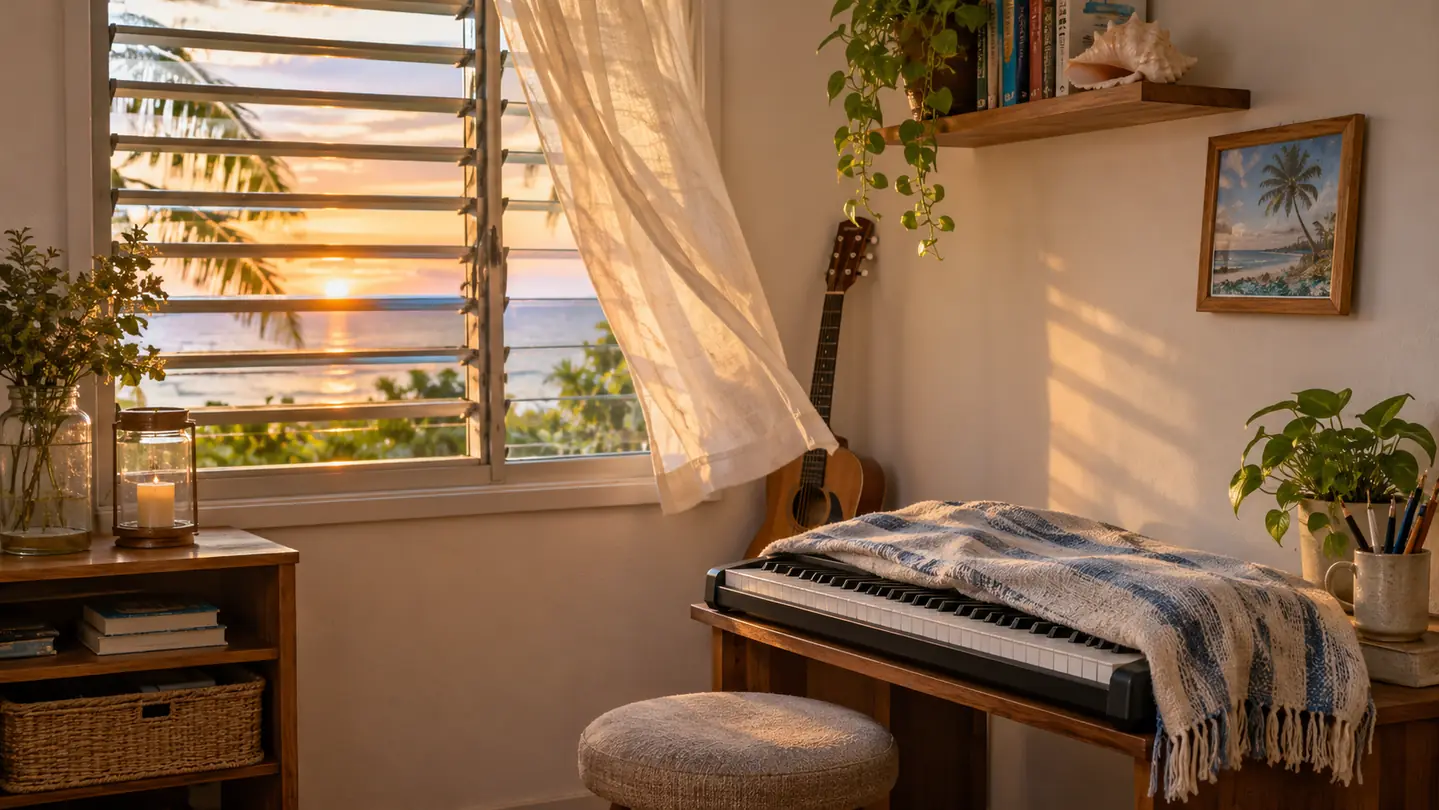
This is the part I was watching for. Kaneohe air is heavy and salt sits in it, and I have seen cheap electronics grow a fuzzy green halo on the connectors inside one summer. The RockJam has none of that. The power supply is sealed, the jack is tight, and there is no crackle when I move the cable. No dead keys, no keys that stick down, no double notes when I play softly. The display is as bright as the day it came out of the box. I wipe it down with a dry cloth once a week and keep a folded sheet over it when it is not in use, and that has been the whole of the maintenance.
The fall happened in June, on a Saturday, when Kaia was running in from the lanai to show me something and caught the cable with her foot. The keyboard went off the desk and landed on a corner on the wood floor. My stomach went with it. I picked it up, checked the power supply first because that is the part that usually dies, plugged it back in, and played a chromatic scale from the bottom key to the top one, slowly, listening for anything that buzzed or dropped out. Every key sounded. The corner has a scuff on it that you can see if you look for it, and the desk has a matching one, and that has been the whole of the damage. I would not recommend that test to anybody. I am only reporting the result.
The one thing I would tell you to watch is the desk it sits on. It is light, and a light keyboard on a smooth desk with a child leaning on it will walk. I put a strip of rubber shelf liner under mine after the fall and it has not moved since. That is not a defect in the instrument. That is physics and a nine-year-old, and it is the cheapest fix in this whole review.
What I Liked
- Light enough to move with one hand, so it gets played instead of stored
- No dead or sticky keys after months in humid island air
- 200 sounds and 200 rhythms give a beginner plenty to explore
- Headphone jack means evening practice without waking the house
- Note stickers and Simply Piano lessons included, so a child can start the same day
- Record and playback lets a student hear what she actually played
Where It Falls Short
- Keys are light and do not build finger strength for an acoustic piano
- 61 keys leaves out the low and high ends of real repertoire
- Built-in speaker gets thin at the bottom of the keyboard
- Rhythm styles lean pop and dance, thin for gospel and hymns
- Light enough to slide on a smooth desk without a liner under it
Who This Is For
This is for the family that wants a child at a real keyboard this week, not next year, and does not have a piano tuner on speed dial. It is for a small house or an apartment where a full piano will not fit and the neighbours are close enough to hear. It is for an adult coming back to playing after thirty years who wants something to pick up after dinner with headphones on. And it is for anyone whose instruments live in damp air and who needs something that tolerates it without drama, because that has been the pleasant surprise of these months.
If you are that family, the thing I would tell you is not to wait for a better instrument. A child who is ready to learn is ready now, and the difference between a keyboard in the house this month and a nicer one next year is a year of practicing that does not happen. Kaia went from picking out one melody with one finger to playing through a whole method book piece with both hands, and none of that had anything to do with how good the keys were. It had to do with the thing being three feet from the dinner table and light enough that I could carry it into the living room when the cousins came over.
Who Should Skip It
Skip it if your student is already past the method books and needs weighted keys to build real touch, because this will let her form habits she has to unlearn later. Skip it if the music she wants to play lives at the bottom of the keyboard, or if she is working toward a graded exam that will be sat on an acoustic. And skip it if you want an instrument that sounds like a piano in the room from the built-in speaker alone. That is not what this is, and no keyboard in this category is going to be that.
Months of daily use, and it still plays every key
61 keys, 200 sounds, headphones for the nights, and lessons in the box for the child who wants to start tonight. It has already survived one fall and a Kaneohe summer.
Amazon Check Today's Price on Amazon →