
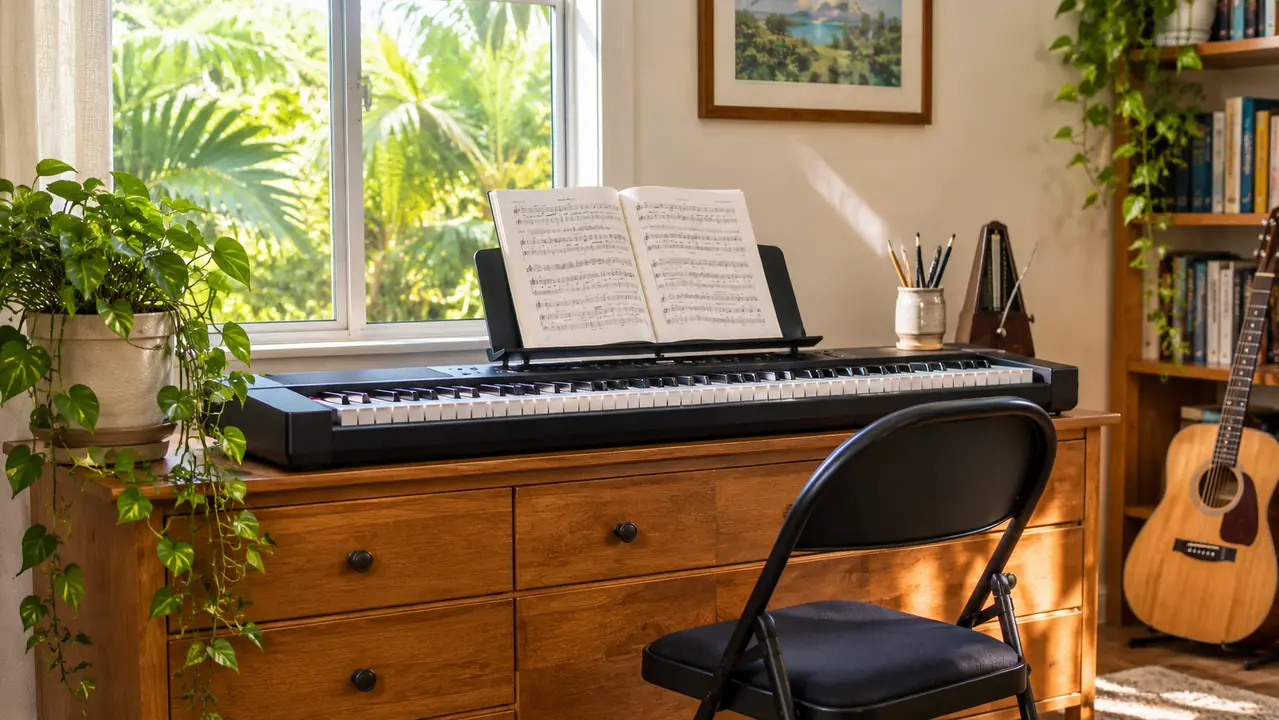
Parents ask me this every year, usually in the same week. Their kid has been taking lessons for three months, the lessons are sticking, and now they are standing in a store aisle in front of a wall of keyboards trying to work out whether 61 keys is a real instrument or an expensive toy that will be abandoned by spring.
Here is the answer I give them. For a beginner, a 61-key keyboard like the RockJam RJ361 is enough. Not enough forever. Enough for the two or three years when a student is learning to read music, count out loud, and use both hands at once. I taught middle-school music for 31 years here in Kaneohe, and my granddaughter Kaia is nine and learning now, so I have watched this play out with a room full of kids and then again at my own kitchen table. What follows is the plain list I would hand a friend.
The keyboard a beginner will still be practicing on in month five
61 keys, 200 sounds and 200 rhythms, note stickers and Simply Piano lessons in the box. Headphone jack for the rest of the house.
Amazon See Today's Price on Amazon →Five octaves covers every piece in the beginner books
Sixty-one keys is five octaves, C to C. Open almost any beginner method book and the pieces sit in that middle zone, because the books were written for an instrument exactly this size. A full 88-key piano adds the top and bottom octaves, and a beginner spends years never touching them. The trade is real but small. When a piece calls for a bass note you do not have, you play it an octave up or leave it out, and nobody in the living room notices. I would rather a student have five octaves in a room where practice actually happens than 88 keys in a room where it does not.
It fits on a dresser, which is where practice actually happens
The specs list 31.5 inches wide, 11.02 inches tall, 3.07 inches deep, and 2.84 kg. That is roughly the footprint of a large cutting board, and it will sit on a dresser top or a small folding table without taking over the room. This matters more than most parents expect. The instrument that gets practiced is the one that stays out and set up. A keyboard that has to come out of a case and be reassembled every evening gets played twice and then quietly becomes furniture. The sheet music stand comes in the box, so there is nothing extra to go hunting for.
Headphones turn practice into something the house can live with
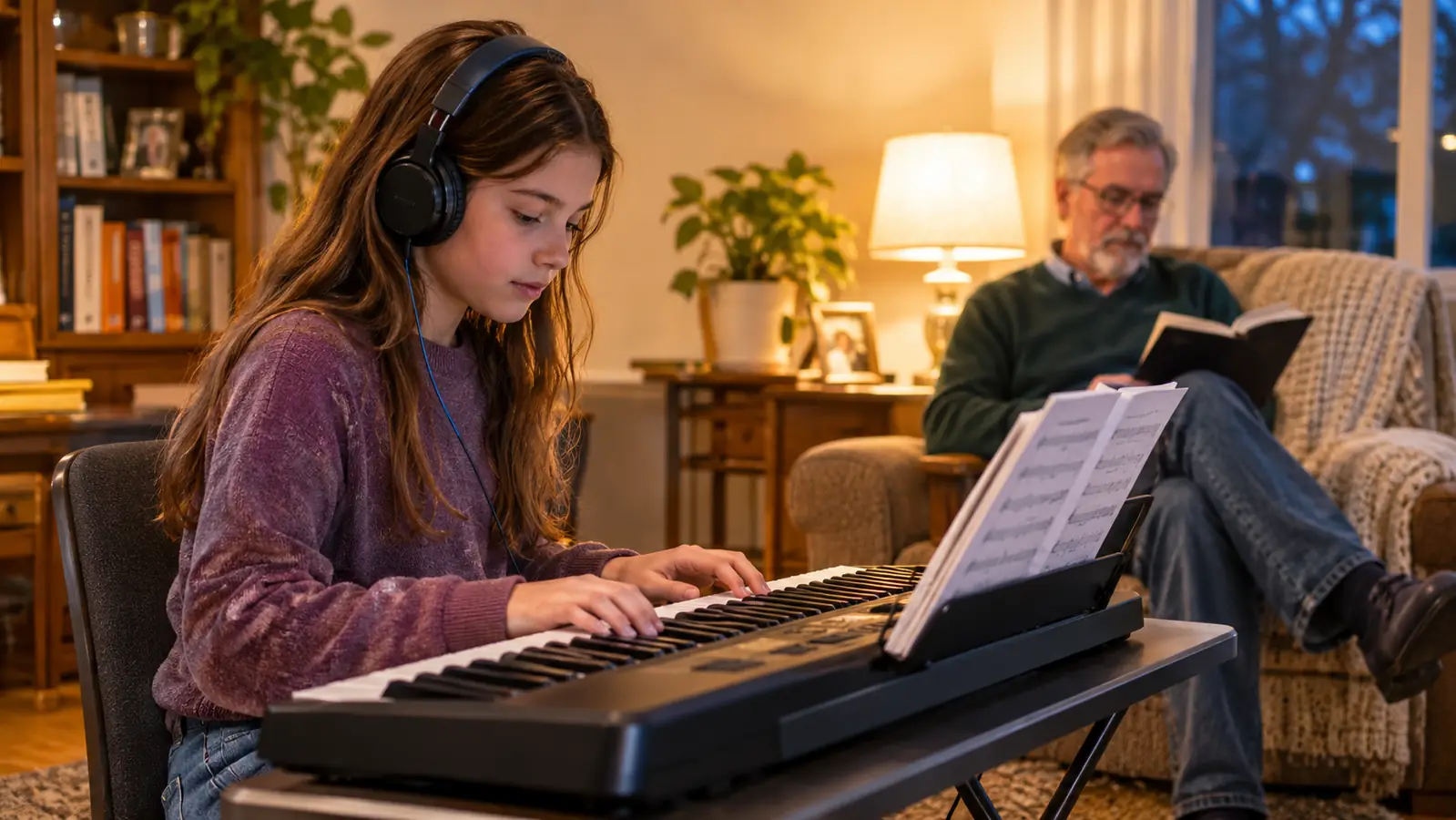
Practice is loud, and a house with a television in it has a limit. The RockJam has a headphone jack with a 3.5mm connector, so a student can work the same passage forty times without anyone in the next room losing their patience. Kaia does her scales after dinner while Leilani watches her shows, and nobody has to negotiate about it. Two practical notes: the built-in speaker is small, so headphones genuinely sound better than the room does, and you want a pair with a cord long enough to reach from where the keyboard sits to where the kid sits.
200 sounds and 200 rhythms buy you another year of attention
A nine-year-old will work one exercise for about four minutes before the attention goes out the window. Two hundred sounds and two hundred rhythms are not a gimmick for that kid, they are the reason the instrument is still interesting in month five. Change the sound to something with a bit of grit and the same scale becomes a game. Put a rhythm underneath it and the timing exercise suddenly has a drummer. I used this trick in a classroom for three decades. Give a child one sound and they get bored of it. Give them a hundred and they start experimenting on their own.
The note stickers teach the first two weeks so you do not have to
The box includes piano note stickers. For a parent who does not read music, this is the difference between being able to help and standing behind the bench saying I think that one is a B. You put the letters on the keys, the child matches the letter to the note on the page, and within a week or two the stickers come off and the mapping is in their head. It is a small thing that costs a manufacturer almost nothing and saves a family a month of confusion.
Simply Piano lessons are included, so week one is not silent guesswork
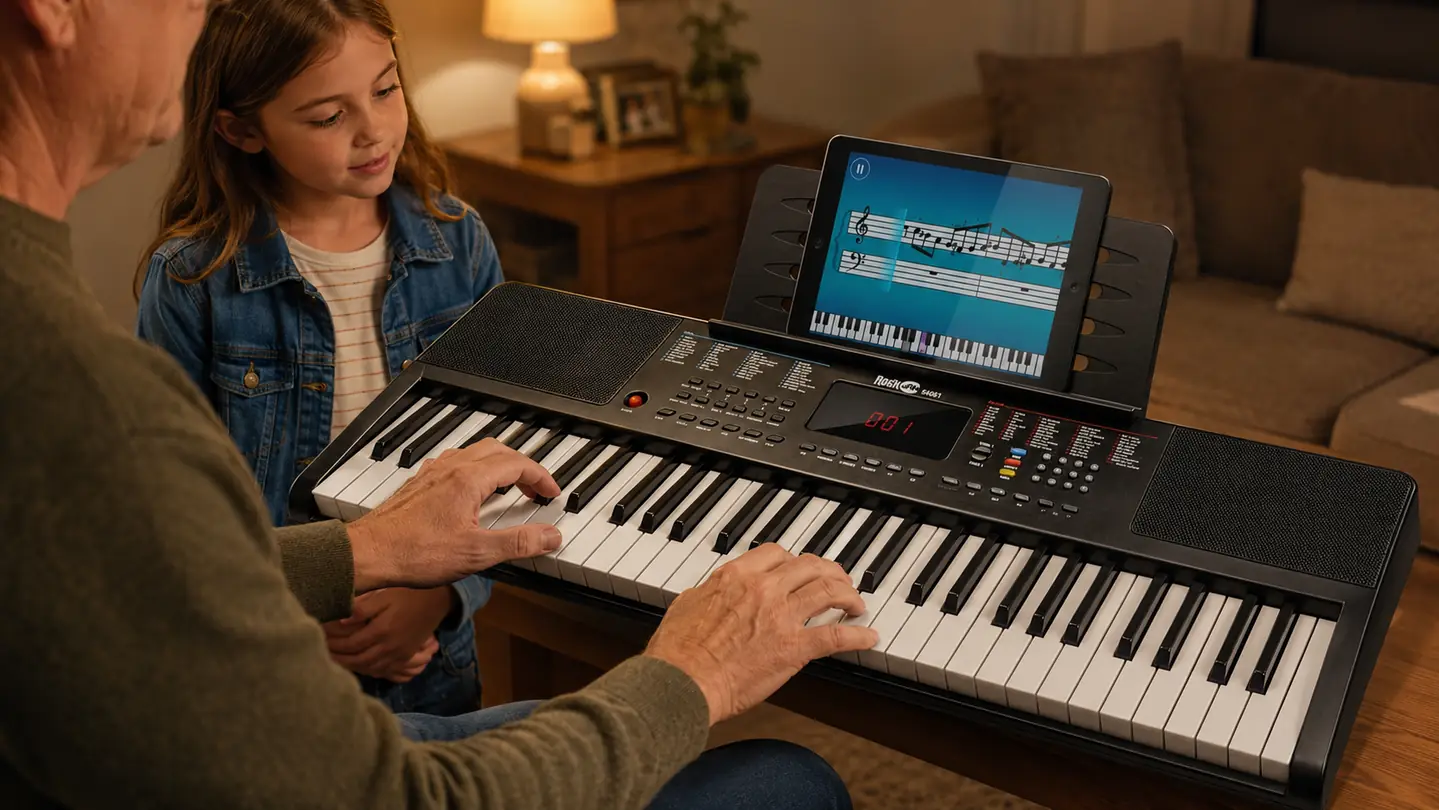
Simply Piano lessons come with the keyboard, and the listing names it as the supported software. For a busy parent this is the practical half of the pitch: a structured path from the first day, on the same instrument, instead of a printed book a child has to be talked into opening. It does not replace a teacher and should not be asked to. It does mean the first month is not six days of waiting around for the weekly lesson, which is where a lot of beginners quietly lose interest.
Record and playback tells a student the truth about their tempo
Record and playback are built into the RockJam RJ361. If I had to cut everything else off this keyboard, this is the one I would fight to keep. A student genuinely cannot hear that they speed up in bar four. They can hear it the moment it comes back at them. Record the piece, listen once, and the problem is obvious in about fifteen seconds. I did this with a cassette recorder and a room full of twelve-year-olds for years and it worked then. It works faster when it is a function on the instrument instead of a separate machine.
Sustain and vibrato let a beginner shape a phrase instead of just hitting notes
Sustain and vibrato effects are both on board. Sustain matters first, because it lets a beginner hold a chord and let it ring instead of releasing the keys the instant the next one arrives. That single change makes a simple piece sound like music rather than an exercise, and it teaches the ear something that no amount of explaining does. Vibrato is a colour. A nine-year-old will overuse it for about a week and then settle down. Both are worth having on a first instrument.
It runs off a wall cord, so a lesson never dies mid-piece
The RockJam RJ361 is corded electric, and the power supply is included. No batteries. That sounds like a minor detail until you have watched a child's practice session end in the middle of a piece because the last set of batteries gave out. It also means the volume holds steady instead of sagging as the cells fade, which is a problem with battery-powered keyboards that nobody warns parents about until it happens twice. Plug it in once and it is ready every evening.
USB and a 3.5mm jack mean it is not a dead end
The specs list USB connectivity and a 3.5mm connector. That matters less on day one and more in year two, when the keyboard is still earning its space for something other than a nightly practice session. It means the instrument is not a sealed box that does exactly one job until it is replaced. I would rather a beginner start on something with a couple of ways out of it than on a piece of furniture that has to be traded in the moment their interests widen.
What I'd Skip
What I would skip is the 88-key upsell for a nine-year-old, which buys two octaves they will not use for years and a much larger thing to store in a small house. Weighted keys are the other one. They matter enormously to me as a working pianist and not at all to a student in their first year, and they come in a considerably bigger instrument. And skip any expectation that the RockJam is a stage piano. The built-in speaker is small, the sound is modest, and it will not carry a church hall. It does not need to. It needs to sit in a corner, stay plugged in, and be easy to walk up to after dinner.
Five octaves, 2.84 kg, and a headphone jack. That is the whole case for a beginner keyboard, and it holds up.
Start with the instrument that fits the room where practice actually happens
61 keys, 200 sounds and rhythms, headphones for the rest of the house, and a wall cord so it is always ready. Check today's price and see if it fits your space.
Amazon See Today's Price on Amazon →