
A parent caught me in the church parking lot last month with the question I have heard maybe two hundred times since I retired: which sixty-one key keyboard do I buy for a child who is just starting? Two names come up every time, and they came up again in that parking lot. The RockJam RJ361 and the Alesis Melody 61. I have taught beginners on both, and my granddaughter Kaia has banged on both at my kitchen table. So here is the short answer first, and the long reasoning after it.
If you want the fastest path from box to first song, buy the RockJam RJ361. It weighs 2.84 kg, it runs on the included power supply, it arrives with note stickers and a Simply Piano subscription, and it fits on a desk in a small room. If the player is older, or has already shown a year of steady interest, or will eventually move to an acoustic piano in the same house, the Alesis Melody 61 is the better instrument under the fingers. That is the comparison in three sentences. Everything below is why I say it.
| RockJam RJ361 | Alesis Melody 61 | |
|---|---|---|
| Key action | Lighter, springier keys that are easy for small hands to press | More resistance and a quicker return, closer to a real piano |
| Build feel | Light shell that can slide a little on a smooth table | Heavier cabinet that stays put under hard playing |
| Weight and footprint | 2.84 kg, 31.5 x 11.02 x 3.07 inches, carries in one hand | Noticeably heavier and wider, so it lives in one room |
| Sounds and rhythms | 200 sounds and 200 rhythms for practice and play-along | A bank of onboard sounds and rhythms doing the same job |
| Speakers | Built-in speaker that fills a small room at half volume | Built-in speakers doing a similar job in a small room |
| Sustain | Sustain and vibrato as switchable effects | A sustain pedal you press with your foot |
| Learning tools in the box | Note stickers plus a Simply Piano subscription | Onboard demo and lesson content, no sticker set |
| Cost to start | The smaller outlay of the two, with the power supply included | The larger outlay, though the pedal comes with it |
Where RockJam Wins
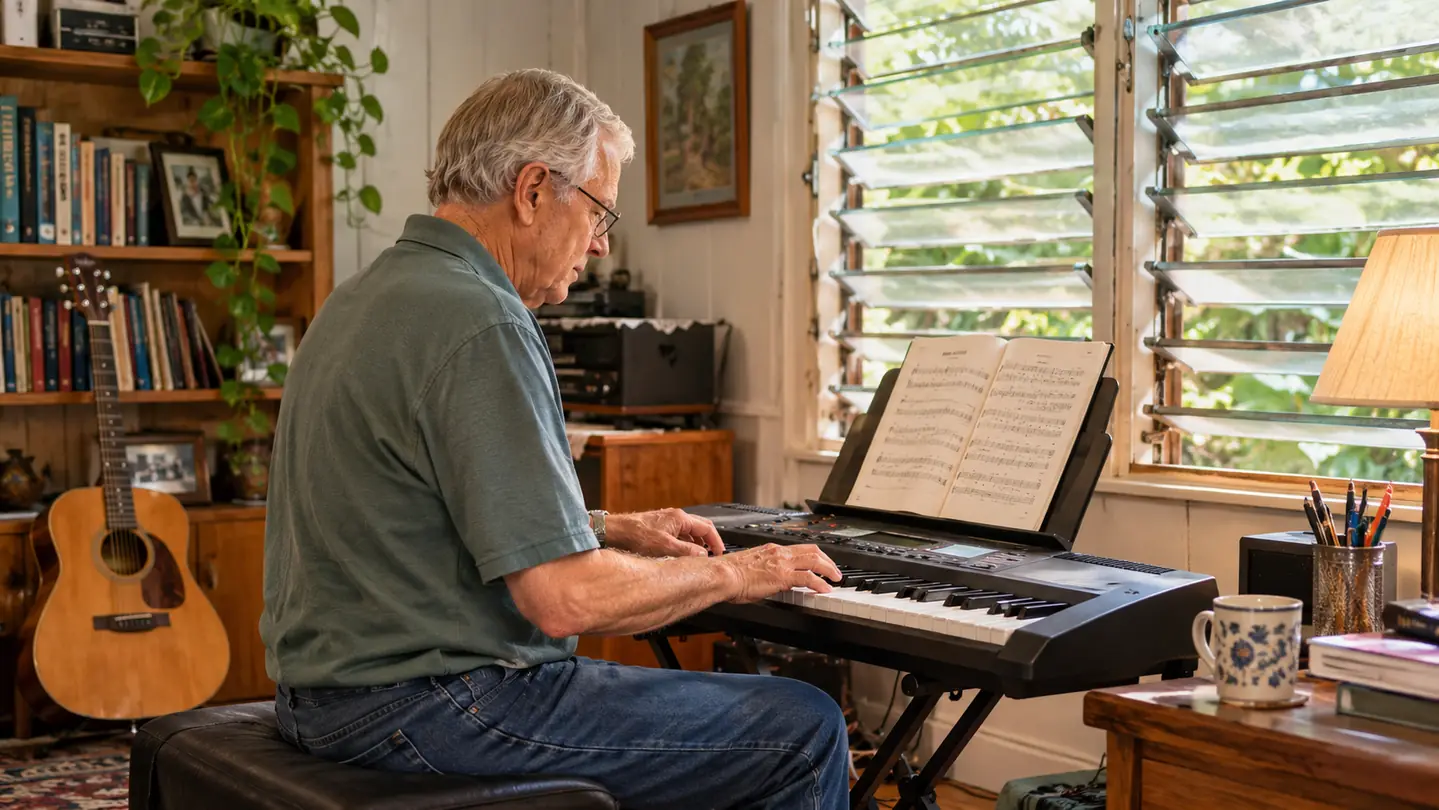
Start with weight, because weight decides whether an instrument gets used. The RJ361 is 2.84 kg and measures 31.5 inches across, 11.02 inches deep and 3.07 inches tall. I can pick it up with one hand and set it on the dining table, on a bed, or across two chairs on the lanai. A nine year old can carry it to her grandmother's house in the back seat of a car. In my experience the keyboard that is easy to move is the keyboard that gets played on a Tuesday night when nobody is watching. The heavy one stays in the corner and turns into furniture. I found that out the ordinary way. On a Saturday in March I carried it out to the lanai to play along with a slack-key record, then back inside when the rain came, then out again an hour later once the shower passed. Three moves, no strain, no help from anybody. With a heavier cabinet that becomes a decision instead of an impulse, and most days the decision goes the wrong way.
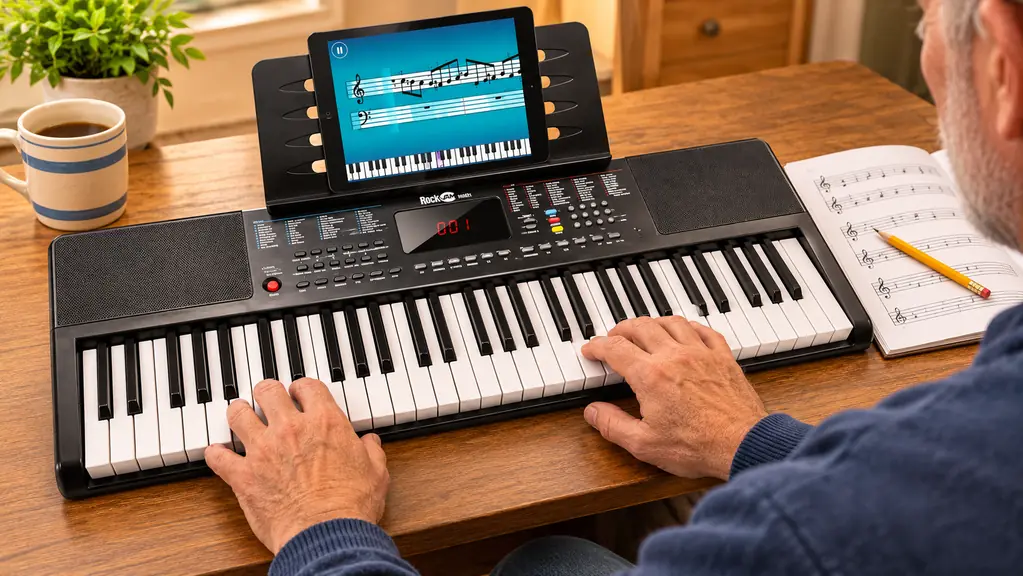
Then there is what comes in the box. RockJam ships the power supply, a sheet music stand, a set of piano note stickers and a Simply Piano subscription. That last item matters more than a spec sheet suggests. Stickers plus a lesson app means a child can sit down on day one with a guided path, instead of a parent trying to remember which line is middle C. I have watched beginners quit in week two because nobody told them what to do next. The RJ361 answers that question for you before the first lesson.
The rest of the feature list is the usual beginner package, done properly. 200 sounds and 200 rhythms, sustain and vibrato effects, record and playback, a digital display, a headphone jack on a 3.5mm connector, and USB. Record and playback is the one I lean on in lessons. A student plays four bars, presses play, hears the mistake, and understands it faster than any explanation I can give across the room. The headphone jack means a beginner can practice at nine at night in a house with other people trying to sleep.
Where the Alesis Melody 61 Wins
Now the part where the RockJam loses, and I want to be plain about it, because a beginner who practices on keys that feel wrong develops habits that take a year to undo. The keys on the Alesis Melody 61 push back. There is a little more resistance at the bottom of the travel and the return is quicker. On the RJ361 the keys are lighter and springier, which is friendly to small hands but does not prepare them for what waits at the other end of the room. My mother's upright sits in the corner of that same spare room. When Kaia goes from the RJ361 to the upright, her fingers collapse. When she goes from the Melody 61 to the upright, she adjusts in about a minute.
The Melody 61 also ships with a sustain pedal, and it feels more substantial in the case. A pedal under the right foot is not a small detail. Half of what makes a piano sound like a piano is the damper pedal, and pressing a sustain button with a finger while both hands are busy teaches a habit that has to be unlearned later. I watched Kaia try to hold a chord that way during a lesson in April. She had to lift her right hand off the keys to reach the button, which broke the very chord she was trying to hold, and after two tries she gave up and played the bar dry. On the Melody 61 she pressed with her foot and kept both hands where they belonged. That is the whole argument in one small moment. The heavier cabinet matters less for a child and more for an adult coming back to the instrument, because it does not skate around the table when you play with any force.
The One I Put In Front of a Brand-New Student
Light enough to move from room to room, and it arrives with the power supply, the music stand, the note stickers and a Simply Piano subscription. The least fussy way to find out whether piano is going to stick.
Amazon Check Today's Price on Amazon →How I Compared Them
I set both keyboards up in the spare room off the lanai for a month and played the same Sunday gospel charts on each of them. I am sixty three and I play for a church service every week, so my hands are not the hands of a beginner. That is exactly why I also handed both instruments to my granddaughter for her lesson book, and watched which one she reached for without being asked. The first thing I tried was the obvious thing. I sat at each one for ten minutes and ran scales and arpeggios in C, and it told me almost nothing, because ten minutes is not long enough for a keyboard to annoy you. The annoyances show up at minute thirty, when the shell starts to slide on a smooth surface or the keys start to feel identical to every other key. So I stretched the sessions out and stopped timing them.
I did not measure anything with equipment. I judged them the way a player judges. How the keys felt after twenty minutes. How the sound sat in a room with a low ceiling and a tile floor. Whether the volume went quiet enough for a house with someone sleeping down the hall. And whether a nine year old wanted to keep going after fifteen minutes, which is the only test that predicts anything.
It weighs 2.84 kg and arrives with the power supply, the stand, the note stickers and a lesson subscription. That is a beginner's first month in one box.
Sound in a Small Room
Both instruments have built-in speakers, and in a room the size of mine neither one will embarrass you. The RJ361 fills the spare room comfortably at about half volume. Push it past that and the sound thins out rather than getting louder, which is normal at this size and not a fault. If you are playing for a room full of people, neither of these is the answer, and I would say the same thing about any keyboard in this class.
The 200 sounds and 200 rhythms on the RockJam are more than any beginner will ever use, and I would rather admit that than oversell it. A student will touch the piano sound, maybe a string patch for one piece, and never leave those two. What earns its place is record and playback and the headphone jack. Those two turn a toy into a practice tool. The rhythms are useful for keeping a beginner steady, and I have used them for exactly that.

The Question of Sixty-One Keys
Every family eventually asks whether sixty-one keys is enough. For the first two years, yes. Sixty-one keys covers five octaves, which is more than every method book I taught from over thirty years. I pulled my old books off the shelf to check rather than trust my memory. The three I used for most of my career top out around the fourth octave in book one and never reach past five octaves even on the last page. The first piece I can remember needing more room was a simplified arrangement of a Chopin waltz a student brought in during my final year of teaching, and by then she was already past what a beginner keyboard is for. The music that runs out of room is late intermediate repertoire, and by the time a student gets there they should be playing on something with weighted keys and a proper action anyway. Buying eighty eight keys now does not save you a purchase later. It just makes the first instrument heavier and harder to live with.
So the real question is not whether sixty-one keys is enough. It is which sixty-one keys you want under a beginner's hands for those first two years, and whether the instrument will still be in the house in month four. Both of these answer that differently, which is why I do not give one answer to every family who asks me in a parking lot.
What Neither One Does Well
Neither of these is a digital piano and neither one pretends to be. There is no weighted hammer action on either, so a student will not build the finger strength that my mother's upright demands. Sustain on the RockJam is an effect you switch on rather than a pedal you press with your foot, and in daily use that is the single biggest gap between it and the Alesis. If a household already owns an acoustic piano, plan on the student splitting time between the two, and plan on the upright winning eventually.
The other thing neither does well is grow with a serious student. Two years in, if the playing is real, you will be shopping again. I would rather tell a family that now than watch them pay for lessons for three years on an instrument that stopped being the right tool. The consolation is that the outlay at this level is modest next to a step-up instrument, and a keyboard that still works passes down to a cousin without any guilt attached.
Who Should Buy Which
Buy the RockJam RJ361 if the player is a child under about ten, if the instrument has to travel between houses, if it will share a table with homework, or if nobody is sure yet whether the interest will last. It is light, it arrives complete, the stickers and the lesson subscription give a beginner somewhere to start on day one, and there is not much at stake if the enthusiasm fades by spring. That is not a knock. It is the reason I hand this one to most families.
Buy the Alesis Melody 61 if the player is older, if they have already put in a year of steady practice, if the house already has an acoustic piano the student will graduate to, or if you want a sustain pedal under the foot from the first week. The keys will build better habits and the pedal saves a correction later. The trade is weight, and it is a real trade, because a keyboard that is a nuisance to move is a keyboard that stays in one room and gets played less.
If You're Still Deciding, Start Here
The RJ361 is the one I hand to a family that is not sure yet. Light, complete out of the box, and easy to live with in a small house. If the playing sticks, you will know within a year, and you will know exactly what to buy next.
Amazon Check Today's Price on Amazon →