
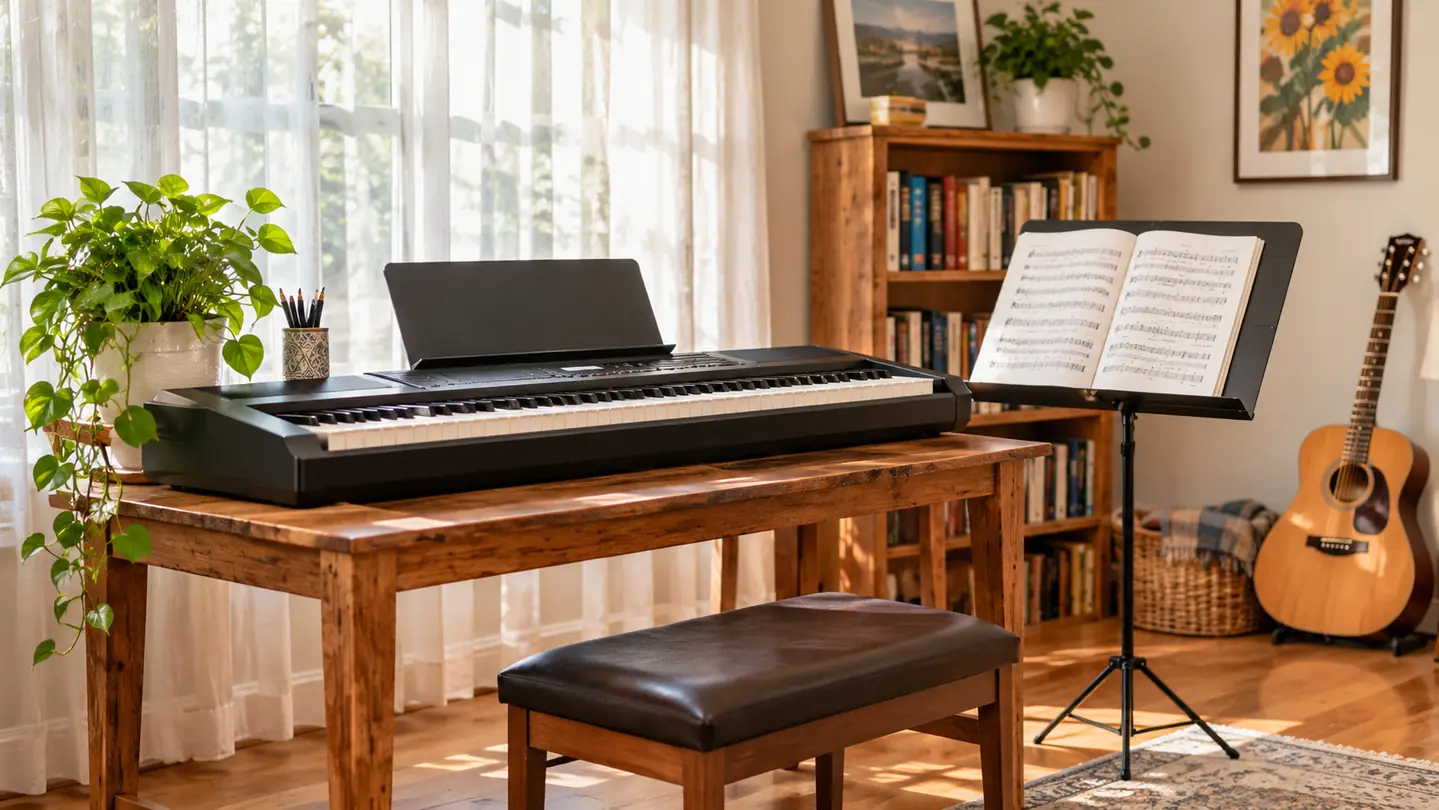
There is a version of this review that writes itself. The Yamaha P71 has 88 weighted keys, a name most people recognize, and a reputation as the sensible first piano. All of that is true. None of it tells you what the instrument is actually like to live with on a Saturday afternoon when the Sunday service is the next morning and you have thirty minutes to run through the hymns. So here is the version I would want if I were you, standing in a store aisle or scrolling a listing at eleven at night.
I taught middle-school music for a long time. I play piano for my church in Kaneohe, I keep an old upright that belonged to my mother, and I have a spare room off the lanai where I practice. The YAMAHA P71 lives in that room. It gets played by me, at 63, and by my granddaughter Kaia, who is nine and still learning where her hands go. Two very different sets of hands on the same keys is a good way to find out what a keyboard really is.
The Quick Verdict
A plain, honest instrument that gets the weight of the keys and the sound of the piano right, then stays out of your way. Buy it for the keys, not for a feature list.
Amazon Check Today's Price →The Keyboard I'd Put Under a Returning Player's Hands First
88 weighted, touch-sensitive keys. 10 voices. A sustain pedal and a power supply in the box, and nothing to learn before you play.
Amazon Check today's price on Amazon →What Nobody Tells You First
The first thing nobody mentions is that the P71 is not a piano with a pile of features bolted on. It is 88 weighted keys with a small, sensible brain attached, and almost everything YAMAHA left out was left out on purpose. There is no screen to learn, no menu tree to get lost in, no bank of accompaniment styles to scroll past at midnight. What you get is a keyboard that behaves like an instrument, plus ten voices and a speaker.
The second thing nobody mentions is the box. Mine arrived on a Tuesday, and unboxing took about fifteen minutes, most of it spent lifting the thing out without putting a knee through the top. In the carton: the keyboard itself, the sustain pedal, and the power supply. That is the entire list, and I checked twice, because I had read the listing before ordering and still found myself looking in the empty corner for something else. No stand, no bench, no dust cover, no bag. Not a complaint, a warning. The day it arrives you need a surface already picked out, or it sits on the floor until the weekend.
The third thing is the size of it in a room. It measures 52.25 inches across, 11.5 inches deep, and 6 inches high, and it weighs 25 pounds. I can pick it up and move it myself, which is not a small detail if you have ever tried to rearrange a room around something that weighs as much as a refrigerator. It lives on a table. When I want the room back for something else, it goes against the wall.
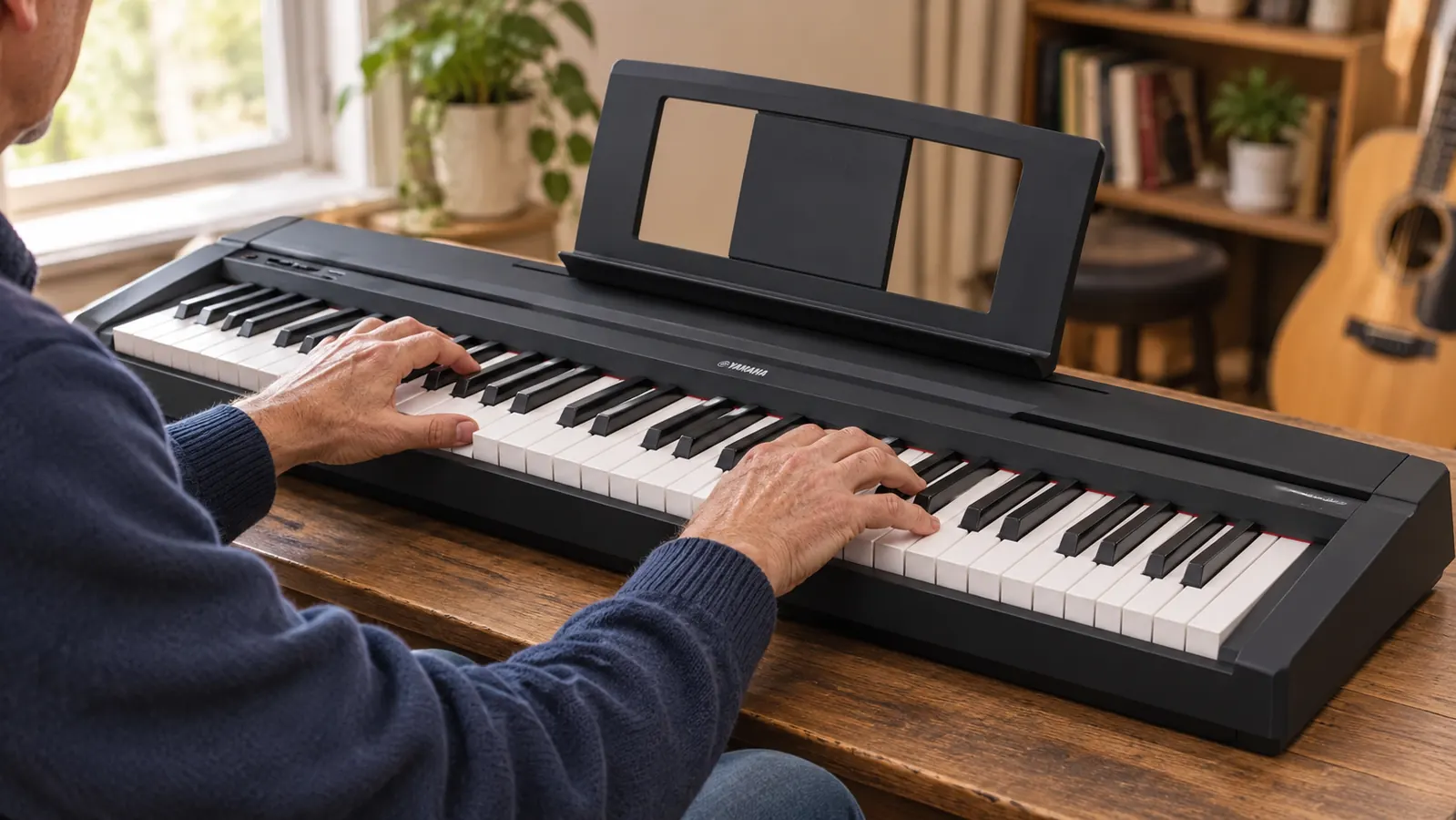
How I've Used It
My week looks like this. Tuesday and Thursday evenings I run hymns and one gospel number for Sunday. Saturday morning Kaia comes over and we work through her lesson book, which means the same keyboard has to handle a nine-year-old pressing one note at a time and an adult playing four-note chords with the pedal down. In between, I practice scales and whatever piece I am trying to keep in my fingers. That is a lot of hours on one set of keys over a month, and the YAMAHA P71 has not developed a rattle or a sticking note.
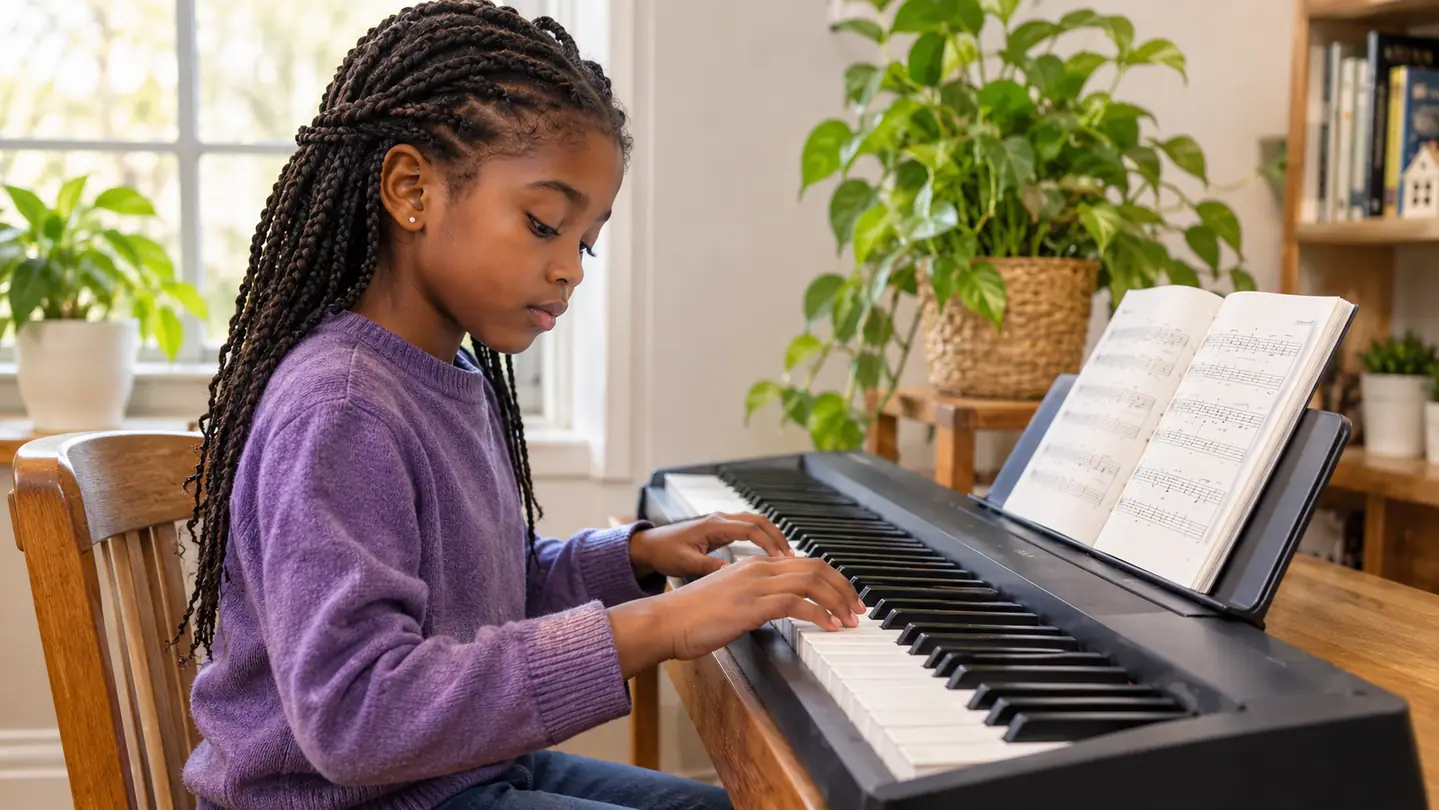
Take one Saturday in March, because it was an ordinary one and ordinary is what you want to know about. Kaia came at nine with her lesson book open to a piece in C position. She played the right hand through twice, then the left, then put them together and lost her place at the same bar she loses it every week. I counted aloud instead of tapping, she came in on the right beat, and the two hands stayed together to the end. Then she got up and I sat down in the same spot and ran the gospel number for Sunday, pedal down through the chorus. Nine-year-old fingers and sixty-three-year-old fingers on the same keys, twenty minutes apart, and neither one of us had to think about the keyboard at all. That is the whole review in one morning, really.
The one adjustment I made was moving it away from the lanai door. The air here is wet most of the year, and while the P71 is a plastic-bodied instrument with no soundboard to swell, I still do not like leaving it where the trade winds push damp air across the keys. A dry corner and a cloth over it when it is not in use, and it has been fine.
For church I do not take it. Twenty-five pounds is light for a piano and still heavy enough that I would not want to carry it up the steps every week. It stays home. What I take to the service is myself and a folder of music, and I practice on the P71 until the hymns are settled in my hands.
The Feel Under the Fingers
This is the part that matters, and it is the part where a cheap keyboard usually gives itself away. The P71 has weighted keys with a hammer action, and it is touch sensitive, which means the volume follows how hard you play. On a keyboard with springy keys, you press and the note comes out at one volume no matter what you do with your arm. On this one, if I lean into a chord the way I would at the church piano, it gets loud. If I back off, it gets soft. You can build a crescendo.
The weight of the keys is the other half of it. My mother's upright has keys that fight back a little, and after forty years my hands are trained to that resistance. The P71 is close enough that moving between the two does not undo my technique. It is not identical. There is a slight lightness at the bottom of the key travel that an acoustic does not have, and if you have spent hours on a well-regulated grand you will feel the difference in about ten seconds. But for an instrument in this part of the market, it is much closer than I expected.
The test I ran that first week was a slow chromatic run from the bottom A to the top C and back, three times, with nothing else going on in the room. I wanted to hear what the action does when you are not covering it up with music. On a spring-loaded keyboard the key comes back with a thin plastic clack and you hear the mechanism working. Here the mechanical sound sits underneath the note instead of on top of it, which matters more than it sounds like it should, because a noisy keybed makes you self-conscious when the house is asleep and you have headphones on. Three passes up and down and I did not find a key that stuck, sat lower than its neighbors, or came back slow.
Kaia noticed the weight too, in her own way. She came from a small keyboard with unweighted keys, and the first week she complained that her hands got tired. That is the point. She is building strength in the right places now, and when she sits at the piano in her school music room she does not have to relearn how to press a key.
The P71 does the one thing that matters most at this end of the market: it makes you play like a pianist instead of a person pushing buttons.
The Sound in a Small Room
The built-in speakers are honest but not big. In my spare room, which is roughly ten feet by twelve, the piano fills the space comfortably at a normal volume. In a living room with a television going and people talking over each other, you will want more than it has. That is not really a flaw, it is physics, and it is worth knowing before you plan to use it as the sound for a family gathering.
Where it sits in the room matters more than you would guess. My first setup had it pushed flat against the wall to keep the floor clear, and the piano sounded closed in, like it was playing into a mattress. I pulled it out so there was a hand's width of air behind the back panel and the same chord opened up immediately. I also had it sitting too high at first, on a table that put my forearms on a downward slope to the keys, and after twenty minutes my wrists were telling me about it. Lower, with the forearms roughly level, and the tone and the comfort both improved. None of that is written anywhere. It is just what years of playing teaches you to try when something sounds wrong.
The main piano voice in the YAMAHA P71 is sampled from a grand, and it is the reason to buy this instrument. It has body in the low end, and it does not turn brittle when you play loud chords, which is where cheaper pianos usually fall apart. Of the ten voices, I use the piano, occasionally an electric piano for a gospel number, and strings when I want to layer. The listing describes a mode that blends two voices, piano and strings being the obvious pairing, and it does what it says. Layering piano under a slow hymn is genuinely useful on a Sunday morning.
The rest of the ten are there because a spec sheet wanted ten. Harpsichord, organ, and the assorted extras are fine and I have no use for most of them. That is not a complaint. They cost nothing to have, and the piano sound is what you are really paying for. Just do not let a list of ten voices convince you that you are getting ten instruments.
For quiet practice there is a 3.5mm headphone jack. I use it after the house is asleep. A word of warning: 3.5mm is the small connector, the one on a phone, not the big quarter-inch plug on a stage piano. If your good headphones came with a quarter-inch adapter you are set. If not, you will be ordering a small adapter before your first silent session.
The Parts That Wear on You
Now the honest part. The P71 is a keyboard, not a piece of furniture. There is no stand in the box and no bench. What you get is the sustain pedal and the power supply, and that is the whole list. So plan for a stand and something proper to sit on, and do not spend a month on a kitchen chair the way I did, because your back will file a complaint.
I want to be specific about that month, because it is the mistake I would most want talked out of. The kitchen chair was the wrong height, so my wrists sat below the keys and I played with my shoulders creeping up toward my ears by the second verse of a hymn. By the third Saturday my lower back had opinions, and the part that actually got me into a store was noticing Kaia copying the way I sat, hunched and reaching. A bench at the right height fixed it in an afternoon: forearms roughly level, feet flat on the floor, back straight without being rigid. Twenty-five pounds is light enough for one person to move, but it is not light enough to balance on your knees, so the couch is not a practice solution either.
The sustain pedal is a single small pedal, and it slides. On a hard floor it walks away from you over the course of an evening. I put a piece of grippy shelf liner under mine and it stays put. It also does not have the graded resistance of a real damper pedal, so half pedaling is crude. For hymns and lesson books that is fine. If you are working through Chopin, you will notice, and it will bother you.
The controls are one button, and that is both the charm and the limit. You cycle through voices, you adjust what little there is to adjust, and that is the end of it. There is no screen to tell you where you are and no way to save a favorite setup. The listing also notes USB and auxiliary connections and mentions Logic Pro, so there is a path into a computer if you want one. But this is not a studio controller. It is a piano that happens to have a USB port on the back.
What I Liked
- 88 weighted, touch-sensitive keys with a hammer action that trains real technique instead of fighting it
- The main grand piano voice holds up under loud chords and stays warm in a small room
- 10 voices plus a mode that layers two of them, with piano and strings genuinely useful
- 3.5mm headphone jack for quiet practice after the house is asleep
- 25 pounds, 6 inches high, 52.25 inches wide, so one person can move it and store it
- Sustain pedal and power supply included, and nothing to learn before you play
Where It Falls Short
- No stand and no bench in the box, so you are adding both
- Single small sustain pedal that slides on hard floors
- One-button control means almost no adjustment beyond choosing a voice
- Built-in speakers are modest in a room with other people in it
- Most of the ten voices exist to fill out the list
- The action is close to an acoustic, not the same as one
Who This Is For
If you played as a kid and want to come back, this is the instrument I would hand you. The keys will not let you build sloppy habits, the piano sound is good enough to enjoy playing, and there is nothing standing between you and the first note except a power button. If you accompany a congregation, the P71 covers hymns and gospel comfortably in a small room. If you are a parent putting a child into lessons, it will carry a beginner for years before anyone needs to talk about an upgrade.
It also suits small homes. In a spare room or the corner of a bedroom, 52.25 inches of width and 11.5 inches of depth is manageable in a way an upright is not. And because the headphones work, the rest of the household does not have to be part of your practice whether they want to be or not.
Who Should Skip It
Skip it if you want a piece of furniture. Some people want the piano to be the thing the living room is arranged around, with a music desk and a bench that matches the rug. The P71 will never be that, and no stand will make it that. Skip it too if you need a long list of sounds, built-in rhythms, recording, or a screen that shows you what you are doing. There are instruments in this range that do all of that. They just do not feel like this one.
And skip it if your repertoire lives or dies on pedal control. The single pedal is the weak point of the whole package. A serious student heading toward auditions needs a graded damper pedal and a technician, not a slab with a switch underneath it. That is not a knock on the P71. It is a different job, and it deserves a different instrument.
If the Keys Are What You Came For, This Is the One
Weighted, touch-sensitive, 88 keys, and a grand piano voice that holds up. Add a stand and a bench and you have a practice room.
Amazon Check today's price on Amazon →