
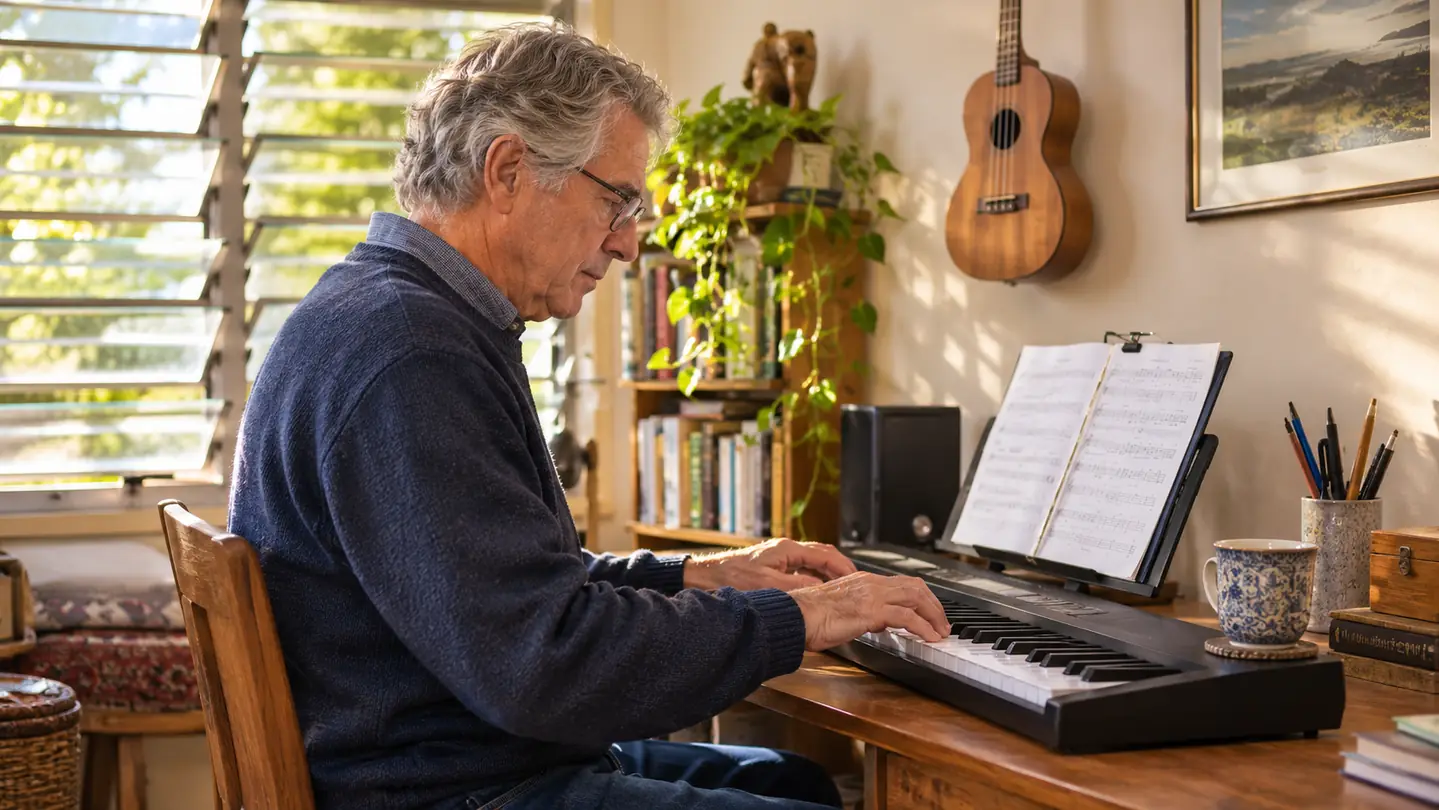
I taught middle school music for thirty-one years, and I have played the Sunday service at my church in Kaneohe for most of that time. In those years I have watched a lot of families buy a first keyboard, and I have watched a fair number of them buy the wrong one. Most of them ask me the same question in the same way, standing in my doorway with a phone held out, screen turned toward me. Is this one okay? Lately the screen usually shows the RockJam RJ361.
The short answer is yes, with conditions. The conditions are the part that never makes it into the product photos. So this is the review I would give you at my kitchen table, with the instrument in front of us and the tea going cold. What it does well, what it does badly, and the one trait that decides whether your household is still using it in March.
The Quick Verdict
A useful and genuinely portable first keyboard for a beginner who will practise at a table with headphones on. Light keys, no real dynamics, and a cord you cannot unplug. If your player needs to feel a piano underneath their hands, this is not that instrument.
Amazon Check Today's Price →The little keyboard I hand to beginners first
61 keys, 200 sounds, a sheet music stand and a set of note stickers in the box. Check the current listing and the review count before you decide.
Amazon Check Today's Price on Amazon →What the RockJam RJ361 Actually Is
Take the measurements seriously, because they explain most of what follows. It is 31.5 inches across, about 3 inches deep, and roughly 11 inches tall at the back. It weighs 2.84 kg. I can carry it from the spare room out to the car with one hand, and I have done it while holding a coffee in the other. Nothing with weighted keys allows that, at any size, and that single number tells you more about this instrument than the marketing copy does.
In the box you get the keyboard, a power supply, a sheet music stand that clips onto the back, a set of note stickers, and access to the Simply Piano lessons. You do not get a pedal, a bench, or a stand to put the instrument on. That last omission matters more than it sounds. A nine year old practising at the kitchen table needs something underneath the keyboard that is not a stack of cushions, and you should plan for that before the box arrives rather than after.
The front panel is a digital display with a row of buttons. Behind those buttons are 200 sounds and 200 rhythms, sustain and vibrato effects, and a record and playback function. There is a built in speaker, a 3.5mm headphone jack, and a USB connection. It runs on the included power supply and nothing else, so wherever it lives needs to be within reach of an outlet.
That is the whole instrument. Nothing hidden, nothing extra, and nothing pretending to be something it is not. Whether that list is enough depends entirely on what you are asking it to do, and that question is the rest of this review.
How I've Used It
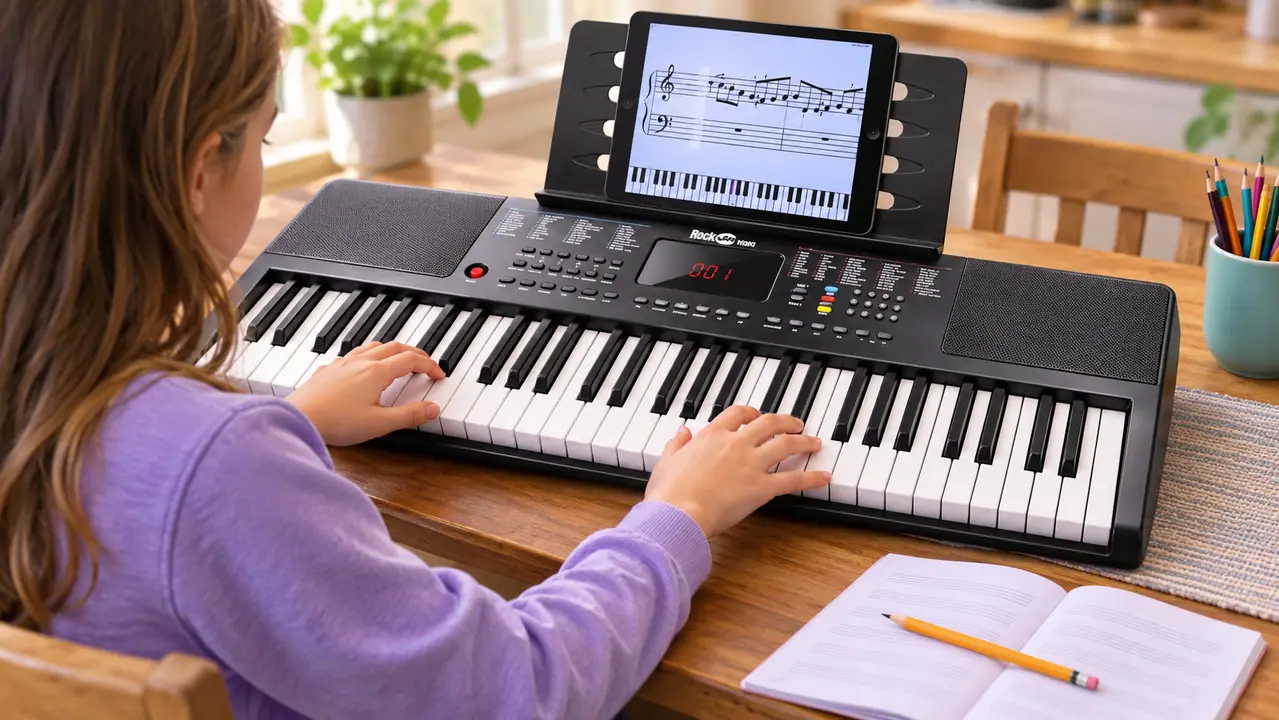
My granddaughter Kaia is nine and started lessons this year. Her mother asked me to find something she could practise on at home that would not take over the living room. The RockJam ended up on loan in my music room for most of the spring, which was not the original plan, but I wanted to hear it before I gave an opinion on it. An opinion is easy. An opinion after a few months of listening is worth something.
That room is a small spare off the lanai, and the humid air out there is unkind to my mother's old upright. I have learned to be careful about what I leave in that room. A 2.84 kg plastic instrument is a far easier thing to live with in island air than a wooden acoustic, and that is not a small point here. It is most of the point.
The first night I played it for an hour, mostly gospel progressions and a couple of hymns, and then I stopped playing and listened from the doorway while Kaia worked through her lesson. Listening tells you more than playing when you are judging a beginner instrument. What I heard was thin but clean, in tune, and never harsh at the volume a child actually uses. The built in speaker has limits, but it does not snarl at you inside them.
The Simply Piano lessons need a phone or a tablet, and the keyboard talks to it over the USB connection. I have not spent much time on that side of it myself, but Kaia has, and she prefers it to having me listen over her shoulder. For a child who is self-conscious about being heard, a screen that does not sigh at her is worth more than it sounds.
I also carried it to a Wednesday rehearsal at the church hall, which is the real test of anything calling itself portable. It came out of the car, went onto a table, plugged in, and was ready. No warm up, no tuning, no fuss. For a volunteer musician with a bad back, that counts for a lot.
What Nobody Tells You About the Keys
Every honest thing I have to say about the RockJam RJ361 comes back to the keybed. The keys are light and quick. They move easily and they spring back fast, and a small hand can get around them without fighting. What they do not have is weight. There is no hammer behind them and no real resistance, none of the feedback that an acoustic action uses to teach your hands the difference between a soft note and a loud one. At 2.84 kg for the entire instrument, there could not be.
For the first six months that is fine, and I want to be clear about it before I get to the complaint. Nobody learning where middle C lives needs a heavy action. A light keybed is forgiving, and a child who makes a clean sound on the first try is a child who comes back the next day. If the choice is between a light keyboard a nine year old will actually play and a heavy one that sits in the corner looking serious, take the light one every time.
The trouble shows up at the handoff. When a student moves from this to a piano with real hammers, the keys feel like they have been filled with sand. The sound they made so easily now takes effort, and for a few weeks they play worse than they did before. That is normal and it passes, but nobody warns the parents, so they assume something has gone wrong and start looking for a fault that is not there.
Kaia could play a C scale and a simple hymn tune on the RockJam inside a week. Making those same fingers sound even on my mother's upright took her the better part of a month.
The 200 Sounds and 200 Rhythms, Honestly
Two hundred of anything reads like abundance on a product page. In a living room it is closer to a drawer of spoons. Four or five of the sounds are genuinely useful, and the rest divide into two camps: ones that are nearly the instrument they are named after, and ones that are clearly a recording of something else being played back at you. The strings do not sound like strings. The brass does not sound like brass. The acoustic piano sound is the one most people will live on, and it is serviceable at home volume.
The rhythms are a different matter. They work as a metronome with some personality, and for a beginner who will not sit with a plain click track because it bores them, a simple pattern underneath a scale is a fair trade. Set it slow. The temptation for a nine year old is to speed it up and then play badly to keep pace, which is worse than no rhythm at all.
The sustain button does most of what a pedal does, in a crude way, and since no pedal comes in the box that button is what you have. The vibrato I could live without. The record and playback is the function I would keep if I could keep only one. A student who records four bars and then listens back hears their own uneven timing faster than any correction I can give them, and they hear it without arguing.
What I Liked
- Weighs 2.84 kg, so a child can shift it and an adult can carry it with one hand
- 61 keys inside 31.5 inches of width, which fits a desk or a kitchen table
- The 3.5mm headphone jack lets a beginner practise at nine at night without the whole house listening
- Record and playback turns practice into something a student can hear back and judge
- Note stickers, sheet music stand, power supply and Simply Piano lessons all in the box
- Light, quick key action that small hands can manage from the first day
Where It Falls Short
- No weighted action, so the move to an acoustic piano is a genuine shock
- Runs only on the included power supply, with no battery option
- Most of the 200 sounds and rhythms are novelties you will try once
- No pedal, stand or bench included, and you will need at least one of them
- The built in speaker is thin at the low end and runs out of room in a hall
The Stuff That Wears On You
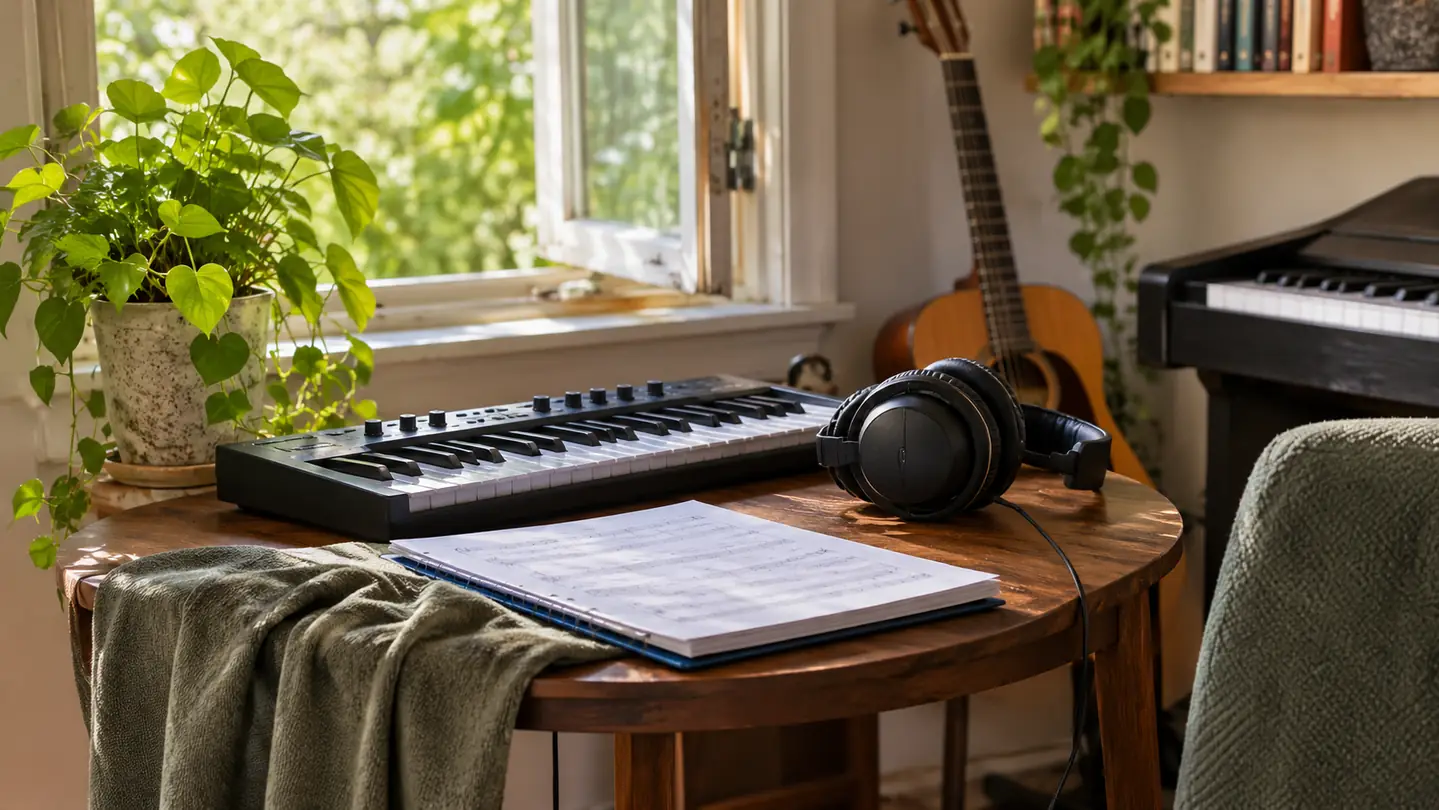
The cord is the first thing. This instrument has no battery option, so every session starts with finding an outlet and ends with somebody stepping over the lead. In my music room that is fine. In a busy living room with a nine year old it is a daily annoyance, and the headphone cable adds a second one. Buy a longer cable than you think you need and route it behind the furniture on day one.
The note stickers are a crutch, and they work. I have peeled that kind of sticker off more keyboards than I can count, always at the moment a student stops hunting for a letter and starts reading the page. Until then, leave them on. The music stand that clips to the back holds a single book or a folded sheet, and asking it for more than that will disappoint you.
The built in speaker is honest but small. It is fine in a bedroom or at the kitchen table, and it disappears in a hall with people in it. Headphones solve this for practice, and if you want to play for a room you will end up wanting something bigger. That is not a fault at this size. It is a limit worth knowing before the day you need it.
The panel buttons take a little learning. The digital display shows you what you have selected, and the labels are small but readable under a lamp. A child will press all of it in the first week and find the demo songs, which is the fastest route I know to a parent regretting a purchase. It passes. Everything passes at that age, provided the instrument stays out where it can be reached.
The Question I Get Asked Most
The question I actually get asked is not about sounds or rhythms. It is this one. Should we just buy a real piano instead?
My answer is usually no, and not because I think less of acoustic pianos. I have one. It belonged to my mother, and I would not trade it for anything. But it needs tuning every year in this climate, it takes up a wall, it is loud enough that the whole house becomes part of the lesson, and a beginner who is shy about being heard will simply stop practising. A keyboard with a headphone jack removes that obstacle completely. In a house where the student is nine and self-conscious, that is worth more than the difference in touch.
The other half of the answer is timing. A family who is not yet sure the interest will hold should not buy a piano. They should buy something light that can be passed on without grief, and let the instrument earn the upgrade. If the student is still at it in a year, the conversation changes and weighted keys become the priority. That is the honest sequence, and it is cheaper than getting it backwards.
Who This Is For
This is the right keyboard for a beginner who will practise at a table, with headphones, in a fixed spot near a wall outlet. It suits a child in their first year or two of lessons. It suits an adult who wants to learn chord shapes for accompanying songs without giving a corner of the house over to an instrument. It suits a family who is not sure yet whether the interest will last and wants to find out without making an expensive mistake.
It also suits the player who needs a second instrument for a rehearsal room or a church hall. The one that goes in the car and comes out again. The one you do not mind if somebody knocks over. I have recommended it twice this year for exactly that, and both times it did the job it was bought for.
One more case, and I see it often. A keyboard left out on a table gets played. A keyboard folded away in a closet does not. Width and weight matter less than whether the thing stays visible and within reach, and at 31.5 inches across and 2.84 kg, this one stays out.
Who Should Skip It
Skip it if the goal is to learn piano specifically, with everything that word carries. If a student is headed toward a school program, a teacher who assigns repertoire, or any kind of graded exam, they need weighted keys, and the RockJam RJ361 will only delay that purchase. Buying this and then a digital piano eight months later costs more than buying the digital piano once.
Skip it if there is no outlet where it will live. Skip it if the household already has an acoustic piano, because anything this keyboard does, the piano does better, and portability will not make up the difference in a house where the piano already sits.
And skip it if the person who will play it is the sort of learner who is bothered by feel. Some students are. They notice the difference immediately and it eats at them, and no amount of convenience makes up for an instrument that does not respond the way their hands expect it to.
For everyone else, this is a sensible first keyboard, and the families I have sent toward it have mostly stayed with it. It holds its tuning, it is light enough to move, it lets a beginner practise without an audience, and it costs what a first instrument should cost. The caveats are real, but none of them are surprises once somebody tells you about them. That is all I ever wanted from a review.
If your learner is ready for a first keyboard, start here
61 keys, a headphone jack for quiet practice, and a record button that teaches more than any app. Check the current listing and see what other buyers say.
Amazon Check Today's Price on Amazon →