
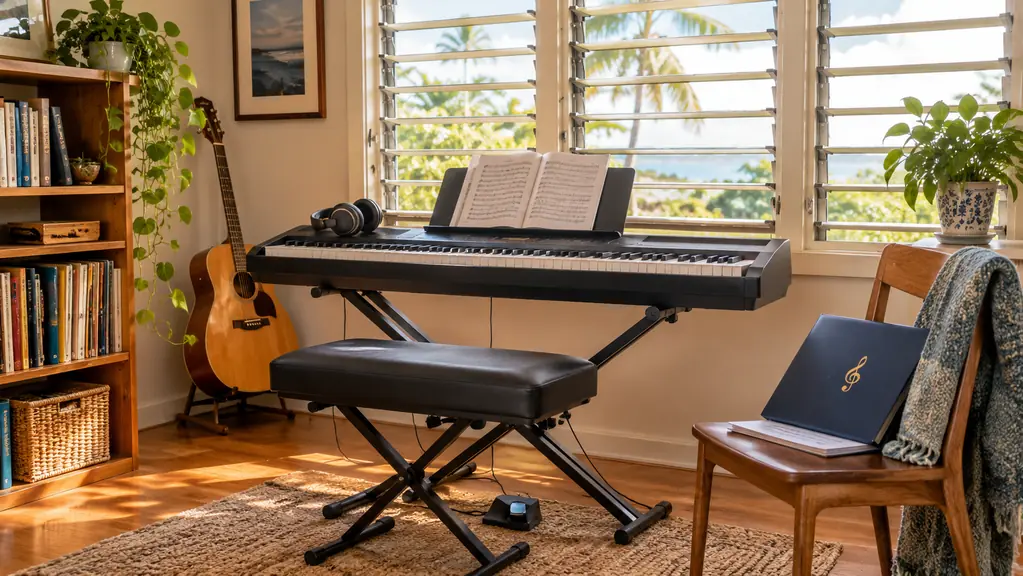
Twenty-nine years in a middle-school band room taught me that the piece of gear which fails is never the piece you were worried about. It is the small thing you stopped noticing. A sustain pedal is exactly that small thing. I have watched students walk into a recital with a keyboard worth more than my first car and a pedal that skated around under their foot like a bar of soap on a wet counter. So when a parent or a choir director asks me whether the M-AUDIO SP-2 or the Yamaha FC4A is the one to buy, I hear the real question underneath it. Which one can I stop thinking about?
My short answer is the M-AUDIO SP-2 for most homes, churches and classrooms. It is the pedal under the keyboard in my music room off the lanai, and it is the one I hand a student without a second thought. The Yamaha FC4A is a good pedal and I will not pretend otherwise. If your keyboard says Yamaha on the back and you grew up on an acoustic piano, the FC4A gives you something the SP-2 does not. Two different jobs. Here is where each one actually wins.
| M-AUDIO SP-2 | Yamaha FC4A | |
|---|---|---|
| Price | Costs noticeably less for the same one job | Costs more, closer to what a piano-style pedal typically runs |
| Pedal action | Chrome foot pedal with a natural, realistic action | Heavier throw that feels closer to an acoustic piano's damper pedal |
| Polarity switch | Yes, a switch built into the pedal body | No polarity switch |
| Cable | 6 foot cable with a 1/4 inch jack | Captive cable ending in a 1/4 inch plug |
| Footprint | 10.5 x 3 x 2.5 inches, 14.1 ounces, rubber body | Compact piano-style housing that lives under one keyboard |
| Best for | Home practice, church, classrooms, swapping between keyboards | Yamaha keyboards and players who want a heavier pedal |
Where the M-AUDIO SP-2 Wins
The first win is the one nobody puts on the box: the polarity switch. A sustain pedal is a switch, and different keyboards read that switch in opposite directions. Plug the wrong pedal into the wrong board and you get the mirror of what you wanted, sustain on every note you are not holding and none on the ones you are. I have watched a guest pianist at our Sunday service discover this eight bars into the opening hymn. Two summers back a visiting youth group brought their own board, a brand I did not recognize, and the young man playing had clearly never met the problem before. We lost four minutes of the service while three of us knelt behind the keyboard. Four minutes does not sound like much until it happens in front of a congregation. The M-AUDIO SP-2 has a switch on the pedal body, so you flip it and keep playing. The Yamaha FC4A does not. That single detail is why the SP-2 is the pedal I keep in the bag for loaners, because I never know which board a student will bring.
The second win is portability and grip. The SP-2 measures 10.5 by 3 by 2.5 inches and weighs 14.1 ounces, so it disappears into the front pocket of a gig bag next to the music folder. The body is rubber, which matters more than it sounds in a room with a tile floor and humid island air, because a pedal that creeps while you play is a pedal you fight all night. The 6 foot cable with the 1/4 inch jack reaches from the floor to the jack on most boards without a strain, and if it is short in your setup, an extension is cheap and easy to find. For a classroom with six different keyboards and a rotating cast of nine-year-olds, that combination is hard to beat. I measured it against my own bag before writing this. The pedal drops into the outside pocket with room left over for a folded order of service, and the cable coils into the same pocket without me unplugging it. That sounds trivial until you are the one who forgot the pedal on a Sunday morning.
Where the Yamaha FC4A Wins
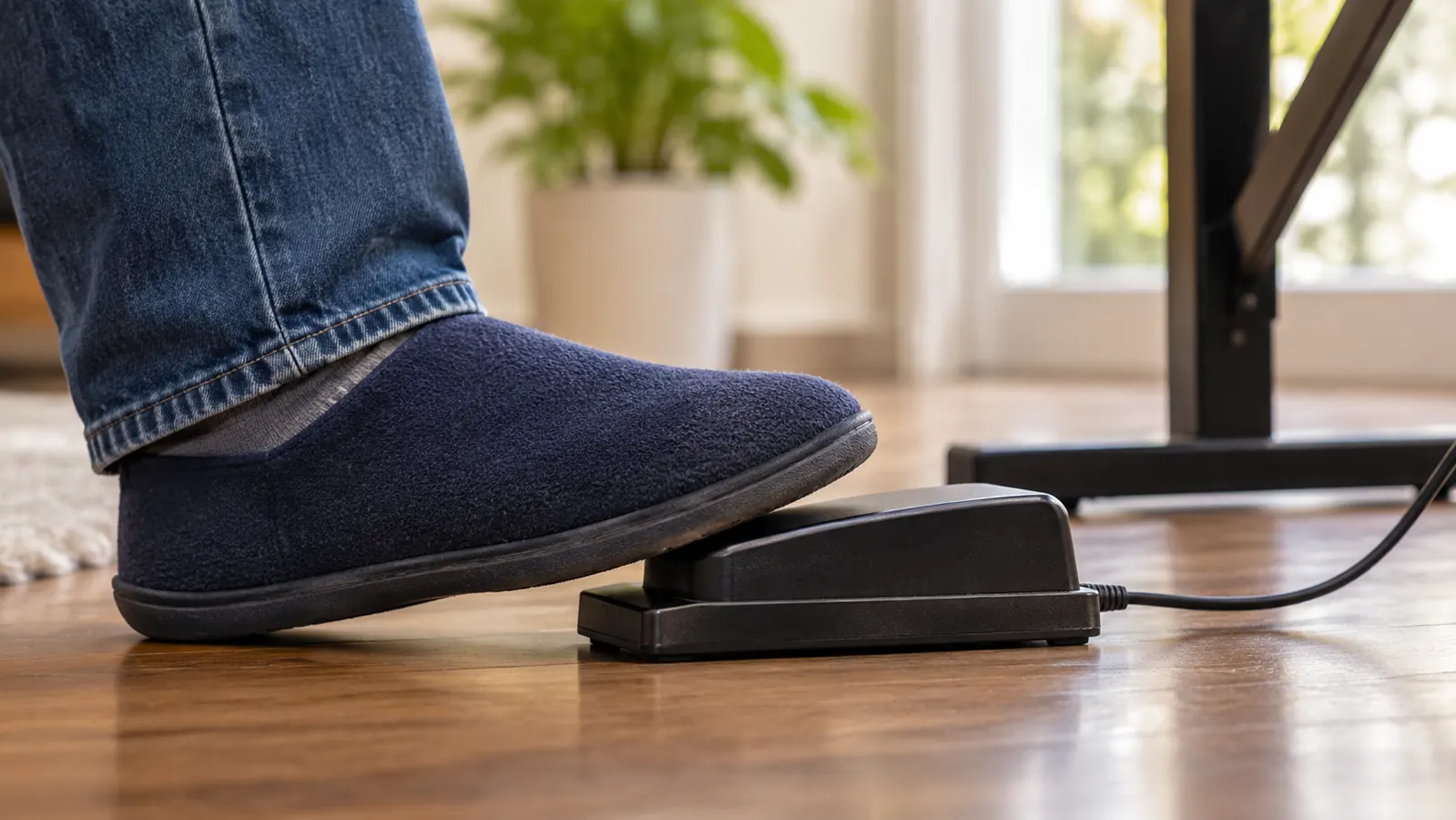
Now the honest part. Under your foot, the FC4A feels better. The throw is heavier and slower to come back, and that resistance is what a damper pedal on a real piano does. If you spent your childhood on an upright like the one my mother left me, a light pedal can feel like stepping on a sponge, and your foot learns to hover instead of rest. The FC4A lets you rest your foot and play with weight rather than with a poke. For a player doing quiet gospel arrangements where the pedal is half the music, that feedback is worth real money, and I would not talk anyone out of it.
The second win is that it is a leave-it-and-forget-it piece. One cable, one plug, nothing to adjust, no switch to bump. If your pedal never leaves the house and your keyboard is a Yamaha, the FC4A simply matches what you already own and you never think about it again. That is a legitimate reason to pay more. The version of me that plays the same board in the same room every week understands it completely.
One pedal that behaves itself on every keyboard in the house
The polarity switch is the difference between a pedal that works and a pedal that works backwards. Check the current price on the M-AUDIO SP-2 and keep one in the bag for the day a different board shows up.
Amazon Check Today's Price on Amazon →How I Compared Them
I ran both pedals for six weeks in the same room, on the same keyboard, playing the same material. My setup is not a studio. It is a spare room off the lanai with a digital keyboard on a stand, a music folder on a folding chair, and a wall that stays damp enough that I wipe down hardware out of habit. I started on a Saturday morning in early March, with the trade winds gone and the room warm enough that the keys felt slick under my hands. I kept a spiral notebook on the chair and wrote one line after each session: which pedal, how long I played, and whether anything about it had annoyed me. Most entries say nothing at all. Three say the word knock, and one says I chased it across the tile, which tells you more than any spec sheet will. I played the Sunday service repertoire, the warm-up scales I still run at 63, and a handful of Hawaiian pieces I play for family, and I let my granddaughter Kaia, who is nine and learning, use each pedal for a week of her own practice so I could hear what a small foot does with them.
I listened for four things: how quickly the pedal returns under a fast passage, how much mechanical noise it makes in a quiet room, whether it stays where I put it on a hard floor, and whether I ever have to think about it while playing. That last one is the only measurement that really counts. I also swapped each pedal across two other keyboards I keep for students, which is where the polarity switch stopped being a footnote and started being the reason I reached for one pedal over the other.
The Polarity Switch, Explained
Here is the ten-second version for anyone who has never hit this problem. Inside the pedal is a simple contact. Press the foot down and the keyboard sees a closed circuit. Some keyboards expect that closed circuit to mean sustain is engaged. Others expect it to mean sustain is released. Neither design is wrong, they are just wired from opposite ends, and a universal pedal has to live in both worlds. The switch on the SP-2 flips which way it reads. No tools, no menu, no manual.
The test is quick. Hold a chord, press the pedal, and listen. If the note cuts off when you press down instead of ringing, flip the switch. Do it before the first rehearsal, not during it. If you only ever play one keyboard and it is a Yamaha, none of this will ever apply to you, and the FC4A's simpler design is genuinely simpler.
A polarity switch sounds like a footnote until the church keyboard is a different brand from the one you practiced on, and your pedal behaves exactly backwards during the opening hymn.

What Six Weeks of Daily Practice Revealed
The SP-2 is quieter than I expected for the money, but it is not silent. There is a soft mechanical knock when the foot goes down hard, and in a living room with a sleeping grandchild two rooms away you will hear it. The FC4A has its own sound, deeper and more muffled, and neither one will bother anyone who is not listening for it. Where the SP-2 pulled ahead in daily use was the return. It comes back fast, which matters in gospel playing where you are pumping the pedal between chords, and it never left me waiting for it. The rubber body stayed put on the tile, which is more than I can say for the metal pedals I have owned. The Friday before Palm Sunday I spent forty minutes on one arrangement, changing pedal on every chord change and listening for smear in the low register. The SP-2 kept up without complaint. The FC4A made the same passage easier on my foot and slightly harder to hear, because the heavier return tempts you into longer pedals. I ended up writing pedal sooner in the margin, and that is not a note you write about a pedal, it is a note you write about yourself.
Where the FC4A pulled ahead was how it treated my foot over an hour. With the SP-2 I found myself lifting my heel and tapping, which is fine for a hymn and tiring over a long practice. With the FC4A my foot rested and the pedal did the work. If your sessions run long and your keyboard sits still, that is the trade you are making, and it is a real one. My 63-year-old ankle voted for the Yamaha and my gig bag voted for the M-AUDIO, which tells you most of what you need to know.
Two Things Neither Pedal Fixes
A pedal will not teach your foot. The most common habit I correct in students is stomping, and no amount of hardware fixes it. Heel down, ball of the foot on the pedal, press from the ankle. Practice a scale and change the pedal on every chord change until it stops being a decision. I tried it the lazy way with Kaia first, just telling her to pedal on the chord changes, and it did not take. What worked was taking the pedal away for a week and making her play the left hand alone, then adding it back. By the second week she was changing cleanly on the third beat of a hymn without being reminded, and she did it on whichever pedal happened to be under the keyboard.
And a simple sustain pedal is on or off. If your keyboard's manual talks about half-pedaling or continuous pedal control, check that feature against whatever you buy, because these two pedals are the plain on-off kind. Nothing wrong with that. Most of the music most of us play does not need more. But if your playing depends on that half-pedal shading, neither of these is your pedal and you should read the manual before you spend anything.
Who Should Buy Which
Buy the M-AUDIO SP-2 if more than one keyboard passes through your life. Church players, classroom teachers, anyone with a student board in the closet and a different one at the venue, parents buying for a kid who will change keyboards twice before high school. The polarity switch, the 6 foot cable, the 14.1 ounce weight and the rubber body solve the problems that actually show up on a Sunday morning. It is also the sensible choice if you want a second pedal to keep in a bag so you stop unplugging the one at home. I have written at length about how the SP-2 has held up for me, and six weeks of comparison did not change that verdict.
Buy the Yamaha FC4A if your keyboard is a Yamaha, it stays in one place, and you learned to play on an acoustic. The heavier throw is not marketing, it is how the pedal talks back to your foot, and players who came up on an upright notice the difference immediately. You are paying more for feel and for a design with nothing to adjust, and if that is what you want, it is money well spent. Just know that if you ever plug it into a borrowed board from another brand, the pedal may read backwards and there is no switch to save you.
The pedal I would hand a student before a recital
Fits in a gig bag pocket, works with whatever board is on the stand, and flips direction in one second when a different keyboard shows up. See today's price on the M-AUDIO SP-2.
Amazon Check Today's Price on Amazon →