
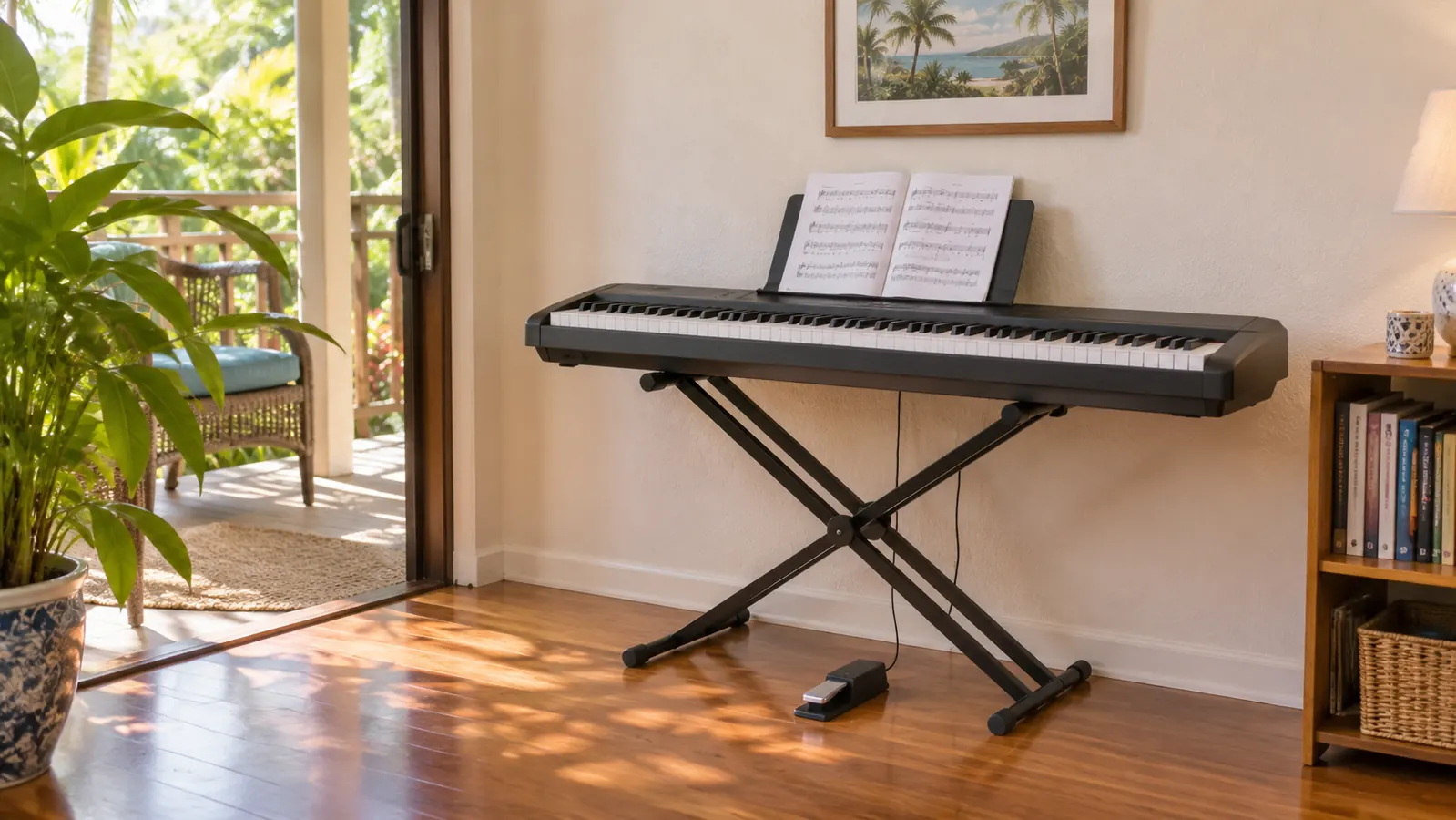
The pedal that comes in the box is the first thing to fail and the last thing you think about. I learned that on a Sunday morning with a full sanctuary singing behind me. The little square pedal that shipped with my keyboard had stopped springing back, and the closing hymn kept ringing after the congregation stopped, so a hundred people sat down in a wash of sound and turned around to look at me. Nobody said a word. My wife Leilani had plenty to say in the car. That week I ordered the M-AUDIO SP-2, mostly because a friend who plays keys at a church in town has had one under his stand for years and never once mentions it. That is the highest compliment a piece of gear can earn.
What follows is not a lab test. I am sixty-three, retired from teaching middle school music, and I play piano for the Sunday service and teach my granddaughter Kaia on the side. This pedal has lived on the floor of the small music room off my lanai for most of a year, in island air that ruins tuning pins and rusts the tools I forget to put away. I have used it for early practice, for lessons, for a monthly gospel set at church, and for the family gatherings where somebody always wants to sing. Here is what I found, including the two things that still bother me.
The Quick Verdict
Heavy enough to stay where you put it, sprung like a real piano, and boring in the best way. It is not silent, and the polarity switch is a fingernail job, but after most of a year of daily use I have stopped thinking about it. That is the whole job.
Amazon Check Today's Price →The pedal I stopped noticing
Chrome foot pedal, six foot cable, 1/4 inch jack, and a polarity switch for the keyboards that read the pedal backwards. Mine has taken a year of Sunday mornings, lessons, and a leaky church roof without a complaint.
Amazon Check Today's Price on Amazon →How I've Used It
The short version is that it has been used hard and treated carelessly. It sits under the keyboard in the music room from about six in the morning until I go in for breakfast, comes up twice a week for Kaia's lesson, gets coiled into a canvas bag and driven to church most Sundays, and gets stepped on in the dark more often than I would like to admit. Kaia has stood on it with both feet to see what would happen. Nothing happened, which tells you something about how it is put together.
The teaching is where I notice the feel most. Kaia is nine and still learning the difference between pressing a key and holding a note. Before the SP-2 I tried a square practice pedal with a spring so light that it stayed half down under nothing but its own weight. Her chords rang through each other no matter what I told her, and for a few weeks I thought she simply was not listening. She was listening. The pedal was holding the sustain for her. For her first few months she played with the keyboard's own sustain button engaged, which is an all-or-nothing switch. The week I put the SP-2 under her foot, her playing changed. She started lifting between chords, which forced her to decide where the harmony actually changes, and she stopped smearing every phrase into one long blur. A pedal that returns cleanly makes that lesson possible. A sticky one teaches the wrong thing, and the student has no idea it is the equipment's fault.
At church the pedal has to behave under pressure. Our keyboard sits on the second tier of a stand with the jack low on the back, and six feet of cable reaches with slack to spare. That sounds like a small thing until you have knelt behind a stand with a cable three inches too short and the opening prayer already underway. The pedal goes down on a carpeted platform. It does not slide, it does not tip, and it comes up every single time. That also sounds like the minimum. In my experience with cheap pedals, it is not the minimum.
One Sunday in the rainy season I unplugged everything in a hurry because water was coming in near the platform, threw the pedal in the bag wet, and did not look at it again until Wednesday. When I plugged it back in there was no crackle, no dead spot, no drama. I am not recommending that as a care routine. I am telling you what happened.
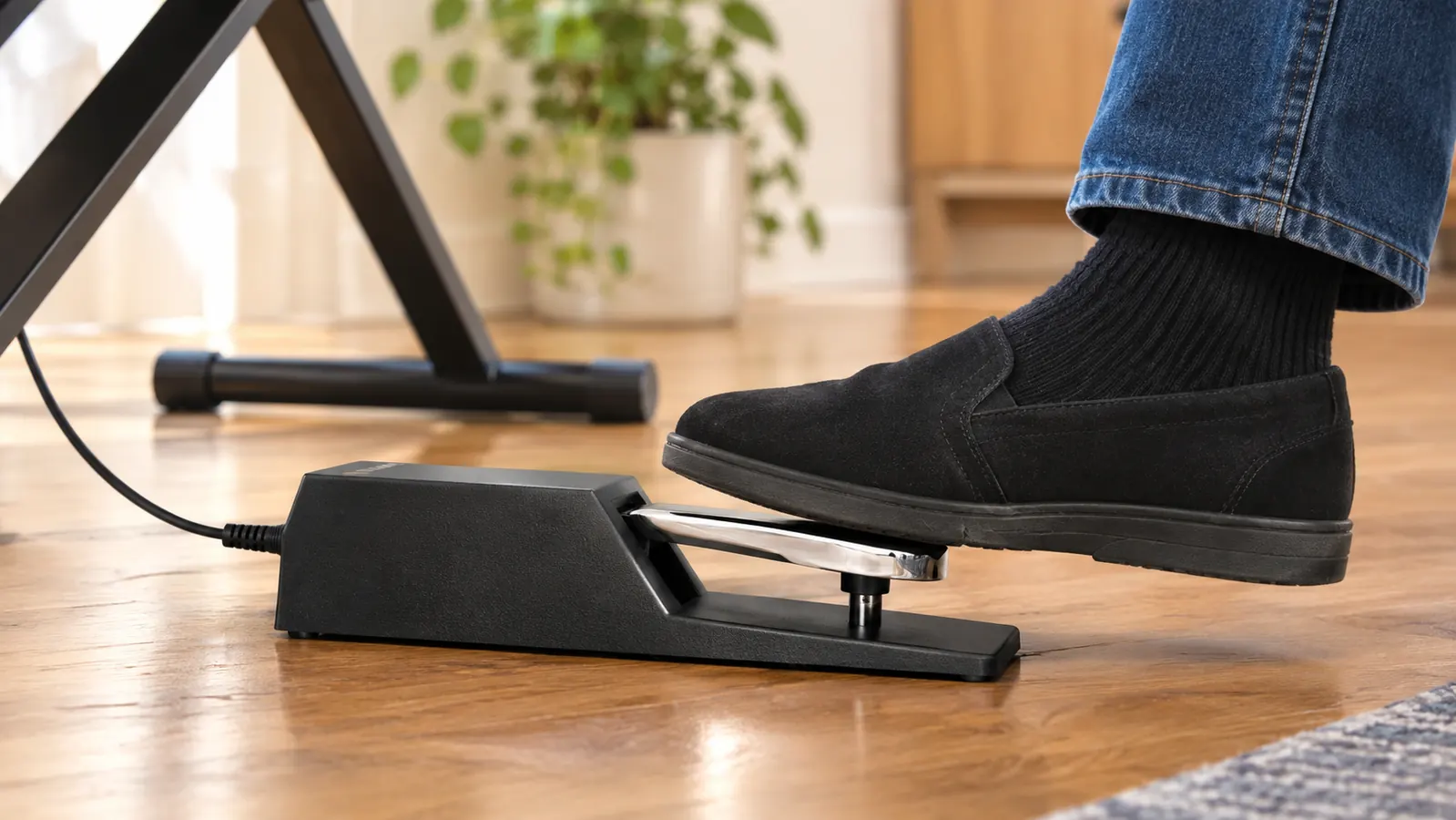
What It Is, in Plain Numbers
The M-AUDIO SP-2 is a single-function sustain pedal measuring 10.5 inches long, 3 inches wide, and 2.5 inches tall, and it weighs 14.1 ounces. The body is rubber, the part your foot touches is a chrome foot pedal, and it connects through a 1/4 inch jack on a six foot cable. It draws nothing on its own, so there is no battery to die in the middle of the last verse and nothing to remember to charge before a service.
The weight is the detail I would not give up. Fourteen ounces on a wood floor stays where you put it. The plastic pedal that came with my keyboard weighed almost nothing and it wandered under my foot during fast passages, so I was chasing it with my heel in the middle of a gospel run and losing the bass line while I did it. I put both of them on the kitchen counter one afternoon and the difference was comical. The SP-2 has not moved once. The rubber base grips and the mass does the rest of the work.
The footprint is small enough to tuck out of the way under the keyboard when Kaia needs the bench pulled in, and the shape is close to a classic piano sustain pedal without pretending to be a full three-pedal assembly. At 2.5 inches tall my heel still rests on the floor at a natural angle instead of reaching down for the thing, and Kaia's feet barely touch the floor from the bench but she manages the stroke fine. If you want something that folds flat into a gig bag, this is not that. It is a small brick with a hinge on it, and it will take up bag space.
The cable runs six feet, which is generous for a home setup and just enough at church. I coil it loose rather than wrapping it tight around the body, because a 1/4 inch plug bent hard at the collar is how these things actually die, and I have killed two cables that way over the years. That is on me, not on the pedal.
The Polarity Switch, and Why It Matters
Half the questions I see about this pedal are about the switch on the side. Here is what it does. Keyboards disagree about which way a pedal should behave. On most instruments, pressing the pedal closes the circuit and the note sustains. On some, it is the reverse, so the note sustains when you lift your foot and stops when you press. The polarity switch flips the behaviour, which is why the pedal is sold as universal rather than tied to one brand of keyboard.
My music room keyboard worked on the first try. The older keyboard at church needed the switch flipped, and I found that out in about ten seconds. One warning worth passing on: flip it while the keyboard is off, or at least before you start playing. Doing it in the middle of a song gives you a lurch of the wrong kind of sustain, and the congregation will hear it even if they cannot name what went wrong. Reaching the switch is the one genuinely annoying thing about the design. It is a small slide set into the side of the pedal, stiff enough that you need a fingernail, and if you swap keyboards every week you will not enjoy it. Set it once and forget it. That is the entire job, and it is worth doing before you drive to a gig.
It has been dropped in a canvas bag, stepped on in the dark, and driven to church most Sundays for the better part of a year, and the spring still returns the way it did in the first week.
How It Feels Under the Foot
The old upright in the corner belonged to my mother, and in this air it needs tuning more often than I would like. Its sustain is heavy and long, and the pedal travels a good inch before anything happens. The M-AUDIO SP-2 is lighter than that but it has real travel, so there is a middle of the stroke you can find and hold. On a keyboard that responds to half-pedaling, and mine does, that middle is where most of the musical decisions live. I can let a chord bloom and then catch it before the whole thing turns to mud.
I tested that on a Wednesday afternoon with the windows shut, running a slow gospel progression and listening for the seam between one sustained chord and the next. The pedal let me hold the harmony open a beat longer without the low end smearing into the melody, which is more than the boxed pedal ever managed. The resistance is enough that my foot does not rest its full weight on it by accident, which was a constant problem before. And it comes back up fast. Fast matters. In gospel playing you are pumping that pedal on every chord change, and a lazy return turns a clean progression into soup. This one returns with a snap that I trust.
The trade-off is noise. There is a soft mechanical click at the top and bottom of the travel and a faint spring sound behind it. In a quiet room with the windows shut, with Kaia playing softly and me listening from the doorway, I hear it. If you record in a silent room you will want to think about where the microphone sits, or use a quieter pedal for those sessions. Under a congregation singing a hymn at full voice, you could set off a firecracker and nobody would notice.
What I Liked
- Chrome foot pedal with real travel and a quick, dependable return
- 14.1 ounces and a rubber base, so it stays put on a wood floor or a platform
- Polarity switch handles keyboards that read the pedal backwards
- Six foot cable reaches the jack on a stacked stand with slack to spare
- Nothing to charge, no battery to fail mid-service
- Has shrugged off a year of humid island air in a room with no air conditioning
Where It Falls Short
- Audible click at both ends of the travel
- Polarity switch is stiff and awkward to reach
- Does not fold, so it takes up bag space
- No tension or depth adjustment, it is what it is out of the box
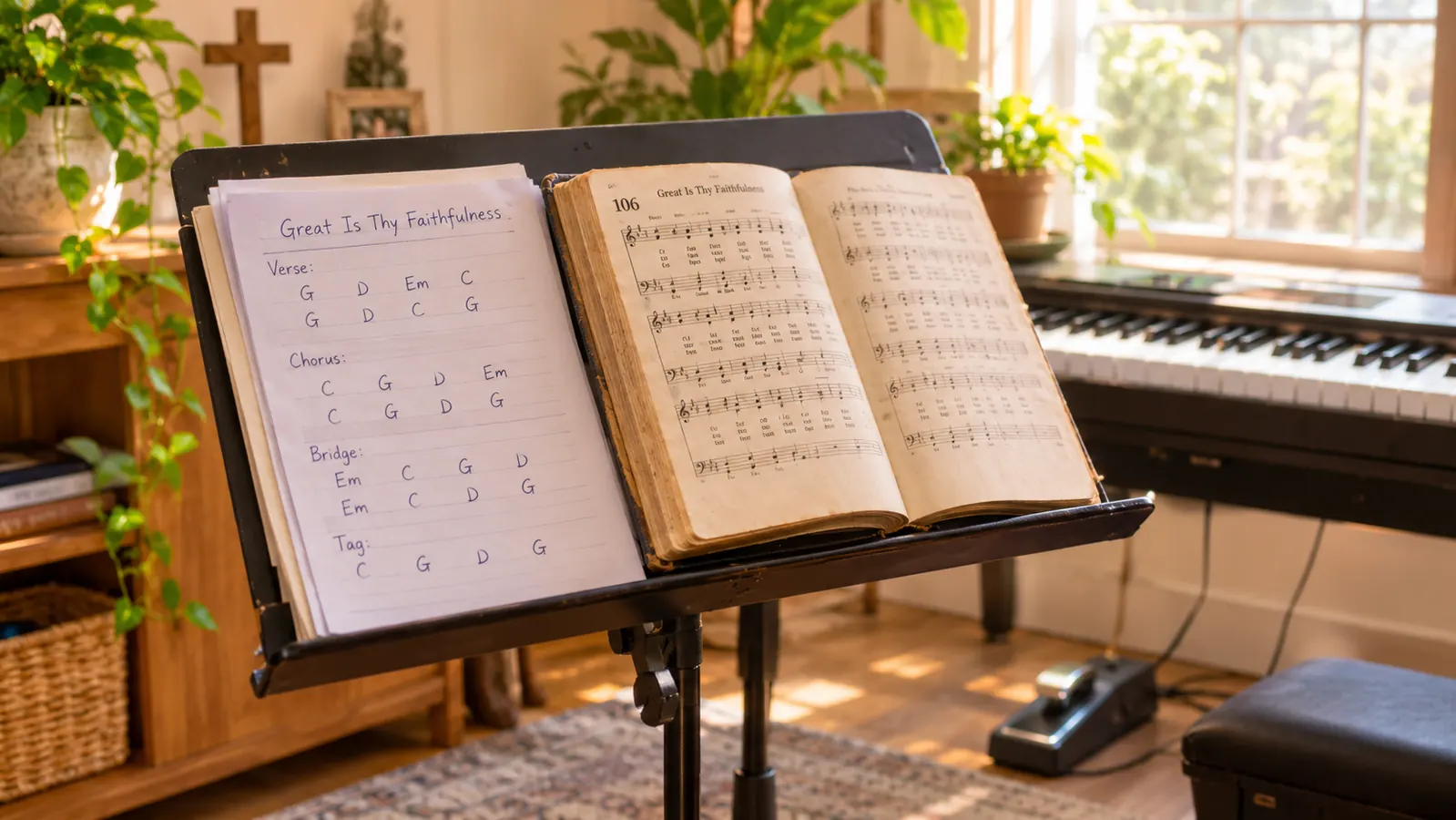
A Year in Island Humidity
The music room is off the lanai and it has no air conditioning of its own. On a Kaneohe afternoon the air in there is thick enough to drink, and I have watched it do unkind things to the upright, whose tuning I fight all year long. I expected the pedal to be the first thing to suffer. It has not. The rubber body wipes clean, the chrome foot pedal still looks like chrome, and the mechanism has not stiffened or gone squeaky in the damp.
In the wettest stretch of the year I left the windows open through a solid week of rain and came in to find condensation beaded on the keyboard and the floor damp under the stand. I wiped everything down, plugged the pedal in, and played through the service set without a second thought. No crackle, no stiff hinge, no rust blooming out of the seam. That was the week I stopped treating this thing like something that needed protecting.
My routine is simple and takes about a minute. The cable gets coiled loosely and put in a tin with the spare cables so it does not get stepped on in the dark. I do not leave the pedal sitting on the bare concrete slab when the room is really damp. Twice a year I wipe the chrome with a dry cloth and leave it alone. That is the whole maintenance schedule, and so far it has been enough.
There is a cheap plastic pedal in the closet that came with the keyboard, and in the same room over the same months it has gone chalky and stiff. That is the honest comparison, and it is the reason I stopped worrying about this one in this climate. The humidity here finds weak spots. It has not found one yet.
Who This Is For
If you play a keyboard with a standard 1/4 inch sustain jack and you are still using the pedal that came in the box, the M-AUDIO SP-2 is the obvious next step, and you will feel the difference in the first five minutes. It suits a home player with a digital piano who practices daily, a teacher who needs a pedal that behaves while a student is learning to lift, and a church or small-group player who hauls gear and cannot afford a failure in the middle of a set. If you are weighing it against the Yamaha FC4A, the two are close enough that feel and cable length will decide it more than anything on paper.
Who Should Skip It
Skip it if your keyboard uses a proprietary pedal connector instead of a 1/4 inch jack, because no adapter is included and you will be shopping again. Skip it if you need a folding pedal that disappears into a gig bag, or a three-pedal unit for a furniture-style home piano. Skip it if you record in a silent room and a mechanical click will land in a microphone. And skip it if you want adjustable tension or depth, because this one is what it is the moment you take it out of the box. None of those are flaws exactly. They are jobs this pedal was not built for, and pretending otherwise helps nobody.
If the pedal is the weak link, fix it first
One 1/4 inch jack, a polarity switch, and 14.1 ounces of pedal that does not wander under your foot. Mine has outlasted my expectations, and I expect it to outlast the keyboard it is plugged into.
Amazon Check Today's Price on Amazon →