

The first Sunday I played without a sustain pedal, nothing sounded broken. That was the strange part. The notes were right, the rhythm was right, my hands knew the arrangement, and the second hymn still landed flat as a tabletop. Every chord stopped the instant my fingers came off the keys. A room full of people singing ran straight into a sound with no air in it, and there was nothing I could do about it with volume or with a better keyboard.
I have been playing the M-AUDIO SP-2 in the spare room off my lanai for a while now, and it is the least interesting object in that room. It is a pedal. It sits on the floor. Nobody has ever walked in and asked me about it. But it changed how I play more than the keyboard did, and it did the work in about ten minutes. Here are ten reasons, roughly in the order they hit me. The last one involves my granddaughter, so stay with me to the end.
Your keyboard is missing one thing, and it is sitting on the floor
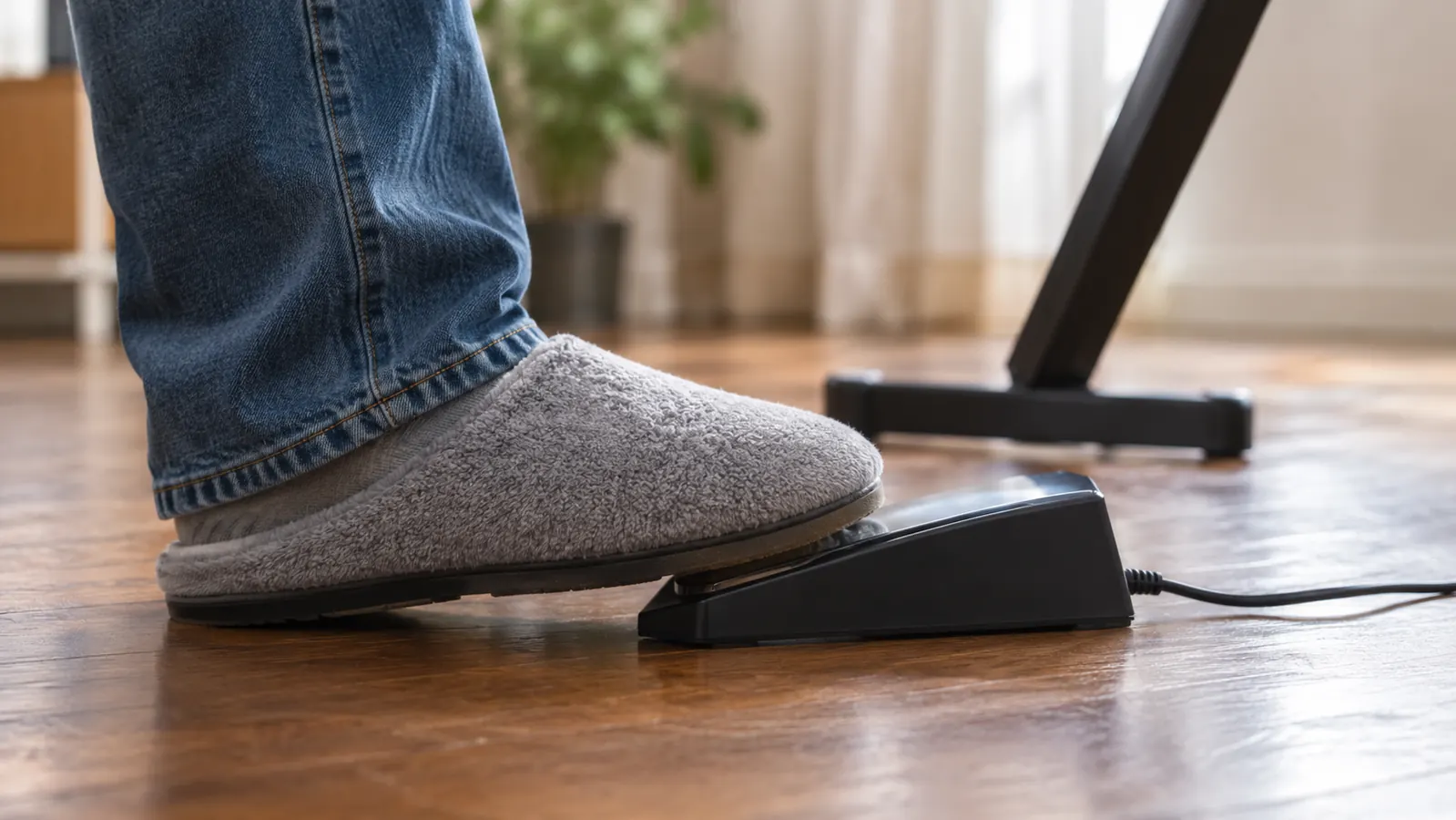
The M-AUDIO SP-2 is a universal sustain pedal with a chrome foot pedal, a polarity switch, and a 6 foot cable with a 1/4 inch jack. It is the smallest change you can make to a keyboard rig, and the first one anybody notices.
Amazon Check Today's Price on Amazon →Ten Reasons It Changes How You Play
Your right foot finally has a job
Before the pedal, my right foot sat on the floor like luggage. Now it works. The chrome foot pedal carries a real weight, so your ankle knows where the bottom of the travel is without you looking down, and the action feels like the sustain pedal on an upright rather than a switch. That weight is the whole point. You press in the same place every time, and after a couple of weeks you stop thinking about your foot at all.
Chords stop sounding clipped
A chord held by fingers alone ends when the fingers end. That is a hard stop, like a singer cutting off a phrase with the back of the hand. With sustain, the chord rings out under the next one and the harmony carries across the bar line. On anything slow, a gospel tune or a hymn, that ringing is the difference between a piano and a keyboard pretending to be one. You do not press harder. You lift your hands a second later than usual.
Hymns breathe the way they were written
Hymn writers built in space. The line ends, the room holds it for a beat, then the next line begins. Without a pedal that space is silence, and silence is not the same thing as resonance. I noticed it on the third verse of a communion hymn where the harmony moves underneath a held melody note. Held that note with my fingers and it died. Held it with the pedal and the alto line had something to sit on.
The motion transfers to your acoustic piano
My mother's upright lives in the front room and needs tuning more often than I would like. Here is what matters: the pedal on a digital keyboard and the pedal on that upright ask for the same motion. Heel down, ball of the foot, small pressure, release before the harmony turns to mud. Practice it on the SP-2 all week and Sunday on the upright feels familiar. Practice it wrong for a year and you build a habit you have to unlearn.
A starter keyboard stops sounding like a toy
The keyboard Kaia started on is not a fine instrument. Decent samples, plastic action, and it sounded thin until the M-AUDIO pedal went underneath it. Sustain does something to the ear that more volume cannot. It lets notes overlap, and overlapping notes read as a bigger instrument in a small room. Ten minutes with a pedal did more for that keyboard than any setting buried in its menu. I am not exaggerating for effect.
Nearly thirty thousand people have rated this pedal 4.7 stars. Most of them, I suspect, bought it because their keyboard sounded wrong and they could not say why.

The polarity switch ends the guessing game
Here is the thing nobody tells a beginner. Some keyboards expect the pedal to be open when you press it, and some expect it closed. The M-AUDIO SP-2 has a polarity switch for exactly that. You flip it once, hear the sustain behave properly, and stop wondering whether your keyboard is broken. I have watched two students buy pedals that did not work, get discouraged, and quit using them entirely. One switch would have saved both of them a month.
It takes a weekly pack and unpack without complaint
Church gear gets treated badly. It goes into a bag on Saturday, comes out Sunday morning, gets stepped around by whoever is setting up the sound, and goes back in the bag. The SP-2 has a heavy duty mechanism and a rubber body, and mine has not developed a rattle or a dead spot in the travel. I would not call it indestructible. I would call it the one piece of my Sunday setup I have never had to think about twice.
The 6 foot cable actually reaches the jack
A short cable on a pedal is a small insult. The jack on a keyboard is usually at the back, sometimes underneath, and it is never where your foot wants to be. Six feet is enough to put the pedal where your leg actually sits, which on my setup is well off to the right of the stand. If that cable had been three feet I would have spent every service playing with my knee at an angle. Small detail. Felt every week.
At 14.1 ounces it never gets left at home
The SP-2 weighs 14.1 ounces and measures about 10.5 by 3 by 2.5 inches. That is small enough to live in the front pocket of my gig bag and light enough that I do not notice it until I need it. Compact gear gets used. Gear that needs its own case stays in the closet. That is the practical argument for the M-AUDIO over anything bigger and heavier. It gets carried, so it gets played.
Kaia is learning the habit at nine instead of fifteen
My granddaughter Kaia is nine and learning piano. For the first few months her left hand and her foot were not on speaking terms, which is normal at that age. What I like about putting this pedal in front of her now is that pedaling stops being a trick she picks up later and becomes part of how she hears a phrase. Nine is young for it. It is also the age where a habit is cheap to build.
What I'd Skip
If you already own a pedal and it works, keep it. The SP-2 is not an upgrade for somebody with a functioning pedal, and I will not pretend otherwise. I would skip the pedals with extra switches and settings if all you want is sustain, because every extra thing is one more thing to go wrong in a dark church at eight in the morning. I would skip buying a second one as a backup before you have played a hundred services on the first. And if your pedal arrives and the sustain behaves backwards, do not return it. Flip the polarity switch. That is the entire troubleshooting tree and it takes about four seconds.
One pedal on the floor, and the room sounds different
It is the least glamorous thing in your setup and the one you will notice on the first hymn. Universal sustain pedal, chrome foot pedal, polarity switch, 6 foot cable with a 1/4 inch jack, 14.1 ounces in the bag.
Amazon Check Today's Price on Amazon →