
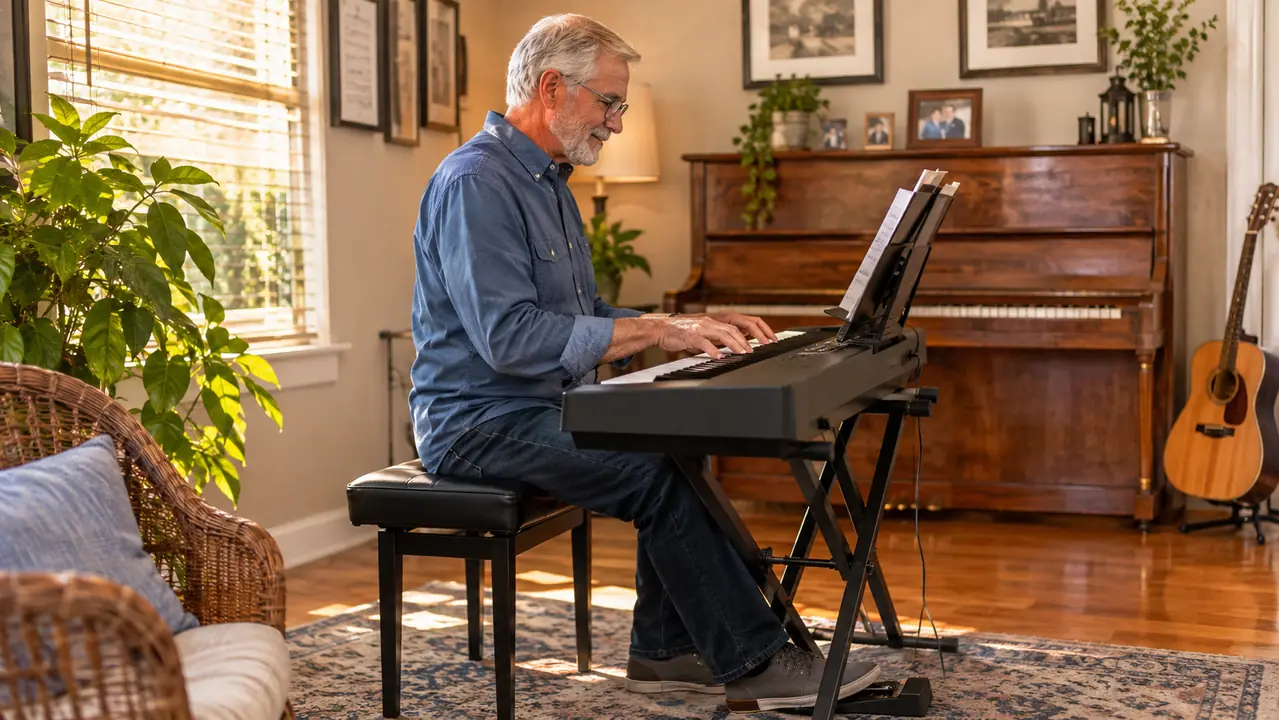
Kaia sat down at my mother's upright last month and asked me why the pedal on my keyboard feels different from the one on the piano. She is nine. She noticed in about four seconds what took me two years to put into words. The answer is that a sustain pedal on a digital keyboard is doing a smaller job than a damper pedal on an acoustic, and the M-AUDIO SP-2 does that smaller job without complaint. I have had one under my foot in the music room off the lanai for months now. It has played Sunday service, weekday practice, and roughly a hundred repetitions of a hymn Kaia is learning. This is what I would tell a friend who asked, including the parts that are not flattering.
Most pedal reviews read like the box. Mine is going to read like the Sunday after the box arrived. The M-AUDIO SP-2 has been in my setup long enough that the newness has worn off and the habits have set in. There are things I like, one thing that annoyed me for a week, and a group of players I would point somewhere else entirely. If you want the short answer it is right below. If you want the long answer, keep reading, because the long answer is where the useful part lives.
The Quick Verdict
A sturdy, simple sustain pedal that does exactly one job well. If your keyboard takes a standard quarter inch pedal and you do not need half-pedaling, this is the pedal I would hand you and stop talking.
Amazon Check Today's Price →The Pedal That Has Been Under My Foot Every Sunday
Universal sustain pedal, chrome foot pedal, polarity switch, six foot cable with a quarter inch jack. If your keyboard has the jack, this covers the job and keeps covering it.
Amazon Check Today's Price on Amazon →What the SP-2 Actually Is, and What It Is Not
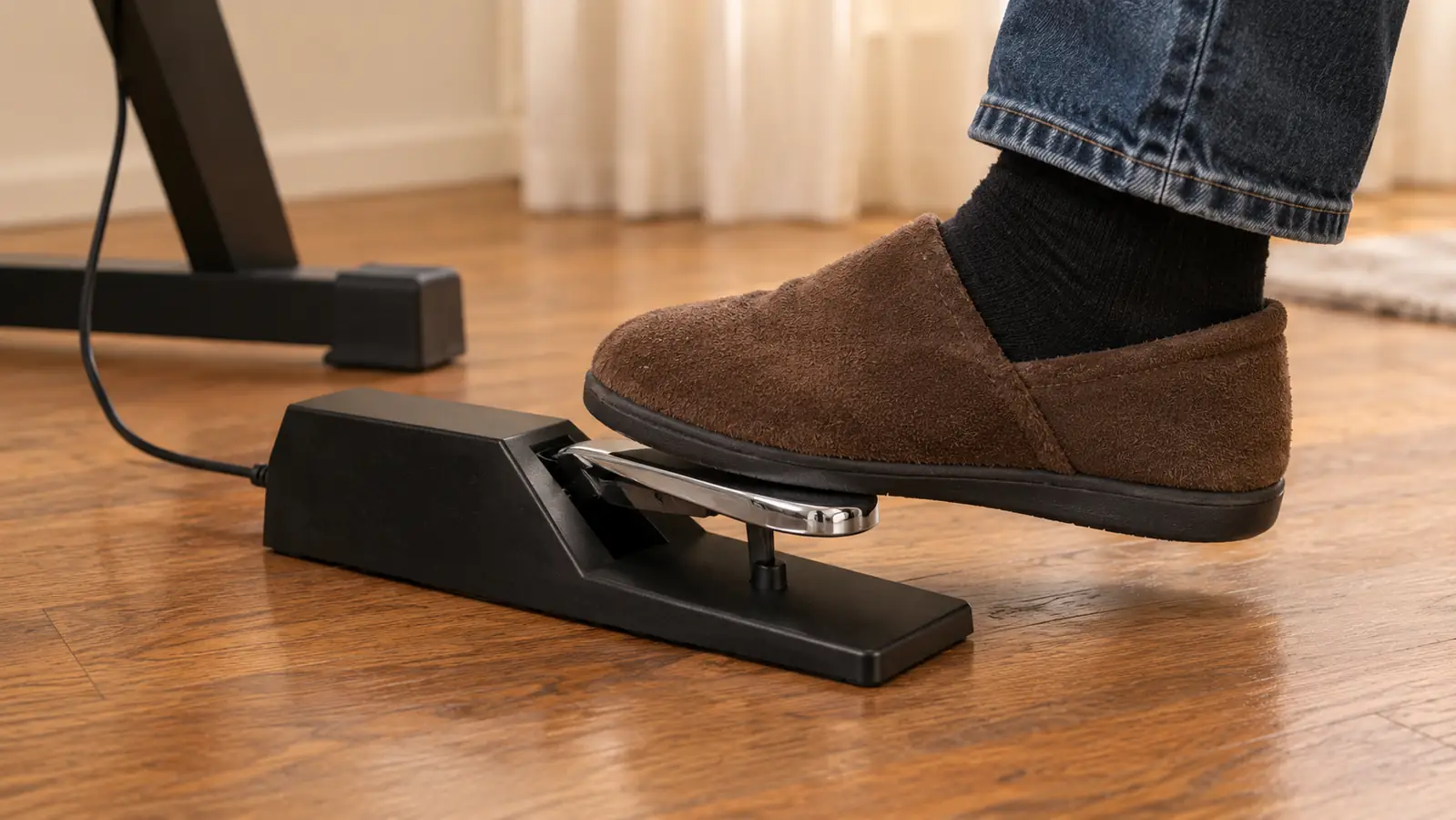
The listing calls it a universal sustain pedal, and that word universal is doing real work. The SP-2 ends in a quarter inch jack, the size that has been standard on keyboards and digital pianos for decades, and it ships with a six foot cable. That is the entire interface. There is no USB, no MIDI plug, no app, no pairing step, no firmware. You plug it in, you press it, the notes ring. For a church pianist who sets up in a dim corner ten minutes before the service, that is exactly the right amount of technology.
The physical numbers are worth knowing because they decide where the thing lives in your room. It measures 10.5 by 3 by 2.5 inches and weighs 14.1 ounces. That is heavy enough to sit still under a normal foot and light enough to pick up with one hand when I am sweeping. The body is rubber, the foot pedal itself is chrome, and the mechanism is described as heavy duty, which matches how it has held up under daily use.
What it is not matters just as much. It is not a volume pedal and it is not a MIDI controller. More importantly, it will not give you half-pedaling if your keyboard does not already support it. Half-pedaling is a keyboard feature, not a pedal feature. The pedal can only report what the jack asks for, and if the jack is asking a yes or no question, that is the answer you get. I wish more people understood that before they buy any pedal, this one included, because it is the source of most of the disappointment I see in pedal reviews.
How I've Used It
My setup is a small spare room off the lanai in Kaneohe. The digital keyboard sits against one wall, the old upright my mother left me sits against the other, and there is just enough floor between them for a chair and a foot pedal. Island air is hard on instruments. Nothing in that room stays truly dry, and I have learned to wipe things down and keep the cases closed. A rubber-bodied pedal that wipes clean with a damp cloth is a better fit for that room than something with fabric or open gaps. The room is about nine feet by eleven, small enough that every bit of dust shows on the wood floor. I keep a rag on the piano bench and wipe the SP-2 down on Saturday nights before service, the same pass I give the keys. It takes about fifteen seconds and it has kept the rubber looking like rubber instead of like a gray shadow of itself.
The SP-2 has lived on that floor for months. Sunday service, weekday practice, and Kaia's lesson on Thursday afternoons. During service I am playing gospel, which means a lot of pedaling and a lot of stopping and starting, and the pedal has not once failed to engage or stuck down on me. That sounds like a low bar until you have owned a pedal that stuck in the middle of the second verse. I have. I did not enjoy it.
There was one Sunday in March I remember clearly. The power at the church hall flickered twice during the opening hymn and the keyboard restarted itself between verses, which killed the sustain for about four seconds. The pedal was fine. It was the keyboard. But it taught me to check the connection before service rather than during it, and now I press the jack in firmly and give the cable a small tug to feel that it seats. That habit costs five seconds and has saved me twice since.
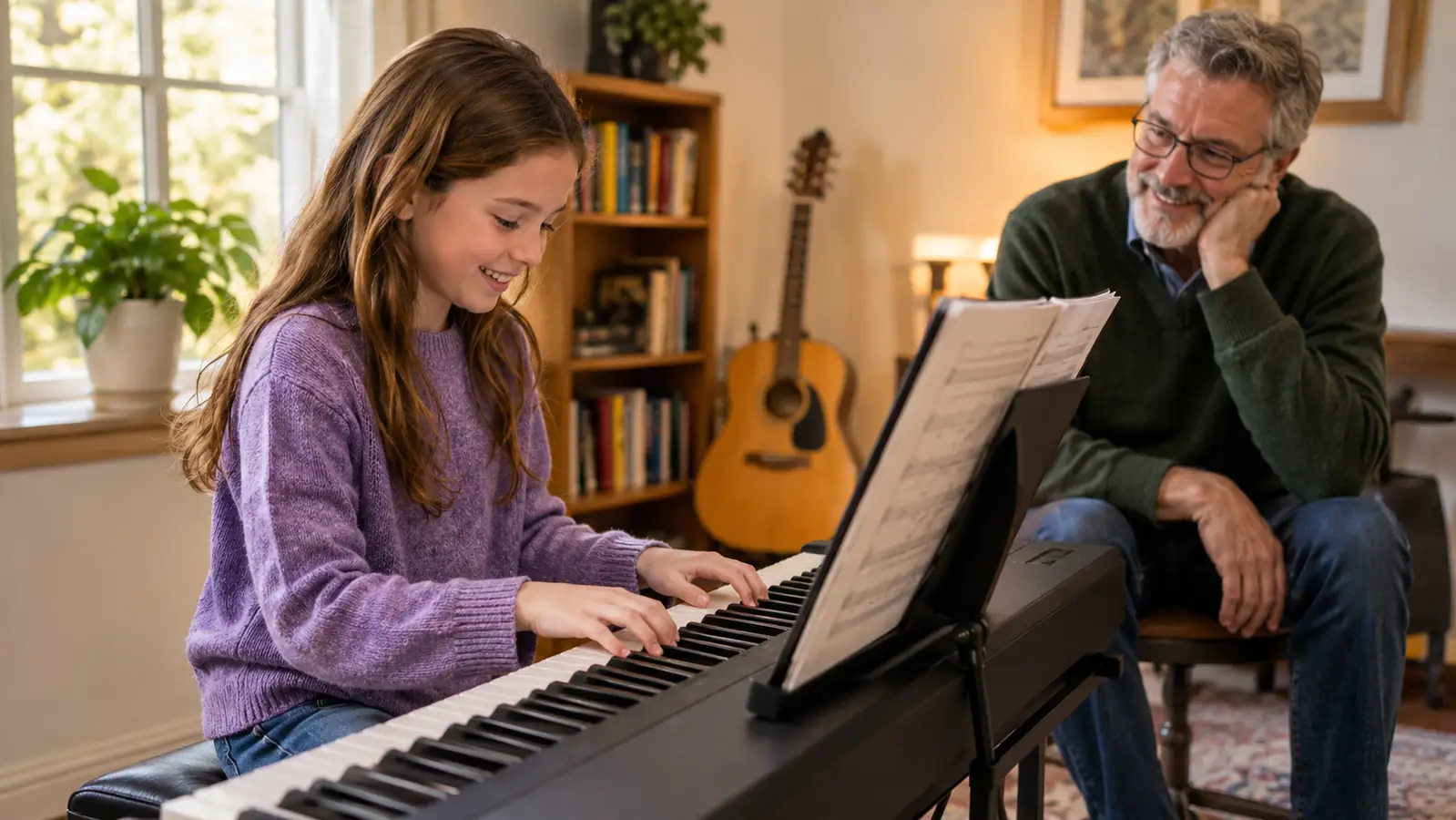
Kaia is nine and she pedals like a nine year old, which is to say she steps on it hard and lets it snap back up. The pedal has taken that for months. The chrome still looks like chrome and the rubber body has picked up a little dust from the lanai and wiped right off. I have also taken it to the church hall twice for a borrowed keyboard, dropped it in a canvas bag with a tuner and a coil of cable, and it came out working both times.
The six foot cable has turned out to be the detail I notice most. The jack on my keyboard is on the back left, and six feet is enough to run the cable around the stand and put the pedal where my right foot naturally lands rather than where the cable forces it. That sounds small. It is not small. Where the pedal sits decides how relaxed your ankle is for the next hour, and a relaxed ankle is most of what makes pedaling sound natural.
A sustain pedal is the least expensive thing in your rig and the thing you will touch more than any knob. Buy the one that stays put and stays quiet.
The Things Nobody Tells You
First, the polarity switch. It is a small switch and it exists because different keyboard makers wire their pedal jacks differently. If your sustain works backwards, meaning the notes ring when you are not touching the pedal and stop when you press it, you flip that switch and you are done. I have had to do it exactly once, on a borrowed keyboard at a wedding, and it took ten seconds of confusion followed by ten seconds of fixing. What happened was this. I plugged in, played a chord, and the chord kept ringing after I lifted my hands while the next one died under my foot. For a moment I thought the keyboard was broken. Then I remembered the switch on the side of the pedal, flipped it with a thumbnail, and everything made sense again. My cousin still does not know how close her wedding march came to being one long sustained noise.
Second, and I will keep saying this, half-pedaling is not on the menu unless your keyboard puts it there. If your digital piano has a pedal input that reads continuous values and a pedal the maker specifies for it, use that pedal. The SP-2 is a universal pedal built to work with any keyboard that takes a standard quarter inch sustain pedal. Universal is a great thing to be. It is not the same thing as specialized.
Third, the cable is the entire cable. Six feet, permanently attached, and that is what you get. In my room that is generous. On a stage where the keyboard is racked three feet behind the player, six feet disappears fast. Plan on an extension if your instrument sits far from your foot, and plan on it before the first rehearsal rather than during it.
Fourth, weight does more for you than you think. At 14.1 ounces the pedal has enough mass that it does not walk across the rug while I play. On the smooth floor near the lanai door it will slide a little when I am pedaling hard through a fast chorus. A square of shelf liner under it fixed that for me in about a minute. That is not a defect in the pedal. It is what a light pedal does on a slick floor, and I would rather have a light pedal than a heavy one.
Where It Genuinely Falls Short
Here is my real complaint, and it is about feel. My mother's upright has a damper pedal with a long, weighted travel that lets you find the halfway point with your ankle before your ear even catches up. The SP-2 is shorter and firmer underfoot. It is a good footswitch and I have no hesitation saying that. It is not a piano pedal and it was never going to be. If you are coming off an acoustic and you expect that exact resistance, you will notice the difference in the first five minutes and you will keep noticing it for a while. Before this one I tried a heavier pedal a friend lent me, and it was worse in the other direction. The travel was so long that my ankle got tired by the second hymn and I started missing lifts. The M-AUDIO sits in the middle of that range, short enough to be quick and firm enough that you feel where the bottom is. Middle is not a compromise here. Middle is the right place for a keyboard.
The second complaint is the chrome. It looks good and it wipes clean, which matters in a humid room. It is also slick under a smooth dress shoe when your foot is at an angle, and that happens at the end of a long service when you are tired and pedaling carelessly. I have adjusted. A player with a heavier or less precise foot might find it more annoying than I do, and I would rather say so than pretend the pedal is perfect.
The third complaint is that there is nothing to adjust. You plug it in, you flip the polarity switch if you need to, and then you play. For me that is the appeal. For a player who likes to tune the resistance of every piece of gear they own, it will feel like a plain tool. It is a plain tool. That is the whole idea, and if the idea does not appeal to you, the pedal will not either.
What I Liked
- Works with any keyboard that takes a standard quarter inch sustain pedal
- Polarity switch fixes a backwards pedal in seconds, no tools and no manual
- 14.1 ounces of weight keeps it planted on carpet while you play
- Six foot cable reaches from a rear jack to a comfortable foot position
- Chrome foot pedal wipes clean and has held up to daily use and travel
- Compact footprint at 10.5 by 3 by 2.5 inches, easy to bag and carry
- Simple enough that a nine year old can set it up and use it
Where It Falls Short
- Pedal travel is shorter and firmer than an acoustic damper pedal
- Chrome surface is slick under smooth-soled shoes at an angle
- Six feet is the only cable you get, so long runs need an extension
- Will not add half-pedal support your keyboard does not already have
- Slides on smooth floors unless you put something under it
What It Does to the Music in a Small Room
A sustain pedal does not change your tone. It changes how long your notes live, and in a small room with a digital keyboard that is most of what you actually hear. Without a pedal, a hymn sounds clipped and dry. With it, the chords bloom and the room fills up. The SP-2 does that reliably, service after service, and reliability is the only thing I want from a pedal at this level.
There is a limit to that, and the limit is your keyboard and your own foot. Hold the pedal through an entire verse and the notes pile on top of each other until it turns to mud. That is not the pedal failing. That is the pedal doing exactly what you asked. Learning when to lift is the actual skill, and Kaia is learning it now, one bar at a time, with me saying lift, lift, lift from the other side of the room. I learned that the hard way at a funeral service last year, where I held the pedal through the whole of a slow hymn because I was nervous and my foot forgot to move. The last verse turned into a wash and I had to lift and start clean on the amen. Nobody said anything afterward, which is how you know they noticed.
Who This Is For
This pedal is for the player who has a keyboard with a quarter inch sustain jack and wants that part of the setup handled so they can think about the music instead. Church pianists, students, teachers, bedroom players, anybody who is tired of the pedal that came in the box or the one that gave out on them in the middle of a set. If you play acoustic at home and digital at church, the SP-2 will feel familiar enough that you stop noticing it within a week, and that is the highest compliment I can pay a piece of gear.
It is also a sensible first pedal for a kid. Kaia can step on it without me worrying that she is going to destroy it, and the polarity switch means it will keep working when she moves up to a different keyboard in a few years. The M-AUDIO build has taken her version of pedaling without a complaint, and I cannot say that about everything in that room.
Who Should Skip It
Skip it if your keyboard needs the maker's specific pedal to unlock half-pedaling and you actually use that in your playing. Skip it if you need a volume or expression pedal, because this is neither and no switch on it will change that. Skip it if your keyboard sits more than six feet from your foot and you do not want to buy an extension cable, because six feet is the whole length and it does not grow.
And skip it if what you are really chasing is the feel of an acoustic damper pedal under your foot. No pedal this size will give you that, no matter what the box says. If that feel is what you are missing, the honest answer is to practice on the upright more and use the digital for what it is good at. The SP-2 is a working tool for a working keyboard, and it is honest about that.
One Pedal, One Job, Done Properly Since the Day I Plugged It In
Universal quarter inch sustain pedal, six foot cable, polarity switch, heavy duty mechanism, 14.1 ounces that stays put under your foot. If your keyboard has the jack, this is the one I would hand you.
Amazon Check Today's Price on Amazon →