
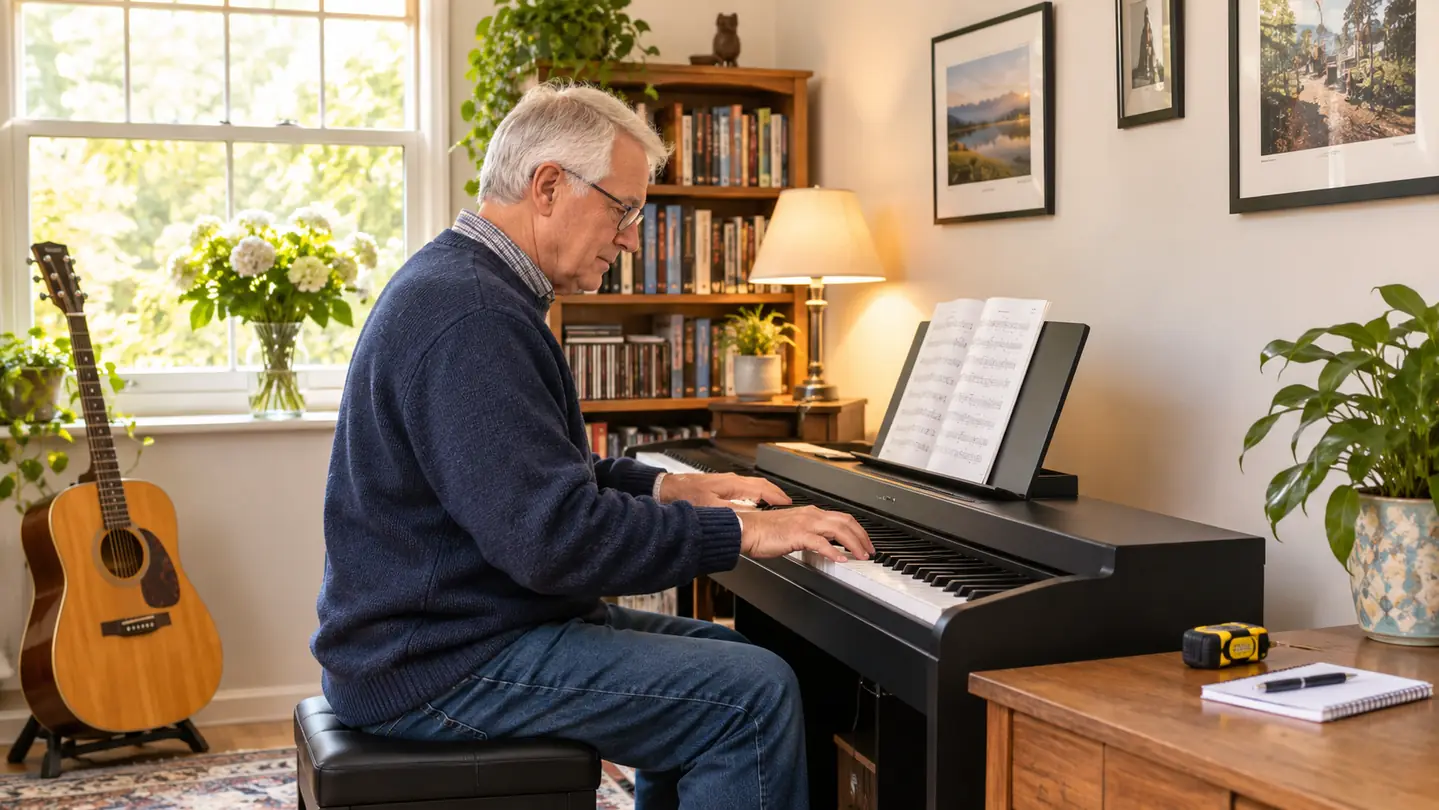
The spare room off my lanai measures nine feet by eleven. My mother's upright piano took the long wall and still left me turning sideways to squeeze past it on the way to the door. That upright needs tuning twice a year in this Kaneohe humidity, and twice a year I find a reason to put it off until the Sunday before Easter. Last spring I moved it into the front room, stood in the empty space with a tape measure, and tried to work out whether a digital piano could live here without swallowing the room whole.
That is how the Donner DDP-80 ended up in my house. Not because I wanted a project. Because it is 59 inches wide and 16.9 inches deep, and those two numbers are a footprint I could actually plan around in a room this small. The box includes the music stand, the triple pedal and the power adapter, so there was no second order to place and no waiting on a part that ships separately. What follows is not a feature tour. It is the part I could not find written down anywhere: how to get this instrument into a small room and make it genuinely playable for a 63-year-old accompanist and a nine-year-old beginner who share the same bench.
Fifty-nine inches of wall. That is the whole negotiation.
88 weighted keys, a triple pedal, a music stand and the power adapter in one box, at 59 inches wide and 16.9 inches deep. Measure the wall before you order anything.
Amazon Check the Donner DDP-80 on Amazon →Step 1: Measure the Wall, Not the Room
Everybody measures the room. Measure the wall instead, because the wall is what decides whether this works. The Donner DDP-80 is 59 inches wide, 16.9 inches deep and 29.3 inches tall. Add four to six inches on each end so you are not shuffling sideways to reach the far keys, and you are really looking for five and a half feet of clear wall with nothing else competing for it. I marked mine with painter's tape and left the tape there for two days before I committed to anything.
Then look at what that wall shares space with. A door swing is the thing that ruins a good plan. On my wall the lanai door opens inward and takes 30 inches of swing, so the piano sits to the left of it and the bench pulls out into the middle of the floor. Walk the path you will actually walk: door to bench, bench to music stand, bench back out to the hallway. If you have to turn your body sideways to get to the seat, the layout is wrong and no amount of practicing will fix it.
Pick an interior wall if the room gives you a choice. In island air an exterior wall against the lanai means afternoon sun on one side and evening damp on the other, and both are hard on an instrument over a few years. A wall that backs onto a hallway stays steadier through the day. If an interior wall is not available, keep the piano out of direct sun and away from the door where the trade winds push moisture through the room. That is advice I would give for an acoustic too. Wood is wood.
Step 2: Move It Once, With Two People
The shipping weight is 23.8 kg and the shape is wide and shallow. That combination handles like a door, not like a box. Two people, one at each end, and clear the path before you lift anything. I have moved furniture alone out of pride and I have regretted it in my lower back every single time. Take the door off its hinges if the hallway is tight. It sounds like an extra twenty minutes and it saves you a gouged cabinet.
Keep the piano flat and level while you carry it. Do not drag it across tile to save a step, because a foot will catch a grout line and the cabinet will twist, and a twisted cabinet is a keyboard that rocks every time you play a bass note. Set it down where it will live, then step back and look at it from the doorway. This is the moment to change your mind about placement, not after the pedals are set and the bench is already where your body expects it.
Once it is in position, leave it alone for a day before you do anything else. Any piano, digital or acoustic, sounds different after it has sat in a room and settled to the temperature. Play a few chords, listen to how the room answers back, and then decide whether the wall is right or whether it needs to come out another six inches. I moved mine twice. The second move took ten minutes and made the room feel twice as large.
Step 3: Set the Bench and the Pedals Before You Play a Note
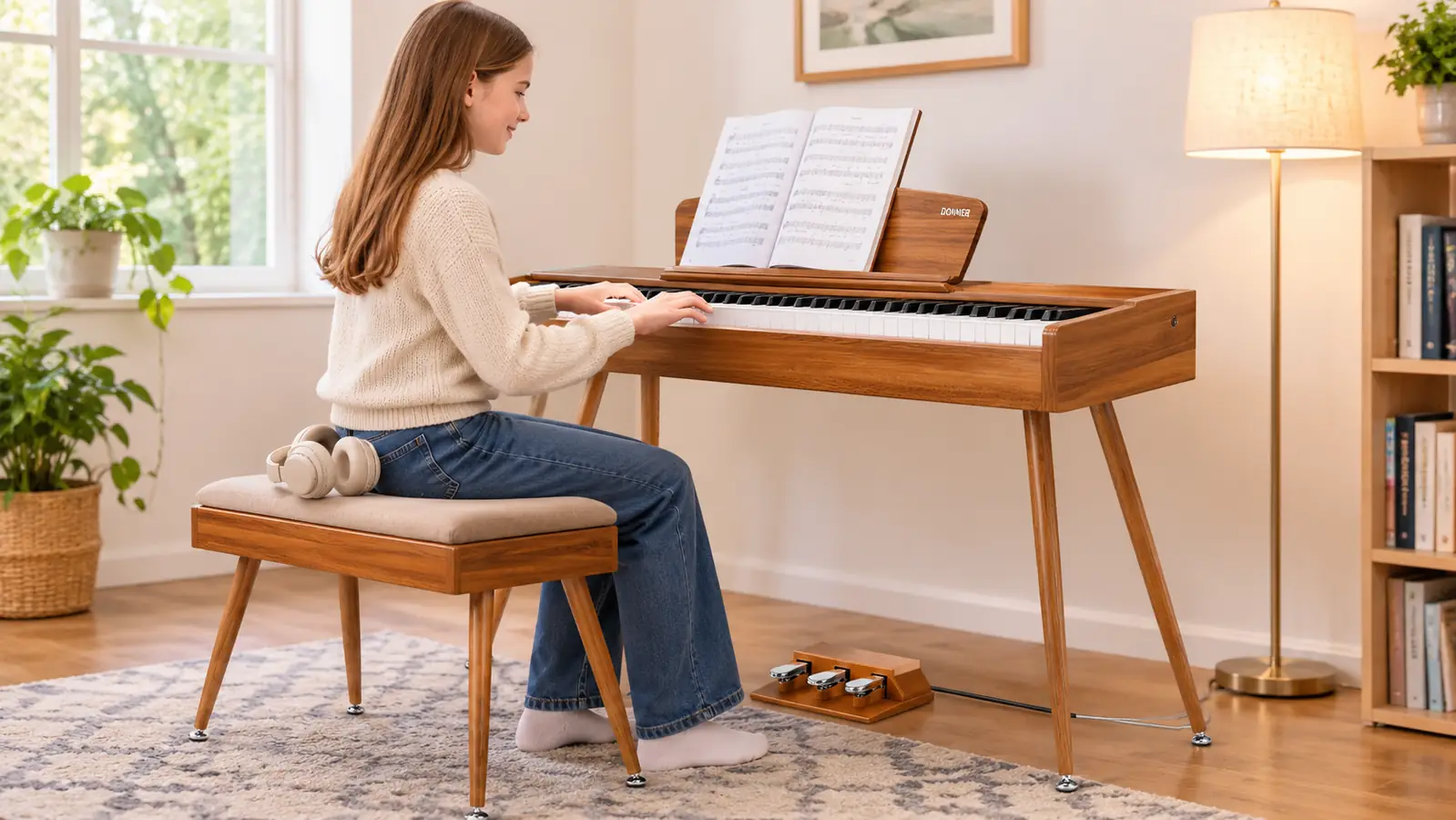
The seat height decides everything above it. Sit down and let your forearms sit roughly level with the keys, elbows slightly out and relaxed. If your wrists bend up to reach the keys, the bench is too low. If your shoulders creep toward your ears, it is too high. For a nine-year-old that usually means a cushion or a bench that adjusts, and Kaia has used both at my house depending on how fast she grew that summer.
Then the feet. The triple pedal sits where your right foot expects it, and your left foot should sit flat on the floor. If the bench is too high your heel lifts and you end up working the pedal with your toes. If it is too low your knee comes up and the whole leg works harder than it should through a long piece. Set the bench first, then the feet, then the hands. That is the order, and it never changes.
Give the bench enough clearance to stand up. The piano is 16.9 inches deep, so the bench sits out in front of that, and a player needs room behind the bench to push back and leave. In a nine by eleven room that is the difference between a space you want to sit in and a space you avoid without knowing why. I moved my bench out four inches and stopped dreading the room. Do that before you buy anything else for it.
Step 4: Tame the Volume Before the Room Does It For You
A small room with a tile floor is a bright room. The DDP-80 runs two stereo speakers at up to 25 watts each, and in a room this size the top third of the volume is simply not usable. Start at about a quarter and work up from there. If the sound turns muddy rather than louder, you have gone past what the room can absorb, and the fix is the room rather than the piano. That has been true of every instrument I have ever owned.
Pull the piano a few inches off the wall if the low end gets boomy, and put a rug under the bench. That is not a refinement, it is the difference between an instrument you practice on for an hour and one that gives you a headache in fifteen minutes. Leilani watches television in the next room, and a rug plus a closed door bought me a whole evening of practice instead of a polite comment about the volume.
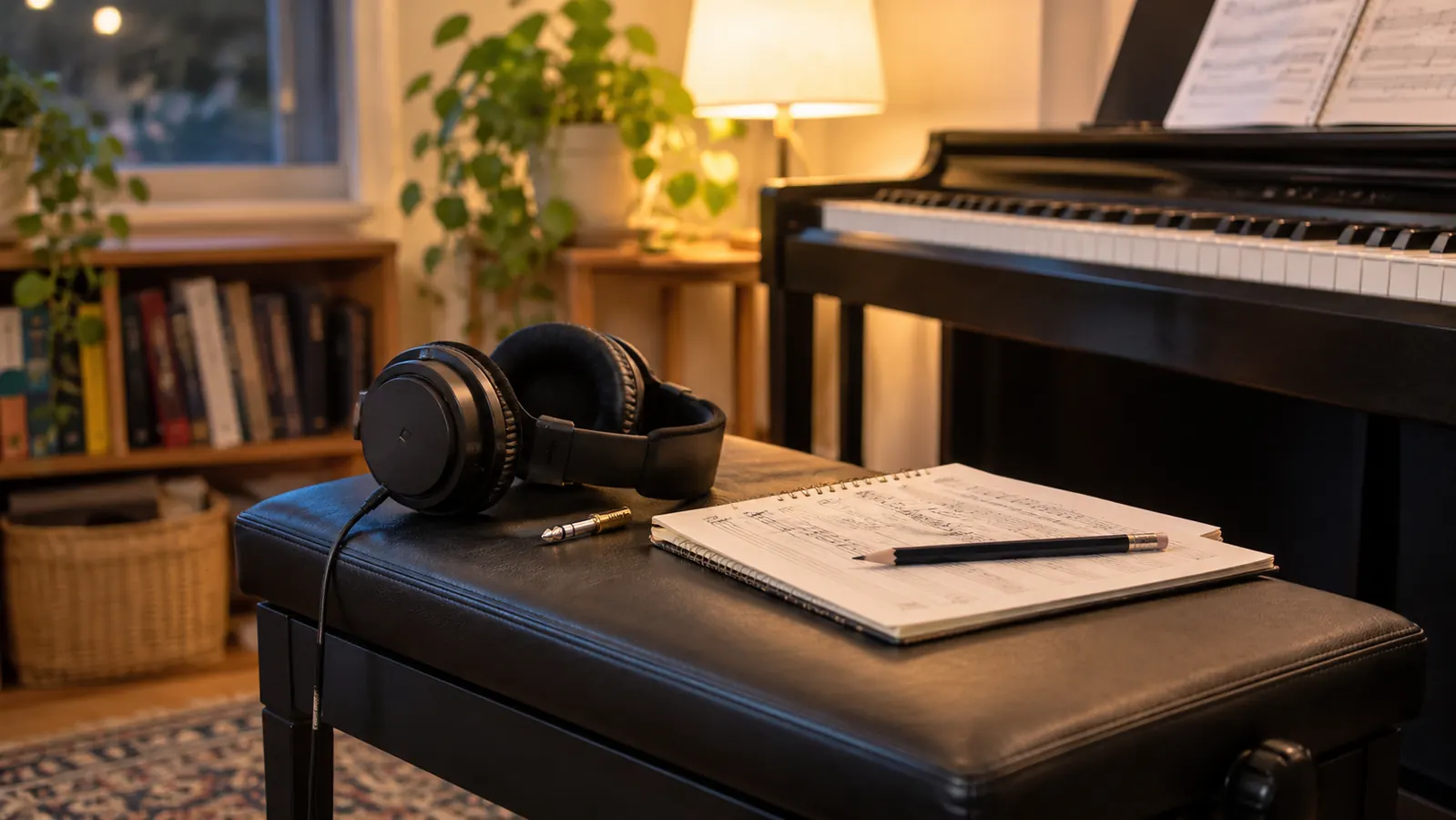
The 3.5mm headphone jack is the other half of the answer. Late at night I use headphones and nobody in the house knows I am working the same eight bars for the fortieth time. Check what you already own: a 3.5mm plug goes straight in, and a quarter-inch studio pair needs an adapter. Keep the adapter in the bench so it does not turn into a search every evening. Your family will thank you, and so will your neighbors.
Step 5: Wire It for Practice and for Recording
The USB-MIDI connection is the part most people ignore, and it is the part that turns this piano into a teaching tool. It works with Windows and Mac and talks to MIDI editors and DAWs without an extra interface. Plug it into the laptop on the desk beside the piano and you can record what you just played, look at it, and see exactly where the rhythm went soft. My laptop lives on a small table two feet from the bench for that reason.
For a beginner, that is worth more than another lesson book. Kaia plays her scale, we record it, and she listens back. She hears the unevenness in about four seconds, which is faster than I can explain it in words. For me it means I can lay down a gospel arrangement on a Tuesday, listen to it in the car, and change a voicing before Sunday service without calling anyone.
The auxiliary connection is the other cable worth running, for playing along with a track through the piano's own speakers. Keep your cables tidy along the wall behind the piano, because a small room with loose cables is a small room with a trip hazard. And put the laptop at eye level on a stand rather than on the bench beside you. Your neck will thank you by Thursday.
What Else Helps
A hygrometer tells you more about your room than your ears will. Island humidity swings a lot between a breezy morning and a closed-up afternoon, and while a digital piano does not drift out of tune the way my mother's upright does, the action and the cabinet still live in that air. Watch the number for a week before you buy anything else for the room.
If it sits high, a small dehumidifier in the room is a reasonable purchase, and it will serve the acoustic piano in the front room just as well. If it sits low, a humidifier through the dry months. Either way a cheap gauge saves you from guessing, and guessing is how people end up blaming an instrument for what their room was doing.
A rug, a lamp, a decent bench and a notebook. The lamp matters more than people expect, because you will read music in this room every evening and an overhead bulb casts a shadow straight across the page. The notebook is for the one thing you are working on this week, so that next Tuesday you do not sit down and wonder what it was. Everything else is decoration. The instrument is already good enough. The room is the project.
Fifty-nine inches against the wall and 16.9 inches out from it. That is all the floor this room had to give, and it was enough.
If the wall measures right, the rest is a Saturday afternoon.
The Donner DDP-80 is 59 inches wide, 16.9 inches deep and 29.3 inches tall, with the triple pedal, music stand and power adapter in the box. Measure first. Then move it once and leave it alone.
Amazon See the Donner DDP-80 on Amazon →