
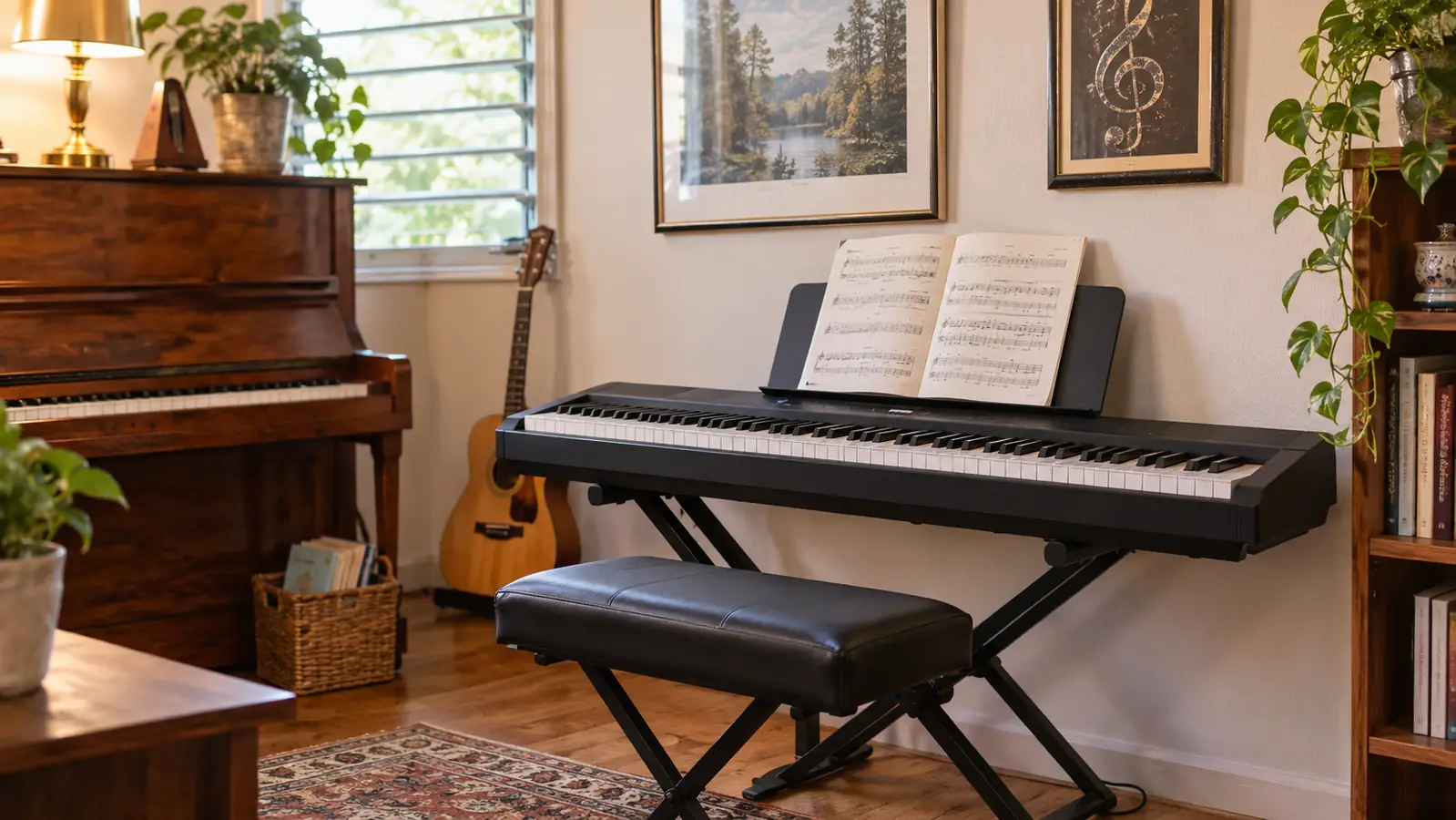
The old upright in my spare room goes out of tune about every four months. It belonged to my mother, so it stays, but Kaneohe air does what Kaneohe air does, and I got tired of paying a tuner to chase the drift. What I wanted was an instrument in that room I could sit down at on a Tuesday night without wondering whether the third octave had gone sharp since Sunday. That is the short version of how a Donner DDP-80 ended up against the wall.
I have played piano for close to sixty years, most of it in middle-school band rooms and church sanctuaries, and I am hard to impress. Three things matter to me. How the keys feel when I press them. Whether the sound fills a small room without turning glassy. And whether the thing still works a year later. Six months in, with my granddaughter Kaia practicing on it three afternoons a week and me on it most evenings, I have a clear answer. The Donner is a good piano for a home music room. It is not a great piano, and there are a few places where you feel the corners being cut.
The Quick Verdict
A genuinely weighted 88 key piano that has survived six months of a child's heavy hands and my Sunday service prep without a single failure. The speakers run out of air at the top and there is no bench in the box, but the action is the real thing.
Amazon Check Today's Price →The home piano that held its pitch through a Kaneohe summer
88 weighted keys, a triple pedal unit, and a USB-MIDI connection I use every week with students. Check the current listing before the configuration changes.
Amazon Check Today's Price on Amazon →How I've Used It
The piano sits in the spare room off the lanai, the one my wife Leilani calls the music room and everyone else calls the room with the piano in it. It is not big. Maybe ten feet by twelve. The old upright takes one wall and the Donner takes another, and I move between them depending on what I am doing. Sunday service music gets worked out on the upright first, because that is the instrument I will be sitting at on Sunday morning. Everything else happens on the digital piano: the arranging, the slow learning of a new gospel chord progression, and the thirty minutes after dinner when I am just playing and not working on anything.
A normal week is four or five evenings of thirty to forty five minutes, plus Sunday morning, plus Kaia on Tuesday, Wednesday and Thursday afternoons. She is nine and she is learning, which means her practice is not gentle. She plays the same eight bars until she gets them, and she plays them loud. If a keyboard is going to fail, that is usually what fails it. Repetition, heavy hands, and a child who has not learned to be careful yet. Six months of that is a real test, and it is the reason I waited this long to write anything down.
What I look for after six months is not the same thing I look for in the first week. In the first week I am checking the sound and the touch. After six months I am checking whether keys have gone loose, whether anything rattles when I hit a low octave hard, whether the pedals have started to creak, and whether I still want to sit down at it. On all of that the Donner has held up better than I expected. One key, the A below middle C, has a very slightly different feel on the return than it did back in the spring. You would only notice it if you play the same passage forty times in a row, which I do.
The Action Under Your Fingers
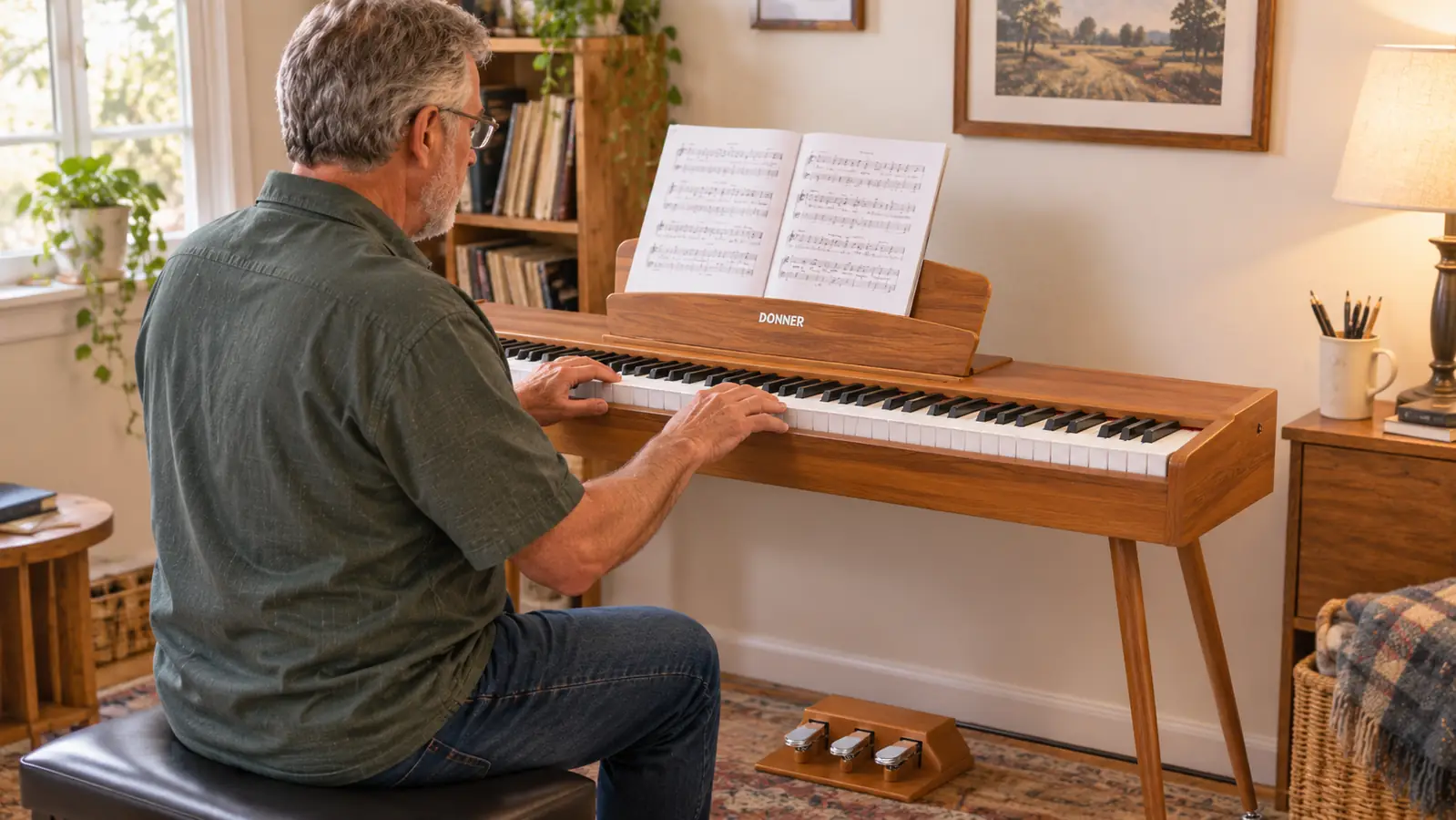
The selling point of this piano, and the reason I chose it over a lighter keyboard, is the weighted hammer action. The keys are full size, all 88 of them, and they push back. Not the way a folded spring pushes back, but the way a lever with weight behind it does. When I play a low octave with the left hand, I can feel the mass swing. That matters to me because I teach, and a student who learns on a light keyboard learns a touch that falls apart the first time they sit at an acoustic piano.
For Kaia it has been the right thing. She came off a small keyboard with unweighted keys and the first two weeks were hard on her hands. She was tired by the end of fifteen minutes. Then her fingers got stronger and her dynamics got better, and now she can play soft without the note disappearing underneath her, which she could not do before. That is the whole point of weighted keys for a beginner, and the Donner delivers it without asking a parent to think too hard about it.
It is not the same as the upright. The upright's action is heavier at the bottom of the stroke and lighter at the top, and there is a point about two thirds of the way down where it seems to help you. The Donner is more even than that, and slightly lighter overall. Fast repeated notes near the back of the key, close to the fallboard, are where I notice the difference most. It is not a problem, it is just not a grand piano, and nobody should expect one here. What it is, is close enough that switching between it and the upright does not wreck my hands for the week.
How It Sounds in a Small Room
Two speakers, twenty five watts each at maximum, and a stereo spread that is wider than a cabinet this size has any right to be. In a room this small it fills the space easily. I keep it around a third of the volume for practice and that is more than enough. Pushed all the way up in a ten by twelve room it is uncomfortably loud, which is a good sign. It means the piano is not straining to get there.
The sound is best in the middle. Gospel voicings with a lot of thirds and sevenths sitting in the middle register come out warm and round, and that is most of what I play. The top two octaves get a little thin and glassy if I lean on them, and the very bottom is not as rich as the upright's bass strings. You are hearing speakers, not a soundboard, and there is a ceiling on how much air a cabinet this size can move. Knowing that going in, the sound is good. Expecting it to sound like a concert grand is how people end up writing angry reviews.
The headphone jack is the small 3.5mm size, which surprised me. My good headphones have the big plug, so I bought an adapter and got on with it. Once I did, evening practice changed completely. I can play at nine at night with the house asleep and nobody hears a thing, and the sound through the headphones is actually fuller than through the speakers because both channels come straight to your ears. If you practice after everyone else has gone to bed, that jack is the most useful thing on the whole instrument.
Humidity, Dust, and Living on the Windward Side
This is the part I actually worried about. The room is off the lanai, which means it gets the trade wind and whatever moisture comes with it. My mother's upright needs a tuner every few months here. A digital piano does not go out of tune, but humidity is still hard on electronics and on anything with a keybed. I put the Donner on the wall furthest from the window and away from the door to the lanai, and I have not had a single issue. No stuck keys, no crackle in the speakers, no dead pedals, nothing that made me reach for a screwdriver.
It is 23.8 kg, so roughly fifty two pounds, and 59 inches wide. I moved it into the room myself, which I would not recommend doing alone on a staircase, but on one flat floor it is manageable. The depth is 16.9 inches and the height with the stand is 29.3 inches, which puts the keys at a comfortable height for me and slightly high for Kaia. She uses a cushion on the bench. There is no bench in the box, so plan for that before the piano arrives and you are playing standing up.
What I do monthly takes five minutes. I dust the keybed with a soft cloth, I check that the pedals still move freely, and I look at the corners of the cabinet where the finish meets the floor. Six months in, the cabinet still looks like it did on the day it arrived, and there is no swelling or lifting anywhere. I will say plainly that no cover came with it, and in this climate a cover would have been welcome. I bought a simple one separately. That is a small annoyance, not a defect.

The Pedals, the Stand, and What Comes in the Box
Three pedals, mounted in a single unit. I use the right hand one, the sustain, almost exclusively, and it does what it should. It holds the notes and it lets go cleanly when I lift my foot. The other two are there and I have tested them, but a church pianist playing gospel does not reach for them often. If you are working through Romantic repertoire you will care more than I do. The pedal unit does not slide around on the floor, which is more than I can say for the folded metal pedal I used on a keyboard years ago.
The music stand slots into the top and holds a thick hymnal without sagging, which is a low bar that a lot of home pianos somehow still fail. Assembly took me about forty minutes by myself, mostly because I did it slowly and read the sheet twice. The power adapter is included and the cable is long enough that I did not need an extension cord to reach the outlet behind the chair.
The USB-MIDI connection is the thing I did not expect to use and now use weekly. I run a cable from the piano to a laptop and the piano comes up as a MIDI device. It works with Windows and with Mac, and with the notation software and the recording software I have tried it with. For a teacher this is genuinely useful. I can have a student play and watch the notes land on the screen, which is a faster way to show someone they are rushing the second beat than anything I can say out loud in the moment.
Six months, forty something Sunday services, and a nine-year-old's three-afternoon-a-week practice schedule. I have not had to open the door for a tuner since it arrived.
What I Liked
- Full size weighted hammer action that holds up to a child's heavy hands
- 88 keys, all full size, close enough to an upright that switching between them is easy
- Stereo speakers that comfortably fill a small room at a third of the volume
- Triple pedal unit that stays put and releases cleanly
- USB-MIDI into a laptop for teaching and recording
- Six months in a humid room with no stuck keys, rattles or dead pedals
Where It Falls Short
- Headphone jack is 3.5mm, so most studio headphones need an adapter
- Top two octaves thin out noticeably when pushed
- Bass is not as rich as an acoustic upright's low strings
- No bench and no dust cover included, both worth buying separately
Who This Is For
This is the right piano for an adult coming back to playing after twenty years away, for a parent putting a child in lessons without clearing a wall for an acoustic, and for anyone playing in a small room where volume and neighbors are a real consideration. It suits a church pianist who wants something at home that feels close enough to the sanctuary instrument to keep the hands honest. It suits a humid house, because there is nothing to tune. And it suits a teacher, because the USB-MIDI connection turns practice into something a student can see instead of just hear.
Who Should Skip It
Skip it if you are playing out, in a hall or with a band, where twenty five watts per side will not carry past the drums. Skip it if your ear is set on the resonance of real strings, because no cabinet this size will give you that and you will be unhappy no matter how good the samples are. Skip it if your daily practice is heavy Romantic repertoire with a lot of pedaling nuance, since the two outer pedals are not where this instrument spends its effort. And skip it if you want a furniture piece with a bench and a cover in the same box, because you will be shopping for both the same week. For everybody else, the Donner DDP-80 is a sensible answer to a small, humid room and a tired upright.
If your spare room is humid and your upright is tired, start here
Weighted 88 keys, a triple pedal, and no tuner to call. Six months of daily use on this one and I would buy it again for the same room.
Amazon See the Donner DDP-80 on Amazon →