
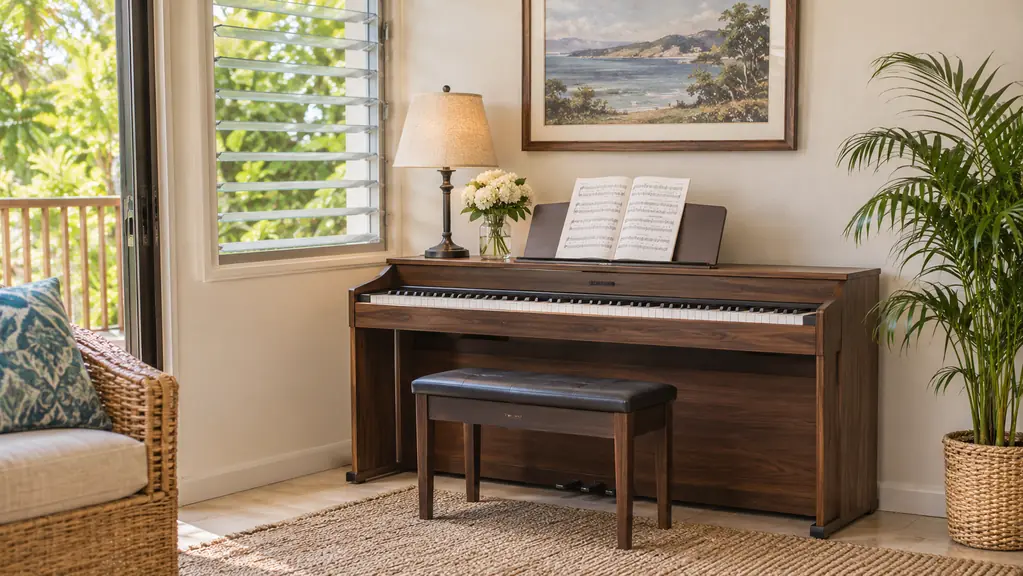
Short answer first, because that is what you came here for. If the piano is going to live in one room and be played most days, I would put the Donner DDP-80 in that room and not think about it again. If the piano has to leave the house, the Yamaha P71 wins that argument without much of a fight. Those are two different jobs, and most buyers only find out which job they have about three months after the boxes arrive.
I am 63 and retired from teaching middle-school music. I play piano for the Sunday service at my church here in Kaneohe, and I keep a small music room in the spare space off the lanai. The Donner has sat in that room through a wet winter and a dry summer, and I have played the Yamaha P71 at students' houses and on the church youth-room table often enough to know exactly what it is. Nobody is paying me to say either of those things, my mother's old upright is still in the front room waiting on a tuner, and I have no interest in pretending a digital piano replaces a real one. It does not. It replaces the hours you would otherwise not practice.
| Donner DDP-80 | Yamaha P71 | |
|---|---|---|
| Key action | 88 full-weighted hammer-action keys. Genuinely heavy under the finger and even from the first key to the last. | Yamaha's graded hammer action, heavier at the low end, and the more refined touch of the two. |
| Pedals | Triple pedal unit included and mounted to the stand, so soft and sustain sit where a pianist's foot expects them. | One sustain pedal that lives on the floor and slides around. |
| Stand and cabinet | Built as furniture. 59 inches wide, 16.9 inches deep, 29.3 inches tall, wood-finish cabinet, music stand included. | A slab. You supply a table, an X-stand, or a stand sold separately. |
| Sound output | Two 25W stereo speakers, enough to fill a living room and be heard over a small congregation. | Built-in speakers that are honest in a bedroom and thin in a hall. |
| Polyphony | 128 notes, so a pedal-washed chord at the end of a hymn holds together. | 64 notes, which is fine until you lean on the sustain. |
| Moving it | 23.8 kg assembled as furniture. Two people and a planned route. | Light and slim enough for one person to carry out to a car. |
| Quiet practice | 3.5mm headphone jack for late nights. | Headphone jack, standard fit. |
| Recording to a computer | USB-MIDI, so it talks to a DAW for MIDI editing and recording. | A USB connection to a computer. |
| Best for | A permanent corner in a home where somebody practices daily. | A student or gigging player whose keyboard has to travel. |
Where the Donner DDP-80 Wins
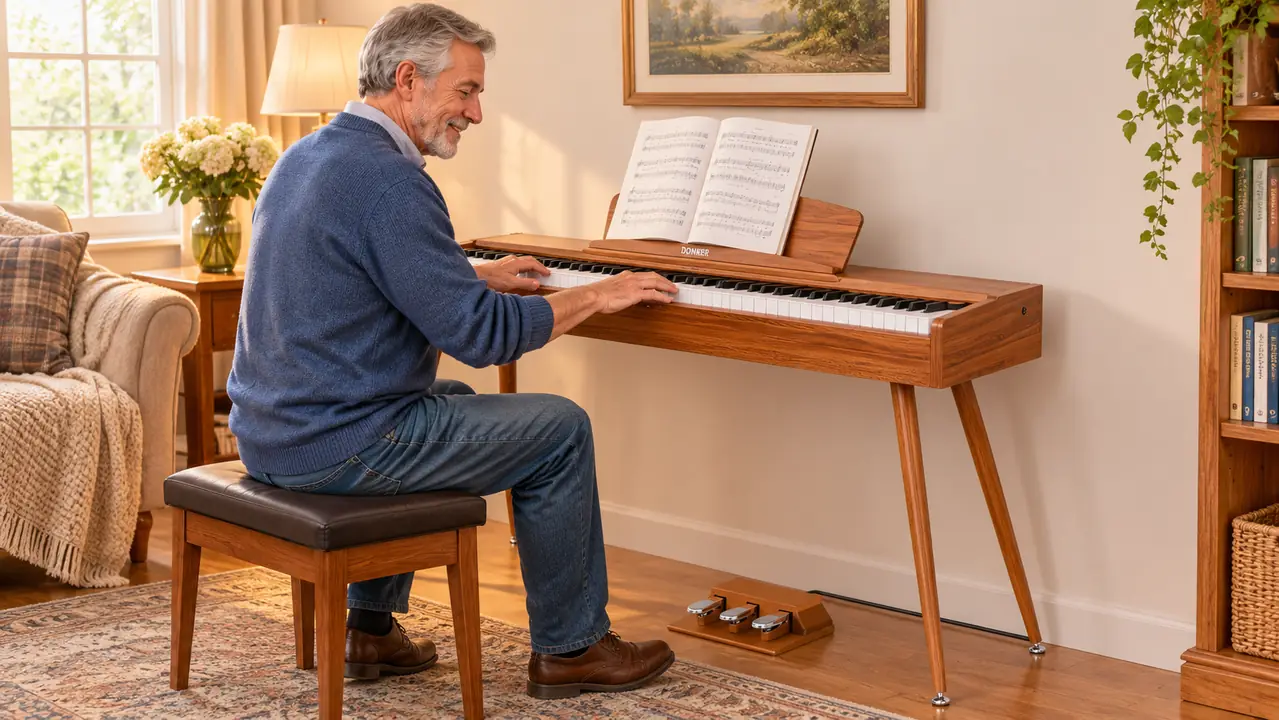
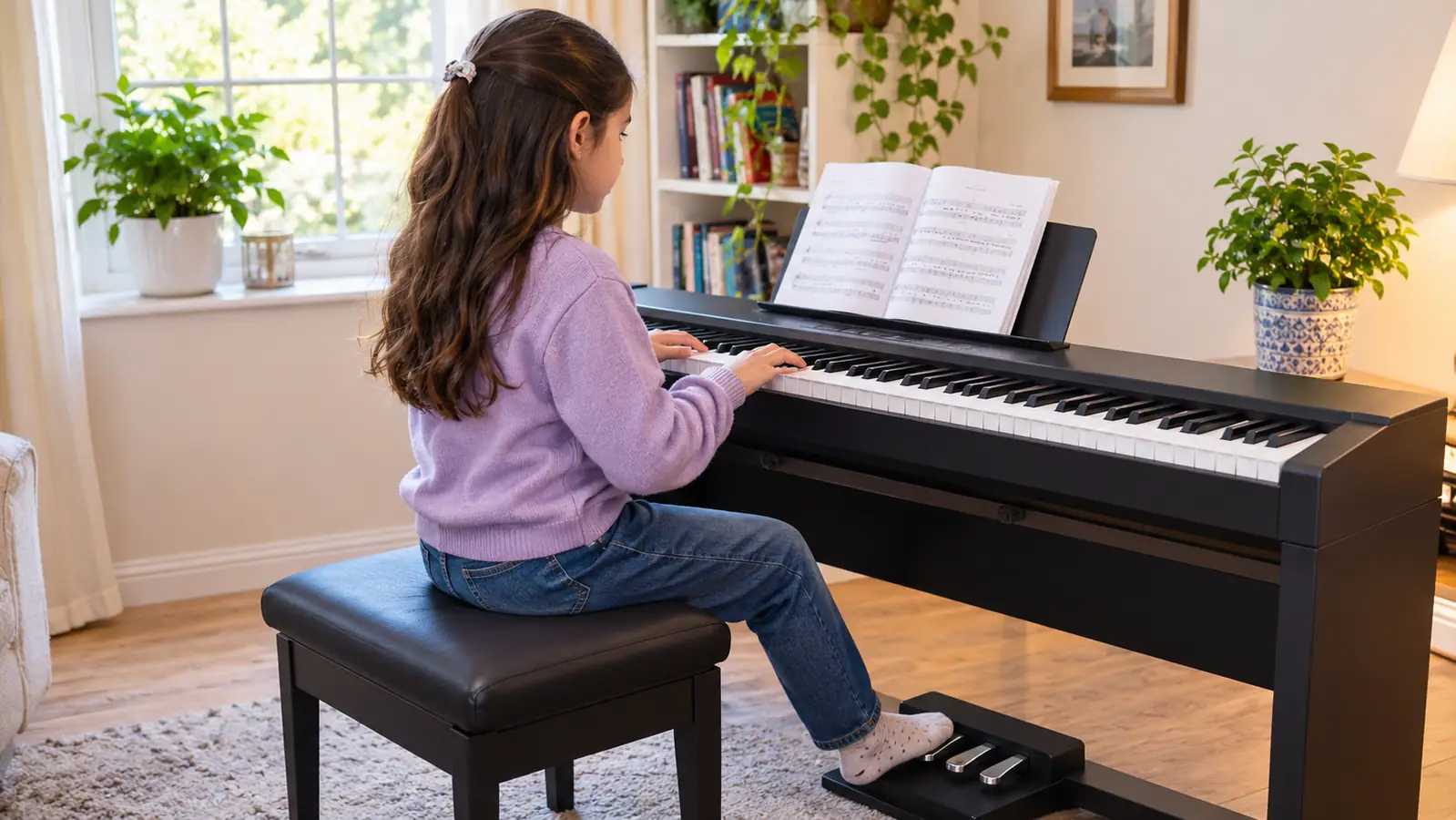
The first thing the Donner gets right is the thing you cannot bolt on later. It stands up. Fifty-nine inches wide, 16.9 inches deep, 29.3 inches tall, and 23.8 kg of it, which means when my granddaughter Kaia sits down to practice, her feet reach the pedals and her forearms sit roughly level with the keys. I have watched too many beginners learn on a keyboard perched on a folding stand, hunched forward with their wrists cocked, and then spend a year unlearning the posture. A console at furniture height fixes that before the first lesson. You are not buying a cabinet for looks. You are buying the seated position, and the seated position is most of what a beginner is actually learning.
Then there is the pedal, and this is the difference I would argue about in a parking lot. The triple pedal ships in the box and mounts to the stand, so the soft pedal and the sustain pedal sit left to right under the right foot exactly where a piano student expects to find them. The Yamaha gives you one sustain pedal that lives on the floor and wanders two inches every time you use it. For gospel playing, where I am on and off the sustain constantly and I want the soft pedal for the quiet verses, that is not a small convenience. It is the instrument teaching the correct habit instead of the approximate one.
And the rest of the Donner spec sheet lines up for a room rather than a road case. Two 25W stereo speakers. 128 notes of polyphony. A 3.5mm headphone jack for the ten o'clock practice session when everyone else in the house is asleep. USB-MIDI so that when a student gets curious about recording, the piano already speaks to the computer. None of it is exotic. All of it is the stuff you end up buying separately, badly, if you start with a slab.
Where the Yamaha P71 Wins
Now the part that stings. The Yamaha P71 has the better keybed, and anyone who tells you otherwise is selling something. It uses a graded hammer action, and graded is the right word, because the bottom of the keyboard is heavier than the top the way an acoustic is, and the keys come back up a touch quicker. The Donner is weighted, genuinely weighted, but it is weighted more evenly across the range and it feels a shade slower on the return. On a hymn at a Sunday tempo you would never notice. On a fast repeated-note passage, or a Bach invention at a lesson tempo, you would notice, and so would your teacher.
The other thing the P71 wins is that it leaves the house. It is a slab. It goes under an arm, into a back seat, into a lesson, into the church hall, onto a friend's table for a Christmas party. A 23.8 kg cabinet piano does not do any of that, and mine is not moving off its spot unless two of us plan the route first. There is also a real advantage in not paying for furniture you do not want. If you already own a decent stand, or you are renting a room and will move twice in the next two years, the P71 is the smarter object to own. It is not the better piano. It is the better decision for a moving life.
The Yamaha travels better. The Donner is the one that stays home and plays better there.
If the piano has a permanent corner, the DDP-80 gives you the cabinet, the triple pedal and two 25W speakers without buying a stand on top of it. Check today's price and what is currently in the box.
Amazon Check the Donner DDP-80 on Amazon →What the Weighted Action Actually Feels Like Under the Fingers
Here is what weighted keys mean when you are the one practicing at nine in the evening. The key resists you. You have to bring the arm, not just the finger, to get a forte out of it, and the note keeps sounding for as long as the string would. That resistance is the whole point. It is what builds the hand a student needs when they eventually sit down at my mother's upright and find that nothing happens unless they mean it. The Donner does this. The keys have heft, they come back, and after an hour your forearms know they have been working.
Where it differs from the Yamaha is refinement rather than honesty. The graded weighting on the P71 means the bass register pushes back harder than the treble, which is a closer copy of a real action, and the keys return fast enough that quick repeated notes do not fight you. The Donner is even across the 88 keys and a hair slower on the rebound. For scale practice, chord work, hymns, reading, and the first three years of study, that gap will not limit anyone. For a student heading toward conservatory auditions, it eventually will, and by then they should be practicing on something else anyway.
One thing I will say for the Donner that has nothing to do with specs. Because the action is mechanical, it feels the same at a whisper as it does at full volume. Beginners on cheaper keyboards learn to control loudness with the volume knob instead of with their hands, and that habit is hard to break. Set the Donner low at night and the touch is still the touch. You are learning the same thing at ten at night as you learned at noon.
The pedal is where beginners cheat, and the Donner is the only one of these two that puts all three pedals under the right foot where a pianist expects to find them.
Sound in a Small Room, and the Humid Air Problem
My music room is roughly ten feet by twelve with a louvered window and a ceiling fan. Two 25W speakers in that space is more than I need. I keep the volume around a third for practice and I have never pushed it past halfway for the family, and the tone stays clean at the bottom of that range, which is where cheap digital pianos usually give themselves away with a buzzy, papery bass. If you are playing for a small church service without a sound system, the Donner will carry. It is not a stage piano and I would not ask it to be one, but it will fill a fellowship hall.
The polyphony matters more than the speaker wattage for the way beginners actually play. 128 notes means you can hold the sustain through a full pedal wash and the earlier notes keep ringing instead of being cut off one at a time from the bottom up. The P71 gives you 64, which is fine until you play a big rolled chord with the pedal down and hear the first notes drop out. Most people never hit that ceiling. A church pianist playing four-part gospel will, and the 128 on the Donner is the reason I stopped worrying about it.
Then there is the island air, which is the thing nobody warns you about. My mother's upright goes out of tune twice as fast in the wet months, and that is a tuner's bill every time. The digital does not care about humidity in the same way, but the cabinet is still furniture and I keep it off the exterior wall and away from the window where the rain blows in. That is not a Donner problem. It is a Kaneohe problem. If you live anywhere damp, treat a cabinet piano like a wooden table, not like a guitar case you can leave on the lanai.
The Stand and Triple Pedal Question
Be clear about what arrives in the Donner box, because this is where people get surprised. You get the piano, the music stand, the triple pedal and the power adapter. You do not get a bench. Budget for one, and buy a bench that puts you at the right height, because a dining chair on a rug will undo the whole point of a console piano. The 3.5mm headphone jack is the small size, so if you own big studio headphones you will want an adapter, and if you are plugging into a computer you will use the USB-MIDI connection rather than an audio cable.
The Yamaha is the opposite arrangement. It is a slab, so the stand is a separate decision and a separate purchase, and the pedal is a single sustain unit on the floor. If you are handy and you like choosing your own furniture, that is freedom. If you are buying for a nine-year-old and you want the piano to be one object in the corner rather than three objects, the Donner's integrated stand and mounted pedals are the reason the whole thing feels like an instrument instead of a setup.
Who Should Buy Which
Buy the Donner DDP-80 if the piano has a room and is staying in it. Buy it if a beginner lives in your house and you want them at the correct height with three pedals from the first week. Buy it if you play for a small church, if you practice at night with headphones, or if you want the piano to look like it belongs against the wall rather than like a piece of audio equipment on a stand. Buy it if you would rather make one decision about a stand and a pedal unit and never think about either again. In my house it earned its corner.
Buy the Yamaha P71 if the keyboard has to move, if you are renting, if you already own a good stand, or if touch is the one thing you refuse to compromise on and you accept a single pedal to get it. Buy it if the player is past the beginner stage and notices the difference in the action, or if you are buying for a student who will carry it to lessons. It is a fine instrument. It is just not a piece of furniture, and pretending otherwise leads to a wobbly stand and a sliding pedal and a beginner learning bad habits. Decide which of those two lives you actually have, then buy accordingly.
If the piano is staying in one room, buy the one built to stay in one room.
88 weighted keys, a triple pedal mounted on the stand, two 25W speakers and USB-MIDI for when she wants to record. It is the one I would put in my own music room again.
Amazon See today's price on the Donner DDP-80 →