

Twenty-two years in a middle-school band room taught me the same lesson every September. The instrument that gets practiced is the one that is already in tune and already five steps away. Everything else is furniture with good intentions. My mother's upright lives in the spare room off the lanai, and between the island humidity and the one tuner in Kaneohe who still makes house calls, that piano sits quiet more weeks of the year than I care to admit. So the question stopped being which piano sounds better in a perfect room and became which piano actually gets played in mine.
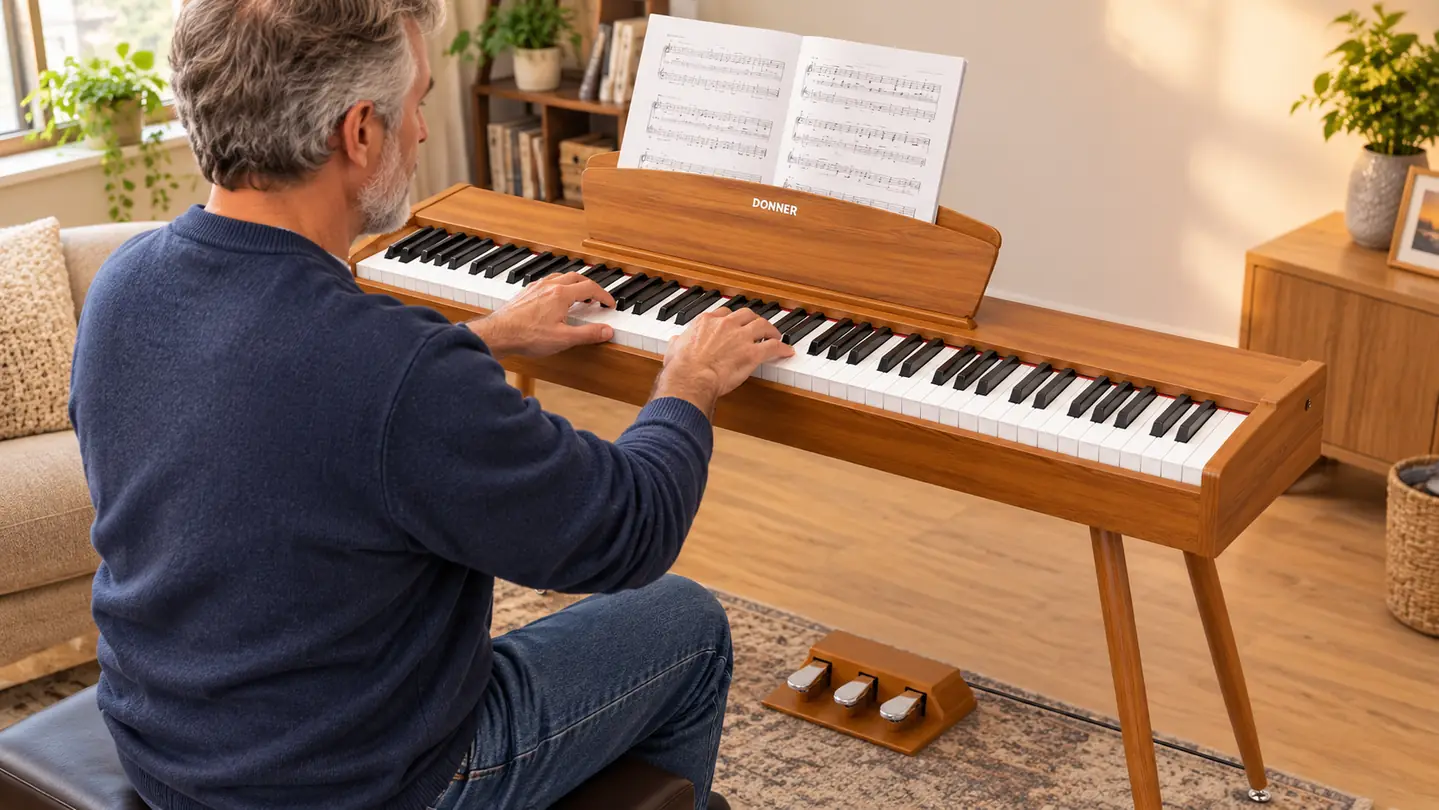
That is where the Donner DDP-80 came in. It is an 88 key digital piano with a full-weighted hammer action, a triple pedal, two stereo speakers and a music stand in the box. Nothing about it needs a technician to stay in tune. I am not going to sit here and tell you it replaces a good acoustic on a concert stage, because it does not, and anybody who says otherwise has not played both. What I will tell you is that it wins the upkeep argument in a house, and here are ten reasons why, in the order they mattered to me.
An 88 key piano that never needs a tuning visit
Full-weighted hammer action, three pedals, stereo speakers and a music stand, all in one box. The Donner DDP-80 arrives ready to play and stays that way through the humidity.
Amazon See the Donner DDP-80 on Amazon →No tuning appointment on the calendar
An acoustic does not drift because it is badly built. It drifts because wood and felt move with the air, and on the windward side of this island the air does whatever it wants. My mother's upright wants a tuning every time the trade winds shift. A digital piano holds its pitch because there are no strings to stretch and no soundboard to swell. The tuner's number is still on my refrigerator and I have not had to use it once. That sounds like a small thing until you count the weeks your acoustic sits sour and you practice less because of it.
Practice at nine at night without a single complaint
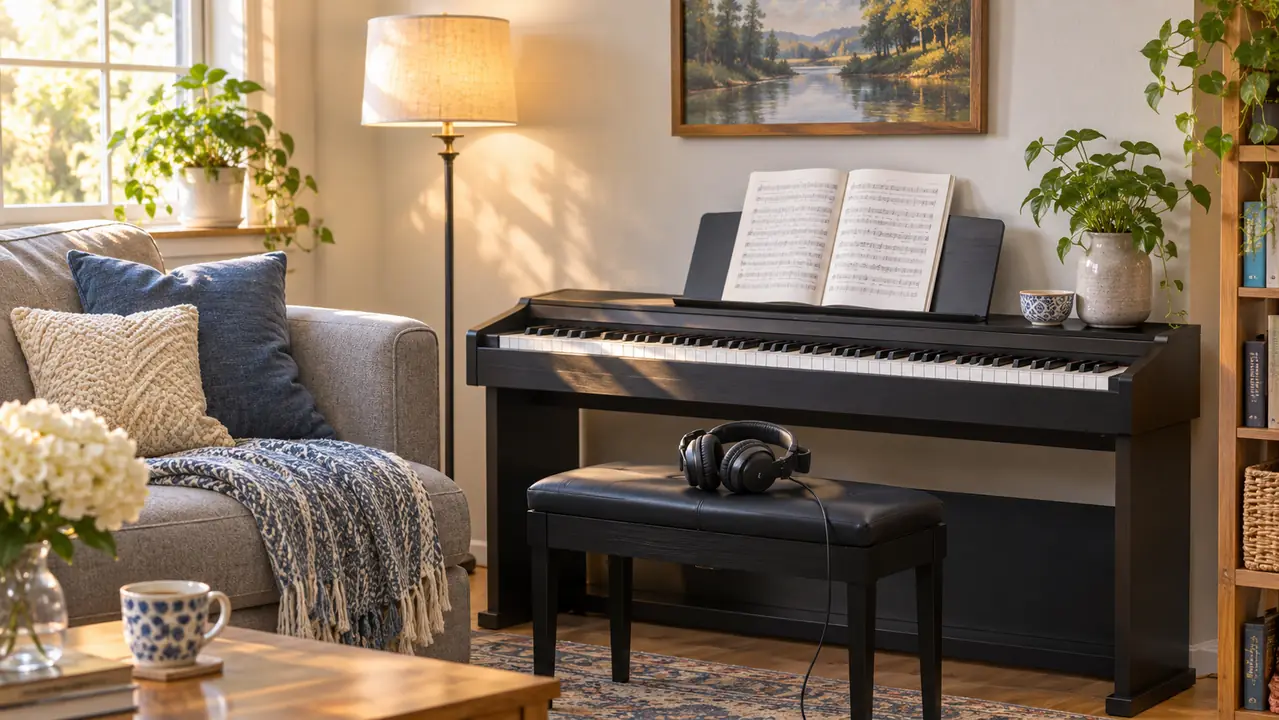
Headphones go into the 3.5mm jack and the room goes quiet except for the keys under your fingers. When Kaia is over and it is past her bedtime but she wants to finish one more run through a piece, this is the difference between a fight and a lesson. My neighbors are close on both sides. Leilani reads in the next room. In four months nobody has asked me to stop playing, and that was never true of the upright.
Weighted keys build habits that transfer to a real piano
88 keys, full-weighted heavy hammer action. That phrase is worth more to a beginner than every other line on the product page combined. A springy keyboard lets a kid get away with pressing from the wrist, and then a real piano punishes her for it two years later. Weighted keys ask for arm weight and let the key come back up on its own. I watched Kaia's hand position settle within a month of practicing here instead of on the light keyboard at her house. That is the whole ballgame.
Three pedals and 128 notes of polyphony
The Donner has a triple pedal, the same layout a student meets on an acoustic, which matters the moment a piece calls for pedal work and she has nowhere to put her foot. Under the hood, 128 max polyphony means the sustained notes do not get chopped off when you pedal through a big chord. Older budget digitals cut you off in the middle of a gospel run and you hear the top notes vanish. You will not hear that here, even with the sustain held down through a full verse.
It fits in a room you already have
59 inches wide, 16.9 inches deep, 29.3 inches high. Those are furniture numbers, not stage-rig numbers. It went into the same small room off the lanai where the upright sits, and there is still floor to walk around on both sides. Depth is what kills you in an island house, not width. Measure your wall tonight and you will know for certain instead of guessing, which is more than I could say before I bought anything.
One person can move it without a piano mover
23.8 kg is about 52 pounds. I am 63 years old and I slid it across the room myself with a furniture dolly and no help from anybody. Try that with an upright, which then has to be tuned again once it settles into its new corner. When we rearranged the room before Christmas, the digital piano moved in ten minutes and was still in tune that evening. The upright would have cost me a phone call and a two-week wait.
Your grandchild learns on the same keyboard you play
88 full-size keys. This is the single reason I stopped shopping for 61 key instruments. A nine year old learning on a shortened board learns the notes in the middle and almost nothing else, then freezes at the top and bottom of a piece. Here she has the whole span, the same as the church piano on Sunday, the same as the upright in the corner. When she sits down at either one, her hands already know where they are. That is not a feature you can add later.
It talks to a computer when you want it to
USB-MIDI out, and it works with MIDI editors and DAWs on Windows or Mac. I am not a recording person and I doubt I ever will be. But a student who wants to slow a passage down, or a teacher who wants to see exactly what a kid played instead of what she said she played, gets all of that with one cable. No interface box, no extra gear to buy and lose. It is there when you need it and invisible when you do not.
Speakers sized honestly for a living room
Two stereo speakers at 2x25W maximum power. In a small room that is plenty, and the sound fills the space without the boxiness I braced for. Sunday gospel arrangements sound full and warm at low volume, which is how I play on a weekday afternoon. I keep it quiet while Leilani reads in the next room and it still carries through the doorway. If you want to fill a hall, use the jack and an amp. For a house, this is the right size.
Everything you need arrives in the same box
Music stand, triple pedal, power adapter. You do not get home and discover that the pedals were sold separately, which is a real thing that happens with budget digitals and it is maddening. The one item I would add is a bench, and the metronome on your phone covers the rest. That is a short shopping list compared with what an acoustic demands: tuner, humidity control, mover, and a spot in the room that never changes.
What I'd Skip
Skip any 61 key keyboard you were considering for a learner, no matter how good the sounds are. She will outgrow the range in a year and the action will teach her habits you will pay to unlearn. Skip the instruments advertised on the number of voices and rhythms instead of the key action, because the action is the one part you cannot upgrade later. And skip the idea that you need both a digital and an acoustic in the house. If the acoustic is going to sit untuned for half the year the way mine does, then one piano that gets played every day beats two that get dusted. That is the honest math.
The key action is the one part you cannot upgrade later. Buy the weighted keys and skip everything else that is trying to impress you.
The instrument that gets played is the one that stays in tune
88 full-weighted keys, three pedals, two stereo speakers and a music stand in the box. The Donner DDP-80 is the home piano that does not ask you to schedule a technician twice a year.
Amazon See the Donner DDP-80 on Amazon →