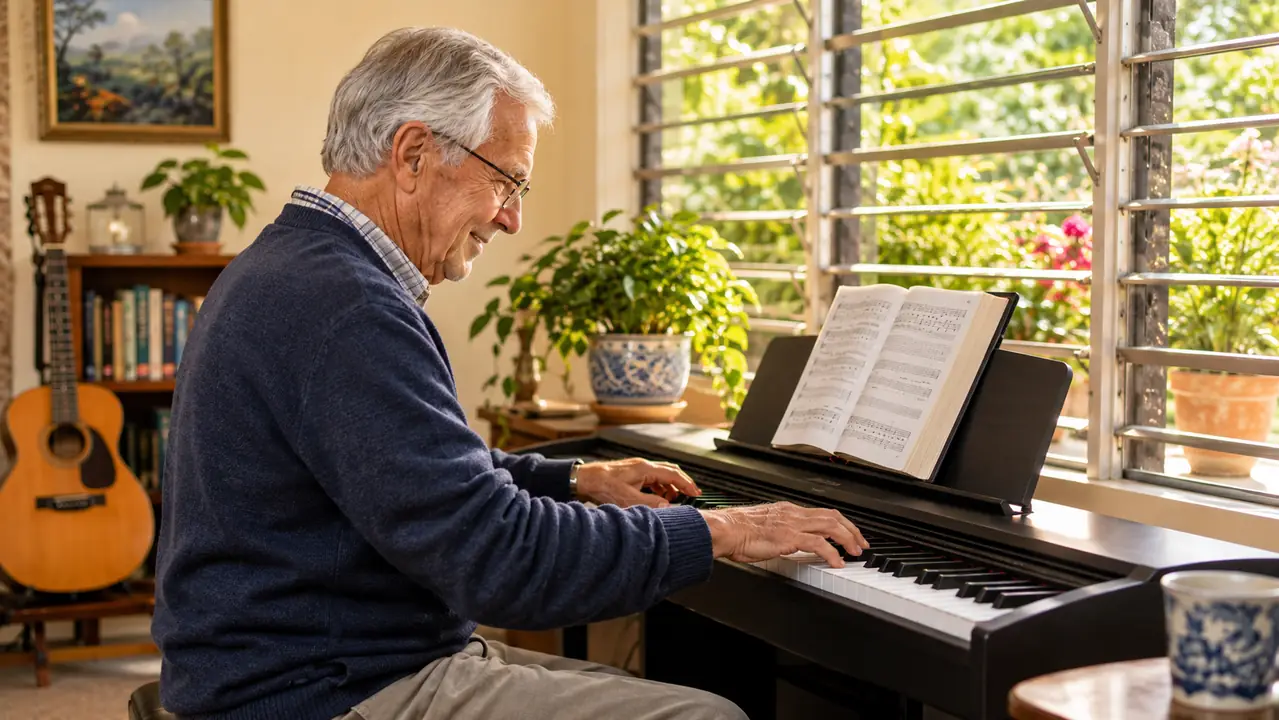
Sunday morning is not a recital. Nobody in the pews is listening for a wrong note in the tenor line. They are listening to find out whether they can sing, and that job is harder than it looks. Hymn playing seems simple from the third row: four parts, a tune everyone already knows, a steady beat. Then you sit down with sixty people waiting and find that the notes were never the hard part. Steadiness is. Rush the third line and the congregation rushes with you. Drag and they drag, and by the last verse everyone is tired and nobody can say why.
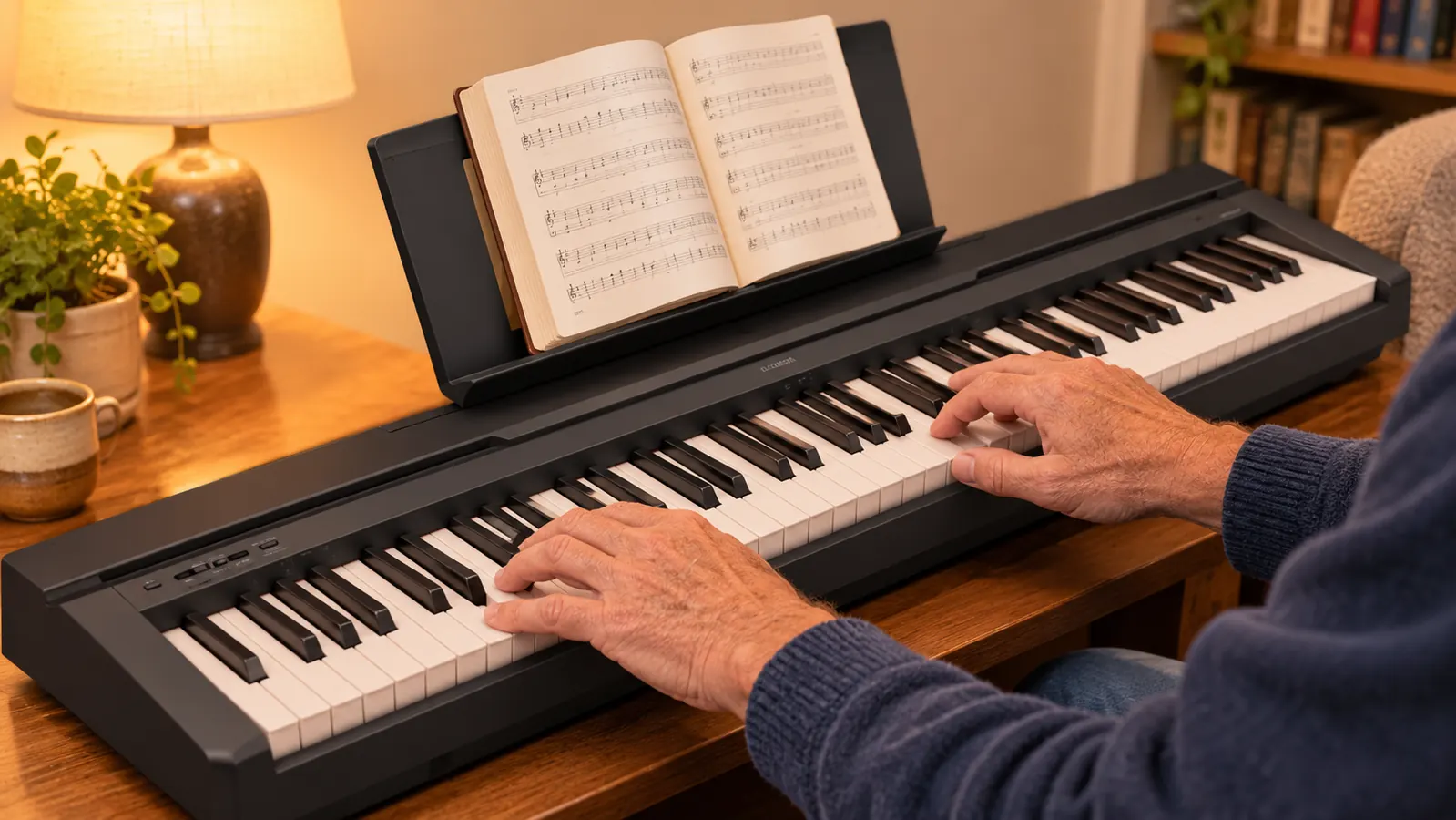
I have played for the Sunday service at my church in Kaneohe for years, on my mother's old upright at home and on whatever keyboard the church had that month. The instrument matters more than people expect, and not for the reasons the spec sheets push. It is not how many sounds it has. It is whether the keys push back when you press them, so you can lean into the soprano line without pounding the whole chord. That is why I ended up doing my hymn practice on the YAMAHA P71: 88 weighted keys, touch sensitivity, a grand piano voice that holds up in a small room, and a front panel simple enough that I never think about it while the pastor is announcing the next song.
Before this I tried the obvious shortcuts. A short board with a light action that slid around on the pew, which taught me nothing about touch. A tablet showing chord shapes, which was fine for learning a tune and useless for learning a hymn. And the old upright, which is the right instrument and also the one that needs tuning every time the weather turns. What I wanted sat in between: real keys I could practice dynamics on, small enough for the spare room, quiet enough for late nights.
The one I practice hymns on, in a room about the size of yours
88 weighted keys, 10 voices, and a sustain pedal in the box. It fills a living room without an amplifier, and it goes quiet the moment you plug in headphones.
Amazon Check Today's Price on Amazon →Step 1: Choose one voice and then leave the panel alone
The P71 lists 10 voices and a one-button operation, which is not an invitation to explore mid-service. For congregational singing you want one sound, the acoustic piano, and you want to stop thinking about it before the first verse starts. The grand piano voice has enough weight in the low end to carry a bass line and enough clarity up top that the melody reads through a room full of people singing.
The other voices earn their keep around the service rather than during it. The prelude before the call to worship, the quiet stretch while the offering plate goes around, the minute or two before the pastor stands up. That is where Dual Mode is useful: you can layer two voices, piano and strings being the obvious pair, and get a wider, softer bed under the room without playing any louder. I use it for the prelude, then I turn it off. A hymn with strings under it sounds like a wedding. A hymn with strings under it for four verses sounds like a mistake.
The 88 keys matter for a reason that has nothing to do with showy repertoire. Hymnals get arranged, and arrangements wander. A last verse lifted a step puts you at the top of the page; a bass line written low needs keys below the staff. On a shorter keyboard you start doing arithmetic in your head, shifting octaves mid-verse, and the congregation hears you thinking. Full range means you can play what is printed.
Step 2: Learn the hymn in four parts, bass first
Pianists who come to hymns from pop or from solo repertoire tend to read the top line and fill chords in underneath. That works until verse two, when the altos and tenors need something to sing and you hand them a mush of thirds. A hymnal is four separate voices stacked on two staves. The quickest way in is to stop reading it as a chord chart.
Start with the bass alone, in octaves if that helps you hear it, until you know where it steps and where it holds. The bass is what the congregation's ear trusts. If it wobbles, everything above it wobbles, and no amount of pretty voicing in the middle will cover for it. Then add the soprano, the line they are actually singing, and play those two outer voices together for a while. Only after that put the alto and tenor in between. What you are building is a hand that knows which finger carries the tune and which fingers stay quiet under it.
Sing each part before you play it. I make my students do this and they hate it and it works. When you can sing the alto line, your fingers find it, and you stop needing to look at the page to know whether the chord is complete.
This is also where weighted keys stop being a specification and start being useful. When the action has some resistance, the gap between a melody note at a comfortable level and the same note pushed harder is something your hand can feel and control. On a light, springy keyboard the same gesture makes almost the same volume, so you end up either buried or banging. The YAMAHA's touch-sensitive keys give you somewhere to live in between.
Step 3: Set a tempo the congregation can walk on
Pick a tempo before the first note and then refuse to change it. Not the tempo you can play it at. The tempo they can sing it at. Those are two different numbers, and the gap between them is where most service playing falls apart.
Practically, that means counting. Most hymns sit at a walking pace, roughly what you would hum while carrying something across a room. Sing the text in your head while you play, because the words set the pace and the syllables tell you when the next chord has to arrive. Four syllables on one beat means that beat waits for all four. A phrase that runs straight into the next one does not get a breath you invented.
Keep your hands off the tempo for the first three verses. A tiny ritard at the end of verse two feels expressive to the player and confusing to a room of people who are not watching your hands. Save the small lift for the last verse, where everyone expects it, and keep even that small. Lifting the final verse by a step is a fine old habit, but only if you have practiced the new key at home. Finding it in real time is how a service ends badly.
One habit helps more than any of this: play for the singing and not for the room. The moment you start listening to yourself the way a recital audience would, the tempo starts following your taste instead of their breath.
The bass is what the congregation's ear trusts. If it wobbles, everything above it wobbles, and no amount of pretty voicing in the middle will cover for it.
Step 4: Shape the line with your hands and the pedal
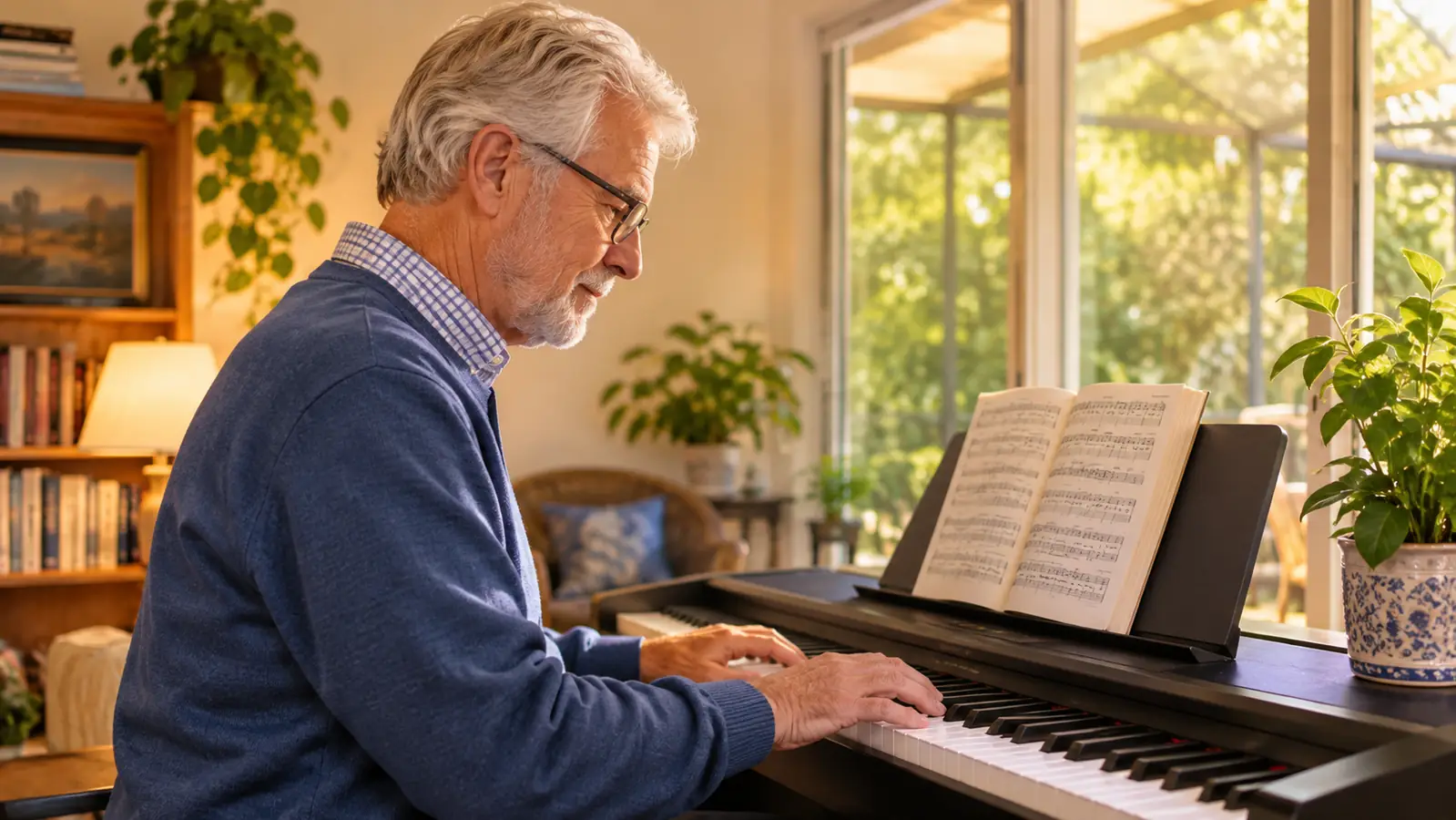
Dynamics in hymn playing are not really about loud and soft. They are about which line is on top this verse. Verse one usually wants clean, even four parts. Verse three often wants the melody carried a little harder, because the room has thinned out and people need help finding it. That is a hand skill, not a knob, and it is the reason I care about the action more than about the sound engine.
The pedal is the other half of it. Sustain through each chord, lift between chords, and never let two different harmonies ring together. Hymns change chord on the beat, so that means a lot of small, quick lifts, and it is worth practicing slowly until your foot does it without being asked. The sustain pedal comes in the box with the P71, which sounds like a small thing until you have played a Sunday on a keyboard where it was sold separately and nobody told you.
Weighted keys are not automatically comfortable. They are tiring for the first week or two if you have been playing on a light synth action. Give yourself short sessions and expect your forearms to notice. After that the keys stop feeling heavy and start feeling like information, and you can tell the difference between playing firmly and playing loudly.
A word about the built-in speakers in a small room: they are honest. They do not flatter a sloppy voicing. If the alto is too loud, you hear it, which is irritating for a week and useful for a year. It trains your hand the way a plain acoustic piano does, and it means you never have to set up an amplifier just to practice.
Step 5: Practice where nobody is listening, then move it
The good practice hours in my house are after Leilani has gone to bed, so the 3.5mm headphone jack is the feature I use most. Plug in a set of headphones and the speakers go quiet, and you can work a difficult alto line at eleven at night without being a nuisance to anyone.
The rest of the time it lives in the small spare room off the lanai, on a stand. At 52.25 inches wide and 11.5 inches deep it does not eat the room, and at 25 pounds I can carry it out to the car by myself when the service needs it, no help and no case with wheels. Humid island air is hard on instruments, so I keep it out of the direct damp coming off the lanai and covered when it is not being played, the same way I look after my mother's old upright.
There is one more use in this house. Duo Mode splits the keyboard so two people can sit at it, one on each half. My granddaughter Kaia is nine and learning, and being able to sit beside her at the same instrument without our hands colliding is worth more than I expected. She takes the melody on her side, I take the bass on mine, and for a few minutes a hymn sounds like a duet instead of a lesson.
What Else Helps
A few things that are not about the instrument at all. Get the bench height right, because your whole touch changes when your wrists sit above the keys instead of below them. Count out loud when you practice, even badly, because the beat is the job. Work from the actual hymnal rather than a chord chart, since the four parts are already written for you and the arranger did that work on purpose. Warm up on a verse you know cold before you attack the one you do not.
Learn to transpose. Not for glory, for the room. Some congregations cannot reach the printed key at eight in the morning, and a hymn that sits too high for the people singing it will thin out by verse three no matter how well you play it. Pick one hymn a week and move it down a whole step, then play it there until it feels like the original.
If you are still deciding, it is worth reading how this YAMAHA holds up over months of daily use before you commit, and worth ten minutes on how it compares with a cheaper 88-key option. Neither decision should be made from a spec sheet, mine included.
If the hymns are the reason you play, this is the one to practice on
88 weighted keys, 10 voices, a sustain pedal and power supply in the box, 25 pounds when you have to move it. Nothing on it gets between you and the singing.
Amazon Check Today's Price on Amazon →