
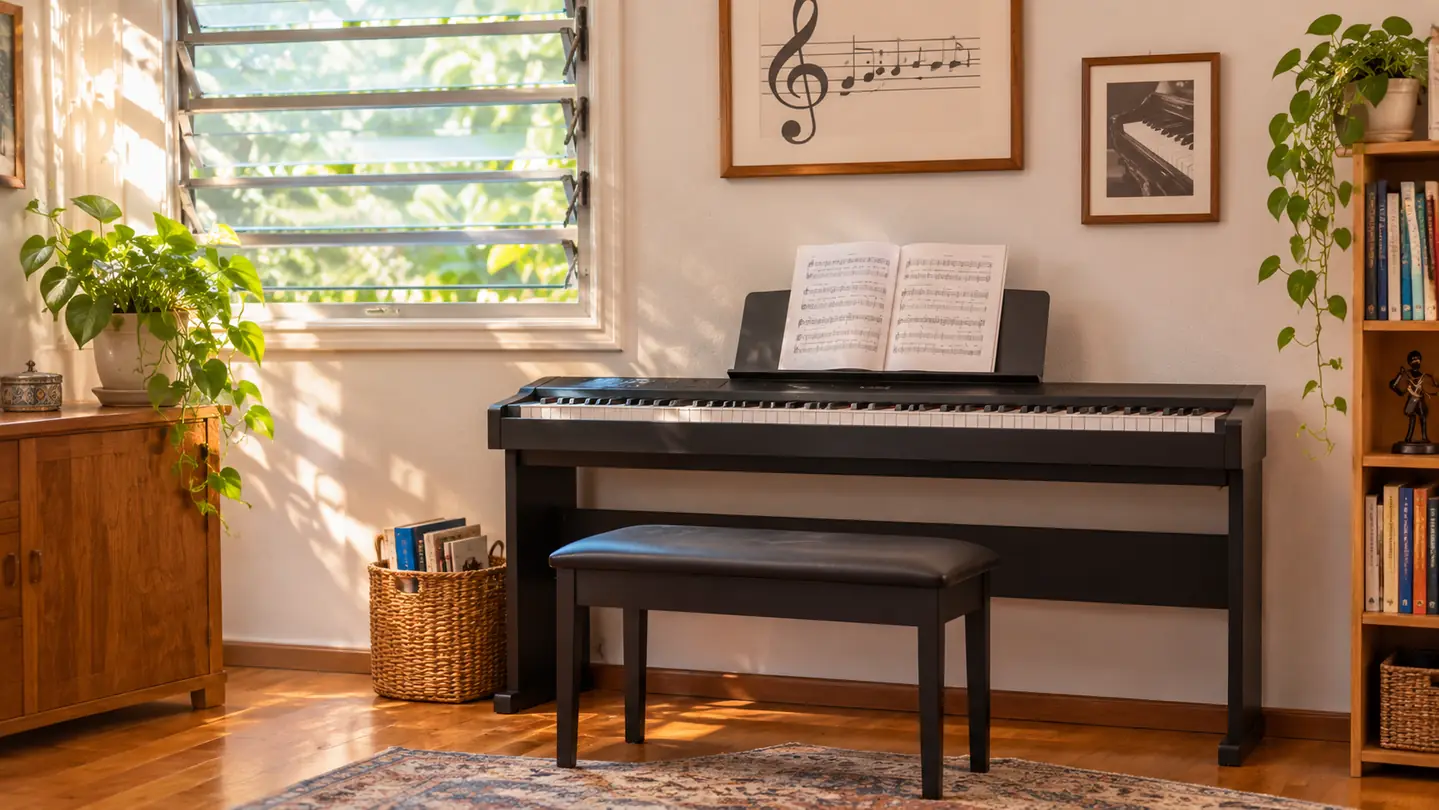
Here is the part of a Donner DDP-80 review that most pages skip. The piano is not the hard part. The hard part is being honest with yourself about what you actually need. I taught middle-school music for thirty-one years, and I have watched a lot of families buy an instrument for the wrong reason. They buy for the photograph in their head: the kid at the bench, the music open, the living room quiet and warm. Then the reality shows up. The kid practices for eleven minutes. Somebody has to dust it. Somebody has to book a tuning. I have an old upright that belonged to my mother sitting in my music room right now, and it needs a tuning. I have been saying that since March. So when my granddaughter Kaia, who is nine, asked to learn, I did not go looking for a second acoustic. I went looking for something that could live in a small room off the lanai without fighting the island air. That search ended with the Donner DDP-80.
Three months later I know a few things the listing does not tell you, and a couple of things the listing says that deserve a translator. So this is the plain version. It is not a hit piece, because I like the instrument and I play it most days. It is not a love letter either, because there are two compromises built into it that would send a different kind of player looking elsewhere. If you want the long account of how it has held up month by month, that lives in a separate piece. This one is short: what is good, what is not, and who should walk away.
The Quick Verdict
A genuinely playable 88-key piano for a learner or a returning adult, with a key action that will not embarrass you in front of a congregation, and two honest compromises you should hear before you buy.
Amazon Check Today's Price →The Keys Are the Whole Argument. Go Put Your Hands on Them.
Everything else about this piano is secondary to how the action feels under your fingers. Read the return policy first, then decide with your hands rather than with a spec sheet.
Amazon Check Today's Price on Amazon →How I've Used It
The piano sits in a spare room off the lanai, maybe nine feet by eleven, with a jalousie window that stays cracked open most of the year. That room tells you a lot about whether an instrument will survive in a Hawaii home. Salt in the air, humidity that climbs into the seventies and stays there, a temperature that does not swing far but never quite settles. My mother's upright has a pin block that has been worked on twice and a middle C that goes sour about six weeks after every tuning. I love that piano. I also know exactly what it asks of me.
The Donner went against the wall opposite the window, which is the drier side of the room. It has been there since spring. It gets played most days, forty minutes on a weekday and sometimes two hours on a Saturday when I am working out an arrangement for Sunday service. Kaia plays Tuesday and Thursday after school for twenty minutes, and again on Sunday afternoon if the weather is bad and she is stuck inside. Call it a hundred and fifty hours of hands on keys, most of it from a nine-year-old who is not gentle and who has not yet learned that you do not have to hit the keys to make them sound.
I have also moved it twice. Once to a Wednesday night rehearsal when the sanctuary piano was being looked at, and once to a funeral where the family wanted something softer than the organ. It weighs 23.8 kilograms. That is heavy enough that I asked a deacon to take the other end, and light enough that the two of us got it into the back of a pickup without a ramp and without either of us seeing a chiropractor afterward. The footprint is 59 inches wide and 16.9 inches deep, so measure the wall before you commit. Mine fits with about eight inches to spare on the window side.
A hundred and fifty hours in, most of them from a nine-year-old who is not gentle, and the action still feels the way it did the day I unboxed it.
The Key Action, Which Is the Only Thing That Really Matters
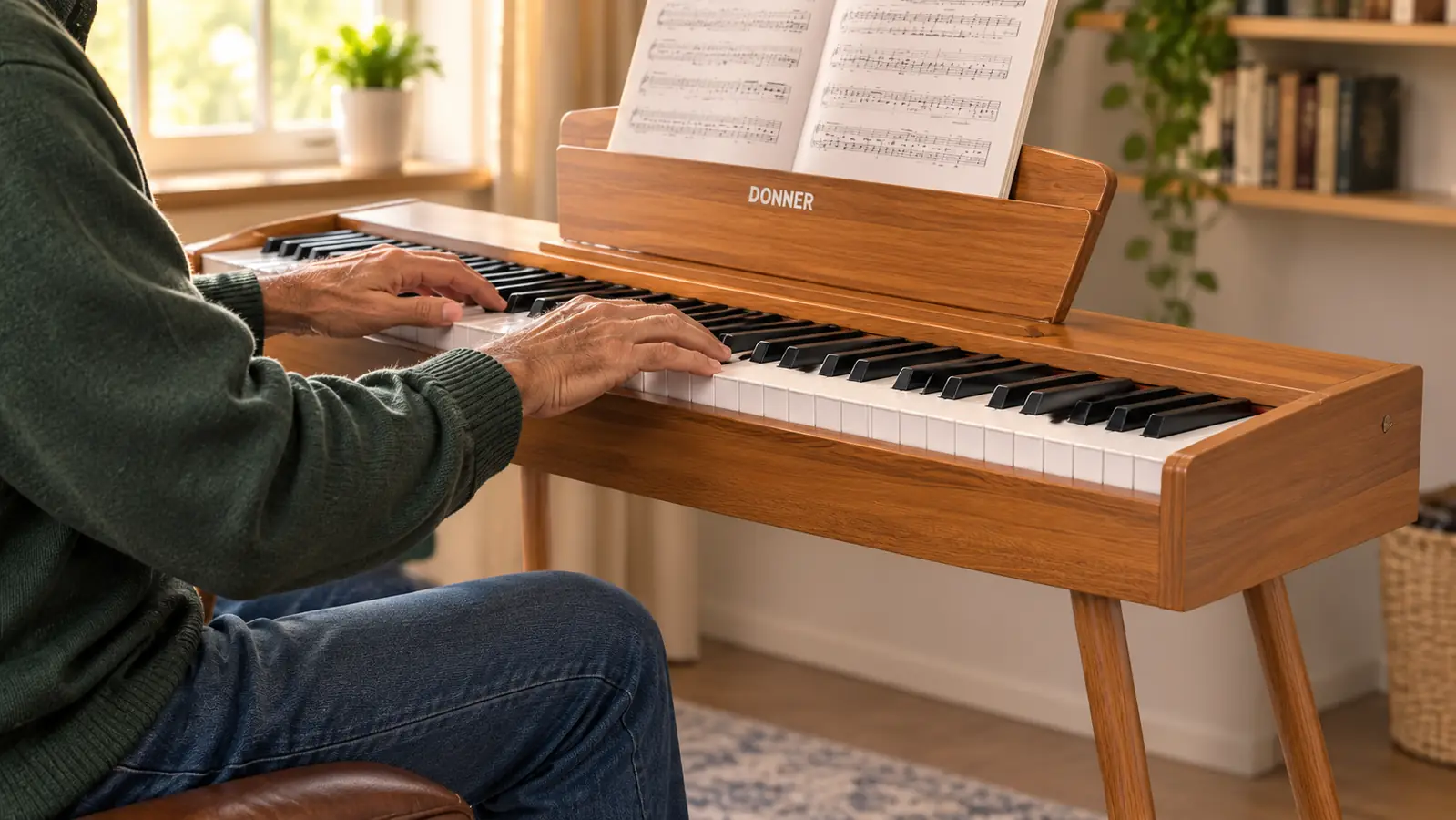
The listing says 88-key heavy hammer action, and that phrase covers a wide range of sins on a piano like this. Plenty of inexpensive boards call themselves weighted and mean a spring with a heavier spring inside it. This is not that. There is real mass under your fingers and you feel it in the first inch of travel, that little bit of resistance before the key gives. When I play a gospel arrangement that leans on the low end, the keys push back the way my mother's upright does. Not identical. The upright has a longer throw and sixty years of slop in the action. But the DDP-80 is in the same family, and for a home piano that is the highest compliment I can pay it.
Where it shows its hand is in fast repeated notes and anything that needs a very light touch high up the keyboard. Kaia playing a simplified minuet will never notice. I noticed on a Wednesday night, doing a walking bass in the left hand with a lot of staccato in the right, and the keys return quickly but not instantly. If you have spent years on a well-regulated acoustic you will feel that. If you have spent years on a keyboard with springs in it, you will feel something else entirely, which is relief.
The 128-note polyphony figure holds up in practice, which is not always true of numbers printed on a box. I held the sustain through a full progression with the left hand running underneath and heard nothing drop out. I have played house keyboards where the top voice disappears once you get busy with the pedal. That does not happen here. Dynamics are decent rather than delicate. I can go from a whisper to a forte without fighting, and a beginner can get loud without banging, which is exactly what you want from a piano a child is learning on.
Here is the test I actually use. I learn a hymn on the upright, then play it on the Donner, then go back. What I am listening for is whether my hands have to change their mind. On most inexpensive pianos they do, and it takes an hour to reset. On this one they do not. The voicing is a little different, the bass is not as deep, and the pedaling has to be a touch cleaner because there is no soundboard to blur it for you. But the physical habit transfers. That is the thing an experienced player needs to know and the thing a beginner cannot yet judge for themselves.
The ceiling is where it is honest. At the very top of the dynamic range the sound tightens before it gets any bigger. It does not distort or break up. It just stops growing. In a room this size, and in a church that seats about a hundred and twenty, that ceiling is above where I ever need to go. If you are playing a hall or a loud band, it is not.
The Speakers, the Pedals and the Jack That Saves the Household
Two stereo speakers rated at 25 watts maximum power each do more than I expected in a room this small. The sound sits in front of you rather than around you, which is the correct choice for a piano. At home I keep the volume around a third and it fills the space without getting hard. Past about two thirds it starts to sound like it is working for a living, and that is the point where I put on headphones if anybody else is home.
The 3.5mm headphone jack is the feature I would keep if I could only keep one. My wife Leilani reads in the evening and I do not practice quietly, so from about eight o'clock on, the piano goes into headphones and the house stays calm. Kaia uses the same jack with a pair of her own and I can sit beside her and hear nothing but her fingernails on the keys. That jack has bought more practice time in this house than any other part of the instrument.
The triple pedal is included, along with the music stand and the power adapter, so there is no shopping list to finish after the box arrives. The right pedal is the one you will use ninety-five percent of the time and it does what you expect, with enough travel that half pedaling is possible for somebody who knows how to look for it. The other two are there, they work, and like most home players I touch them roughly once a month. The music stand holds a standard method book fine. I would not stack a heavy three-ring binder on it.
The USB-MIDI connection is the quiet bonus. I ran a cable from the piano to my laptop once, opened a notation program, and played a hymn line straight into it. It worked, nothing needed configuring that I could not figure out in a few minutes, and then I unplugged it, because I would rather play than click. If you record or write, it is there. If you do not, you will forget it exists, which is fine.
What I Liked
- Hammer action with real weight under the fingers, not a heavier spring
- 128-note polyphony holds up with the sustain pedal down
- Two 25-watt speakers fill a small room at a third of the volume
- 3.5mm headphone jack makes late evening practice possible in a full house
- USB-MIDI lets it double as a controller for a laptop and a DAW
- Music stand, triple pedal and power adapter all come in the box
- 23.8 kilograms moves with two people and no ramp
Where It Falls Short
- Top of the dynamic range tightens instead of opening up
- Fast repeated notes return a hair slower than a regulated acoustic action
- 59 inches wide by 16.9 inches deep needs a real wall, not a corner
- The music stand is fine for a method book and not for a heavy binder
The Humid Room Question
Everyone in Hawaii asks me this, so let me answer it directly. Three months is not long enough to make a promise about any instrument in island air, and anyone who tells you otherwise is selling something. What I can tell you is what I have seen. The keys have stayed even. No sticking, no sluggish return on the ones Kaia hits hardest. The finish wipes down with a dry cloth and does not show the salt film the way the old upright's lid does. I keep the piano on the dry side of the room, away from the window, and I do not leave it in a closed-up room with the trade winds shut out.
If you live somewhere with real winters, the concern flips and becomes dry air and a heater. Same advice in reverse: keep it off the outside wall, away from the register, out of direct sun. What you should not do is buy a piano like this and then treat the room like a garage. It is a piece of furniture with electronics and a lot of engineering inside it, and it will last as long as you let it.
Who This Is For
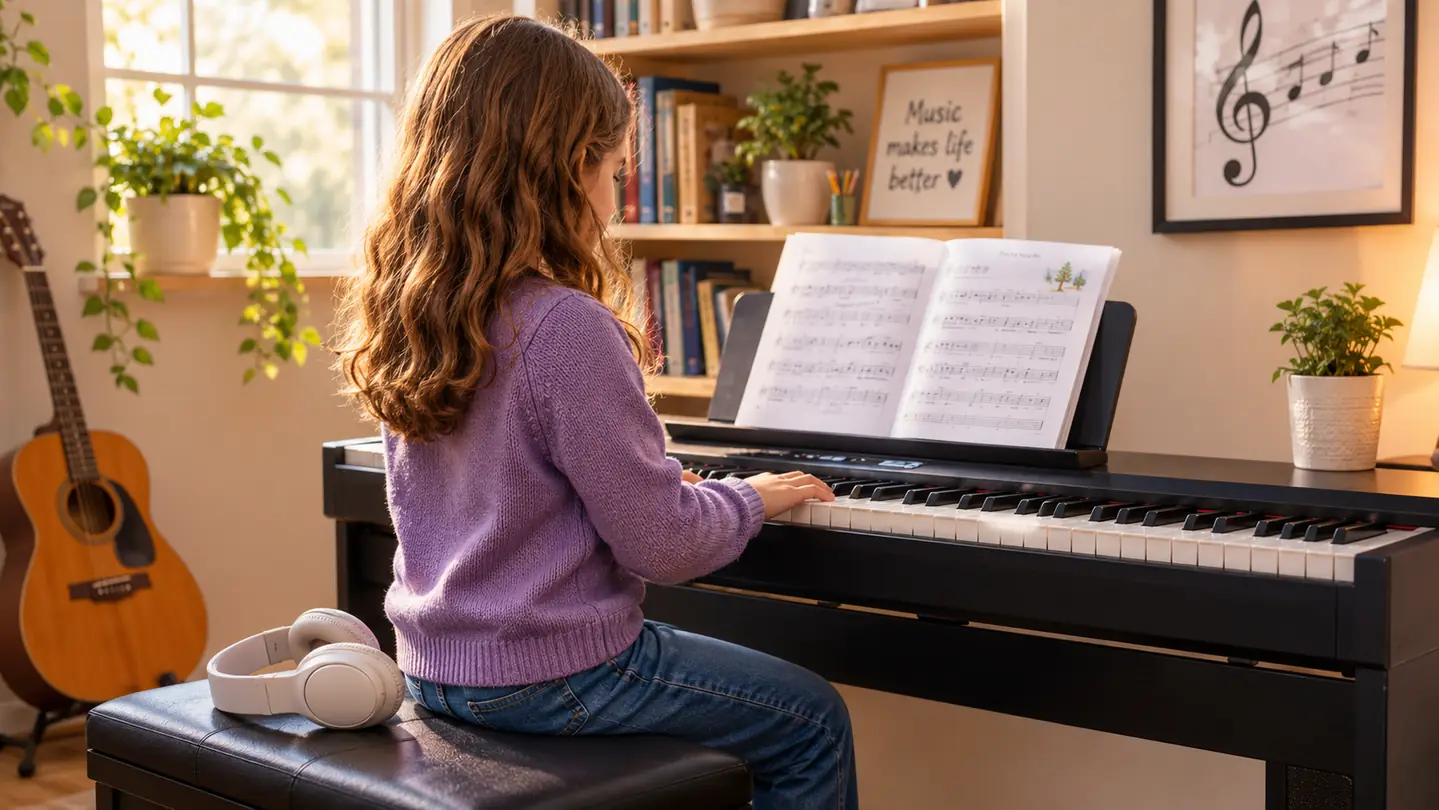
This is for the adult who played as a kid and wants to come back to it without committing to an acoustic piano and a tuner's phone number. It is for the parent whose child has asked for lessons and who wants to find out whether the interest is real before committing to an instrument that needs a specialist to keep it in tune. It is for the church pianist, the Sunday player, the person who needs 88 keys, a pedal, and a sound that carries through a small sanctuary. And it is for anyone who has to practice in a house with other people in it, because the headphone jack solves a problem that no amount of sound quality fixes.
I would also say this to the parent reading over the shoulder: the instrument matters less than the schedule. Kaia has improved because she sits down twice a week with a teacher and twice more at home, not because the piano is remarkable. But a piano that is unpleasant to play is a real reason to quit, and a child will not tell you that. She will just stop. That is the failure mode I was trying to avoid, and it is why I cared so much about the key action and the headphone jack.
Who Should Skip It
Skip it if you are chasing a concert-level action and you know the difference, because you will feel the return on fast repeated notes within the first ten minutes and it will bother you. Skip it if you play in a loud band, because the top of the dynamic range tightens rather than opens up. Skip it if your only space for a piano is a narrow corner, because 59 inches is 59 inches and this is not a board you fold up and put in a closet. And skip it if the room it would live in is the same room as the television, because this instrument wants a wall and a little quiet around it.
What I Would Tell a Friend
Practically speaking: measure your wall, decide where the headphones live, and buy a bench separately because one is not in the box and your back will tell you about it inside a month. Set the piano up with two people. Send in the registration card when it tells you to, because it takes two minutes and the one time you need it, you will be glad. Then stop reading reviews, including this one, and go play something you love badly for twenty minutes. That is the whole point of a piano like this. It is not the instrument I would choose for a recital hall. It is the instrument that got a nine-year-old to ask for Tuesday and Thursday, and that is worth more to me than the last five percent of touch response.
One more thing, and this is the part that surprised me. Kaia still plays the old upright. She likes the way the DDP-80 sounds when she presses the pedal and holds a chord, and she likes that she can hear herself in headphones without the whole house listening. But she goes to the upright when she wants to make a big noise, because an acoustic rewards that in a way electronics do not. I did not expect the two instruments to live together this easily. They do. The Donner is the one that gets practiced on. The upright is the one we both still love.
If a Child Asked You for Lessons, Answer the Question Before You Buy Anything
An instrument that lives in the room and gets played beats a better one that needs a tuner, a bigger space and a week of scheduling. That is the whole calculation, and the DDP-80 is the version of it that fits a small house.
Amazon Check Today's Price on Amazon →