

There is a version of this review that says a folding bench is all you need and you can stop reading here. This is not that version. I have played piano for close to fifty years, thirty of them teaching middle school music in Kaneohe, and I have sat on benches that cost more than my first car and benches that folded up under me in the middle of a phrase. The RockJam RJKBB100 is neither of those. It is a light, adjustable, padded bench that does most of what a working player needs, and it asks you to accept two real compromises to get there. Here is what they are, and who should not care about them.
The short version first. If you need one bench for a house with a nine-year-old learning piano and a sixty-three-year-old who plays for the Sunday service, and the bench has to fold and lean in a closet between uses, this is the one I would put in your hands. If you are setting up a studio where the bench never moves, buy something heavier and stop shopping. The rest of this is the reasoning, including the part where the seat is narrower than the photographs suggest and the part where four height settings turn out to be coarser than the listing makes them sound.
The Quick Verdict
A genuinely useful folding bench for a small house or a traveling player. Firm enough for an hour of practice, light enough to move with one hand, and honest about its limits: coarse height steps, a narrow one-person seat, and a frame that gives a little at the top setting.
Amazon Check Today's Price →Four heights, seven and a half pounds, and it folds into a closet
The bench my granddaughter and I share. Adjustable from kid height to adult, padded for long practice sessions, and light enough that moving it is not a chore. Check the current price and the height range on the listing before you decide.
Amazon Check Today's Price on Amazon →How I've Used It
The bench lives in the small room off my lanai that I use for music, next to the old upright that belonged to my mother and a digital keyboard on a stand in the corner. That room is where I practice, where my granddaughter practices three afternoons a week, and where I do a last run-through on Saturday night before the Sunday service. The bench has been in there for most of a year. It has also traveled: I have carried it to the church hall twice for a small ensemble rehearsal, and once to a family gathering where somebody wanted to sing.
What I am comparing it against matters, so here it is. My mother's upright has its original wood bench, a heavy thing with joints that move with the seasons. The school where I taught had padded adjustable benches that cost considerably more and weighed twice as much. And for about a decade I practiced at home on a plain wood bench that was the right height for the upright and the wrong height for everything else. The RockJam bench is the first one I have owned that had to serve two different players at two different keyboards, and that is the job it is actually being asked to do here.
That framing matters, because most bench reviews are written as if you sit on one thing at one height forever. Almost nobody does. In my house the same bench gets a nine-year-old on a Tuesday and a sixty-three-year-old on a Sunday, and it gets a keyboard on a stand one week and the old upright the next. A bench that handles that is worth more than a fancier bench that does not.
What the Seat Actually Feels Like After an Hour
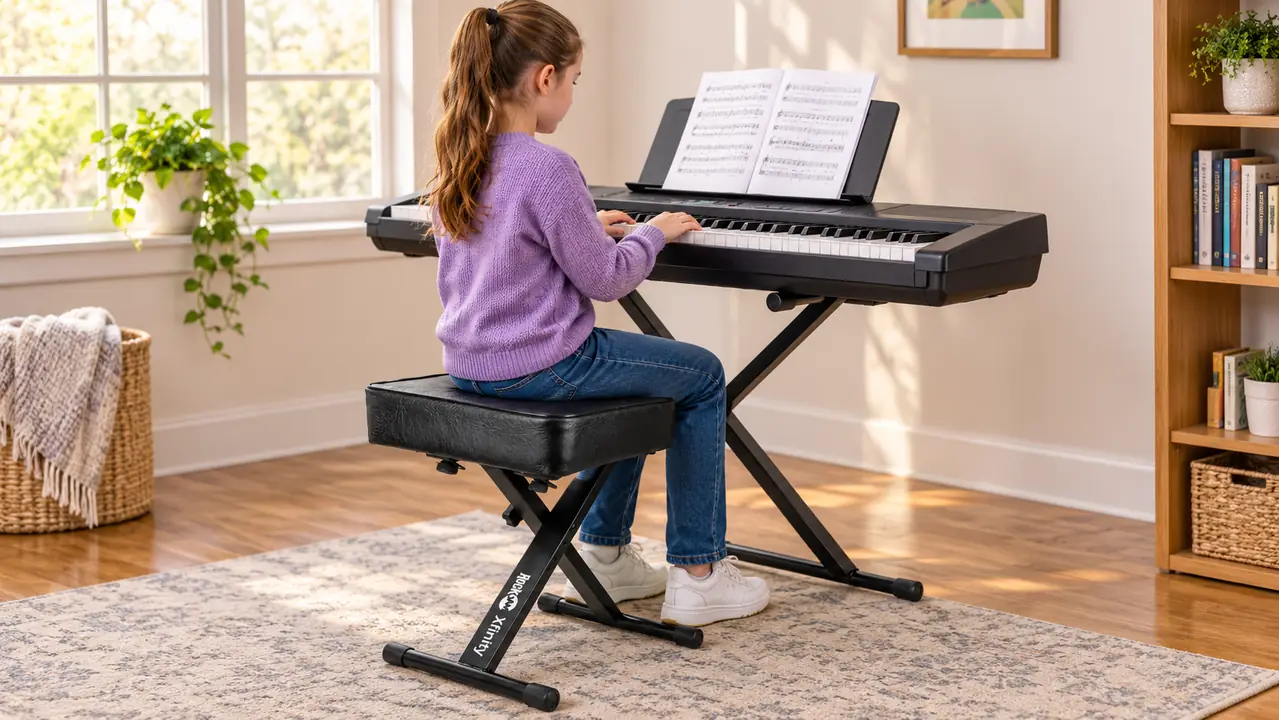
The padding is firm. That surprised me, because the listing photographs make it look softer than it is. Firm is the right call for a piano bench. A soft seat lets you sink, and when you sink your wrists drop, and when your wrists drop your forearms stop running parallel to the keys and your hands start doing work they should not be doing. I have done ninety-minute practice sessions on this bench without the seat being the reason I stopped.
The dimensions tell you what your body will find out. The seat measures about 17.32 inches wide and about 12.59 inches deep, and the whole bench weighs 7.5 pounds. Seventeen inches wide is a one-person seat. That is normal for a piano bench and it is still the first thing people are surprised by. If you pictured sitting beside a student to demonstrate a passage, you will be touching shoulders. If you pictured two grandchildren sharing it, one of them ends up on the floor.
Depth is the part I would change if I could. Twelve and a half inches is enough for me at five foot nine, but a taller player with long thighs will feel the front edge of the seat sooner than expected. My advice to anyone over six feet is to sit on one before you commit, or to accept that you will be perching rather than sitting.
The Four Height Settings Are Coarser Than You Think
RockJam puts four height settings on this bench, and the seat tops out at 20.87 inches. Four sounds like plenty until you have spent an afternoon trying to get your forearms level. The rule I taught for thirty years is simple. Your forearms should run roughly parallel to the floor, wrists flat, elbows slightly out. Too low and your wrists bend up and everything tightens. Too high and your shoulders creep toward your ears and you play like you are carrying groceries.
With four steps you may land between the ideal. That is what happened to me. The third setting put me a hair low at the keyboard and the fourth put me a hair high. What fixed it was not the bench at all. I raised the keyboard stand about half an inch and the problem went away. That is worth knowing before you buy, because the bench is only one half of a two-part decision. The stand height matters just as much, and four settings give you four chances to match it.
For a child the low end is the useful part. My granddaughter is nine and small for her age, and at the bottom setting her feet reach the floor and her forearms sit close to level at the keyboard. Watching her stop sliding forward on a bench that was too tall was the best argument for this purchase in my house. If you have a child starting lessons, that alone probably decides it.
Seven and a half pounds. I carry it from the music room to the car with one hand, which is the whole reason it gets used instead of the heavier bench that lives in my garage.
The Frame, the Feet, and a Room That Stays Damp
The frame is steel, it folds flat, and it has non slip feet. In a house on the windward side of Oahu that combination matters more than it would in Arizona. My mother's upright bench is wood, and wood in this climate moves. Every few months a joint announces itself and I decide whether to tighten it or live with it. The steel folding frame on the RockJam has no such drama. Nothing has loosened, nothing has swollen, and I have not had to touch it.
The feet have held on both surfaces in my house, the hard floor in the music room and the low carpet in the living room where the keyboard sometimes ends up. They do not slide when I shift my weight and they have not marked the floor. Small thing, but it is the small thing that makes a bench feel like it belongs in a room.
Here is the honest trade-off. A folding bench is a compromise between stability and portability, and at 7.5 pounds this one leans hard toward portability. At the top setting there is a small amount of side to side give that I do not feel on a solid bench. It has never felt unsafe and I have never thought about it while playing actual music. I notice it when I deliberately shift my weight, which is not something I do during a hymn. It also carries a one year manufacturer warranty, which is ordinary for this class of bench and worth knowing.
What Daily Use Actually Looks Like
A Tuesday in my house: the bench comes out of the closet at four, my granddaughter sets it two steps up from the bottom, and she practices for twenty-five minutes while I sit on the arm of a chair and listen. When she is done her grandmother calls her for homework, I move the bench about a foot to the left and set it one step higher, and I play for forty minutes or so. On Sunday morning it goes in the car. That is the whole routine, and the routine is the point. The bench has never once been the reason something did not happen.
There is one thing I got wrong about it. I assumed the height changes would be annoying enough that I would leave it at one setting for everybody. That is not what happened. The change takes a few seconds, there is no temptation to skip it, and the bench actually gets set correctly for each player instead of being shared at a compromise height. I have owned enough adjustable things to know that is not always true.
What Nobody Tells You Before You Buy a Folding Bench
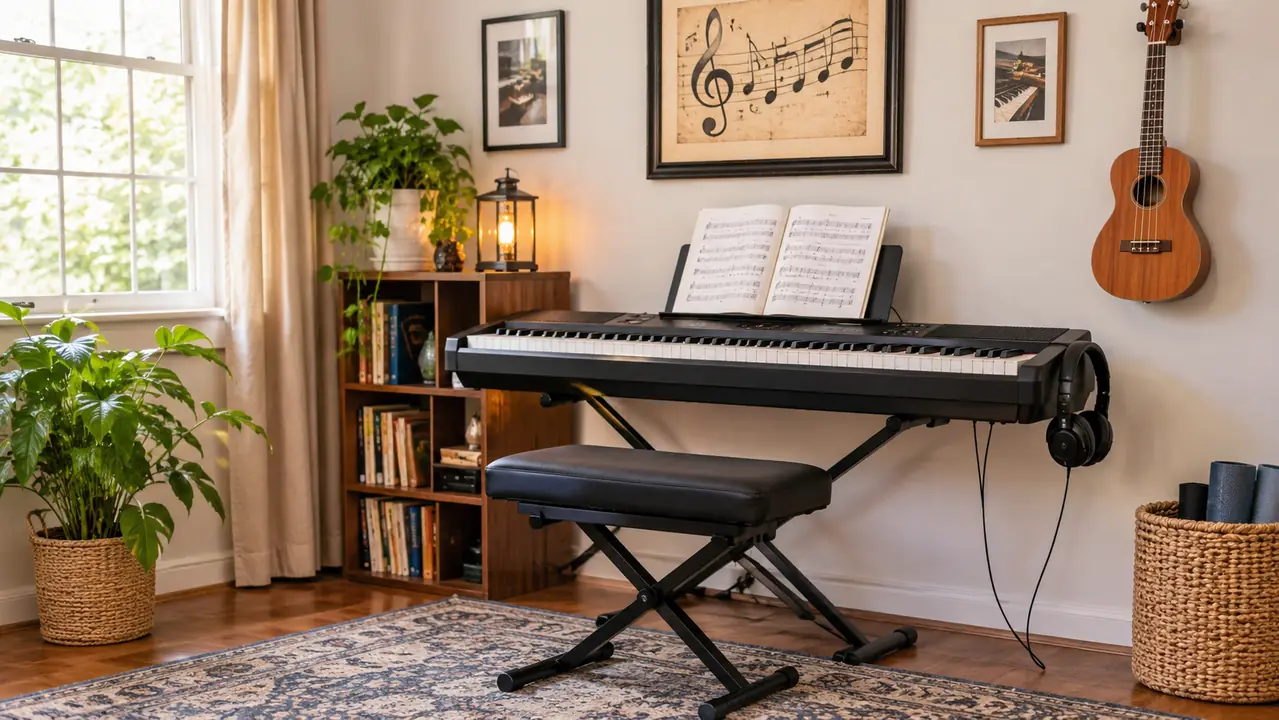
First, a folding bench is not a studio bench wearing a costume. The folding X frame is what makes it light and what makes it stow, and it is also why it will never feel as planted as a bench with four fixed legs. If your bench lives in one spot and never moves, you are paying for a feature you will not use. The seat is also narrower than the shape in your head. Seventeen inches is one player. If you want to teach from the bench or play duets shoulder to shoulder, this is the wrong piece of furniture.
Second, four height settings is a household feature, not a player feature. It is exactly right for a home with a child and an adult, and it is a little crude for somebody chasing a precise posture. If you already know your exact seat height and you want to hit it, a bench with continuous adjustment will serve you better, and it will cost you in weight. Nothing about the RJKBB100 is aimed at the player who has already solved that problem.
Third, expect the pad to feel different from the pictures. Firm, slightly grippy, and it will not swallow you. Some people want a couch cushion under them. Those people are usually the ones who practice for twenty minutes and then go do something else. If you sit for an hour at a time, firm is the version you want.
What I Compared It To
Before this one I looked at two other options. The first was a solid wood adjustable bench, the kind a church or a school buys. It was heavier by a lot, it did not fold, and it would have been the better bench if it lived in one room forever. The second was the cheapest fixed height stool I could find, which would have been fine for me and useless for a nine-year-old.
What decided it was not the bench. It was the closet. The music room off my lanai has one narrow closet, and anything that does not fit in it ends up in the garage, and anything in the garage does not get used. A bench that folds flat and weighs 7.5 pounds gets put away and taken out every day. A bench that does not, does not. Buy for the room you actually have.
Does It Change How the Instrument Sounds?
A bench does not change the sound of a piano. It changes the player, and the player changes the sound. That is not a slogan, it is just what happens. When your wrists are level and your feet reach the pedals, you press keys with your arm weight instead of your fingers alone and the tone opens up. When you are perched too high on a bench that is wrong for you, you play everything at seventy percent and then wonder why the instrument sounds thin in your living room.
In my music room the difference between this bench at the right setting and the old wood bench was not subtle on sustained gospel chords. I could hold them longer before my hands tightened. That is the whole case for caring about a bench, and it is why I would rather have four usable settings than one perfect height that only works for one person in the house.
What I Liked
- Four height settings cover a child and an adult in the same house
- Firm padding held up through ninety-minute practice sessions
- 7.5 pounds, folds flat, carries one-handed from room to car
- Non slip feet held on both the hard floor and the low carpet
- Steel frame shrugs off humid island air with nothing to tighten
Where It Falls Short
- Seat is 17.32 inches wide, so it is strictly a one-person bench
- Four height steps can leave you between the ideal settings
- Some side to side give at the top setting
- 12.59 inch seat depth will feel short to tall players
Who This Is For
This bench is for a household with more than one player at more than one height. If a child is learning on a keyboard in the corner and an adult plays the same instrument in the evening, four settings solve a problem a fixed bench cannot. It is for anyone who has to put the bench away between sessions, and for anyone who carries a bench to a hall, a church or a family gathering. It is also for the player whose practice space is small enough that a heavy bench would end up in the garage instead of under the keyboard.
Who Should Skip It
Skip it if the bench will never move. A heavier fixed bench is more stable, will outlast this one, and there is no reason to trade stability for portability if it never leaves the room. Skip it if you are tall and want a deep seat, if your household practices side by side, or if you already know the exact seat height your body wants and four coarse steps will not get you there. And skip it if you are shopping for furniture rather than equipment, because this looks like a tool.
The bench that got my granddaughter's feet back on the floor
Four height settings, a padded seat that holds up for an hour, and a folding steel frame light enough to carry with one hand. If your house has two players at two heights, start here and check the height range on the listing first.
Amazon Check Today's Price on Amazon →