

My lower back used to start complaining about twenty minutes into the Sunday service. Not from lifting anything. From sitting. I was perched on a hard wooden bench that came with the church, knees higher than my hips, leaning forward to reach the keys. By the last hymn I was shifting around like a kid at a school assembly.
Eventually I bought the RockJam RJKBB100 adjustable padded piano bench for the spare room off my lanai. The honest reason was my granddaughter Kaia, who is nine, so she would have something that fit her instead of a stack of hymnals. What I did not expect was that it fixed my own back first. Here is the list I wish someone had handed me two years ago, from a man who plays gospel on Sunday and practices in a small humid room the rest of the week.
The bench that ended my twenty minute back ache
Four height settings, a thick padded seat, and a frame that folds flat against the wall. The least glamorous thing in my music room and the first thing I would replace.
Amazon Check Today's Price on Amazon →Four height settings, so the keys stop sitting too low
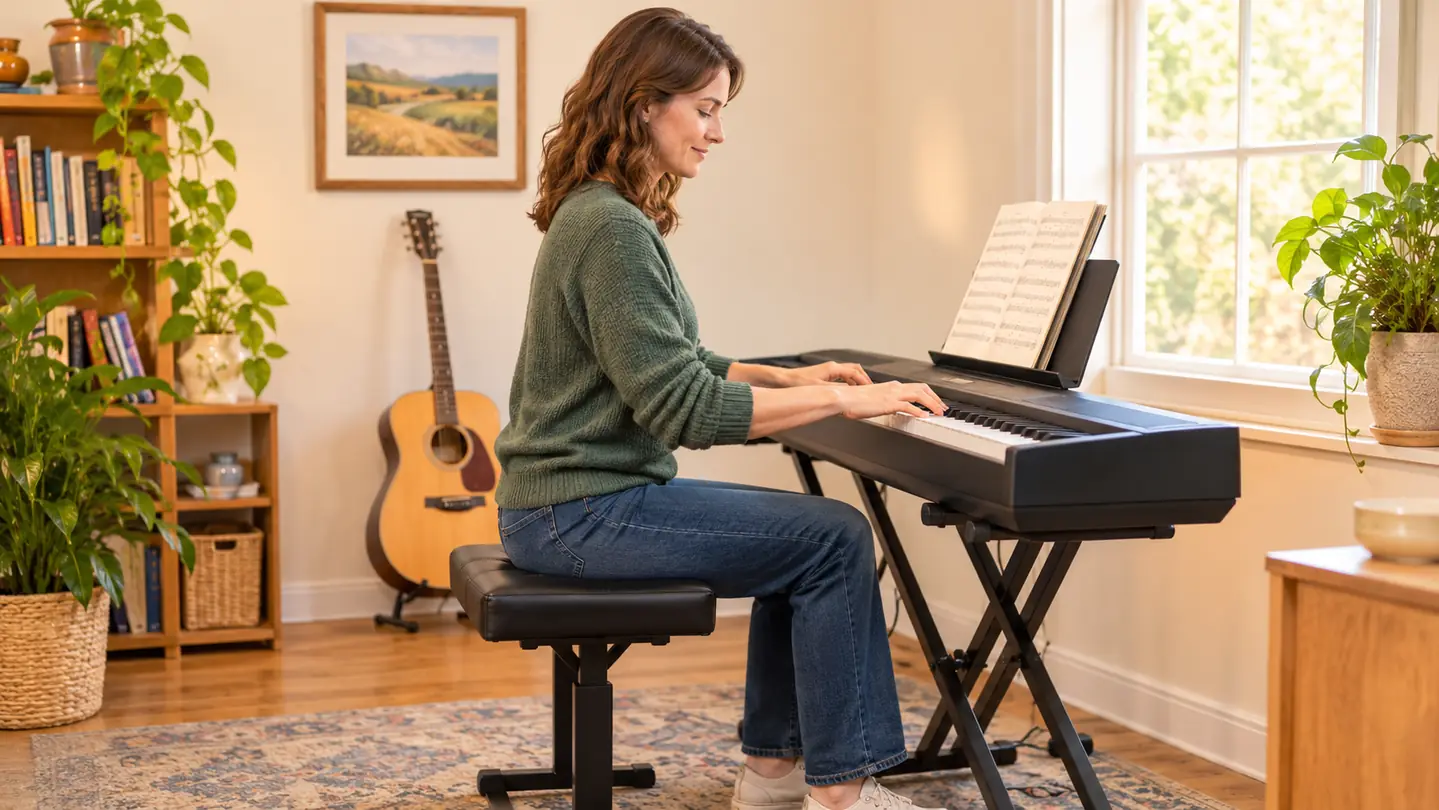
Most home keyboards end up on whatever stand was cheapest, and then you sit on whatever chair is nearby. The result is a seat two or three inches too low, which tips your pelvis back and rounds your spine. The RockJam bench has four height settings and the seat tops out at 20.87 inches. I landed on the second setting to match my keyboard stand. Kaia uses the lowest one. It took a single afternoon of moving it up and down to find the right notch.
It fixes the slouch you do not notice until hour two
A slouch does not announce itself. It accumulates. When the seat height is wrong, your shoulders creep forward to reach, your neck juts out to read the music, and your lower back takes the load in a curve it was not built to hold. Raise the seat until your forearms sit roughly level with the keys and the whole chain straightens out on its own. That is the entire trick, and it is why I stopped noticing my back at all.
The padded seat holds up past the last hymn
The seat is a thick cushion, not a board with a thin cover stapled over it. I have sat on it through a full gospel service with a rehearsal afterward and never once felt the frame underneath. The old wooden bench at church left me sore by the sermon. This one does not. If you practice in long stretches rather than ten minutes here and there, that padding is doing more for your back than any stretch you will do afterward.
It folds flat, so the music room gets its floor back
The spare room off my lanai is small. It has to hold an old upright, a digital keyboard, a music stand, and a ukulele or two. The bench folds on an X frame and goes flat against the wall when I am finished. That matters more than it sounds. A bench you have to step around is a bench you resent, and a bench you resent is one you quietly stop using.
Non slip feet on tile, carpet, and a church stage
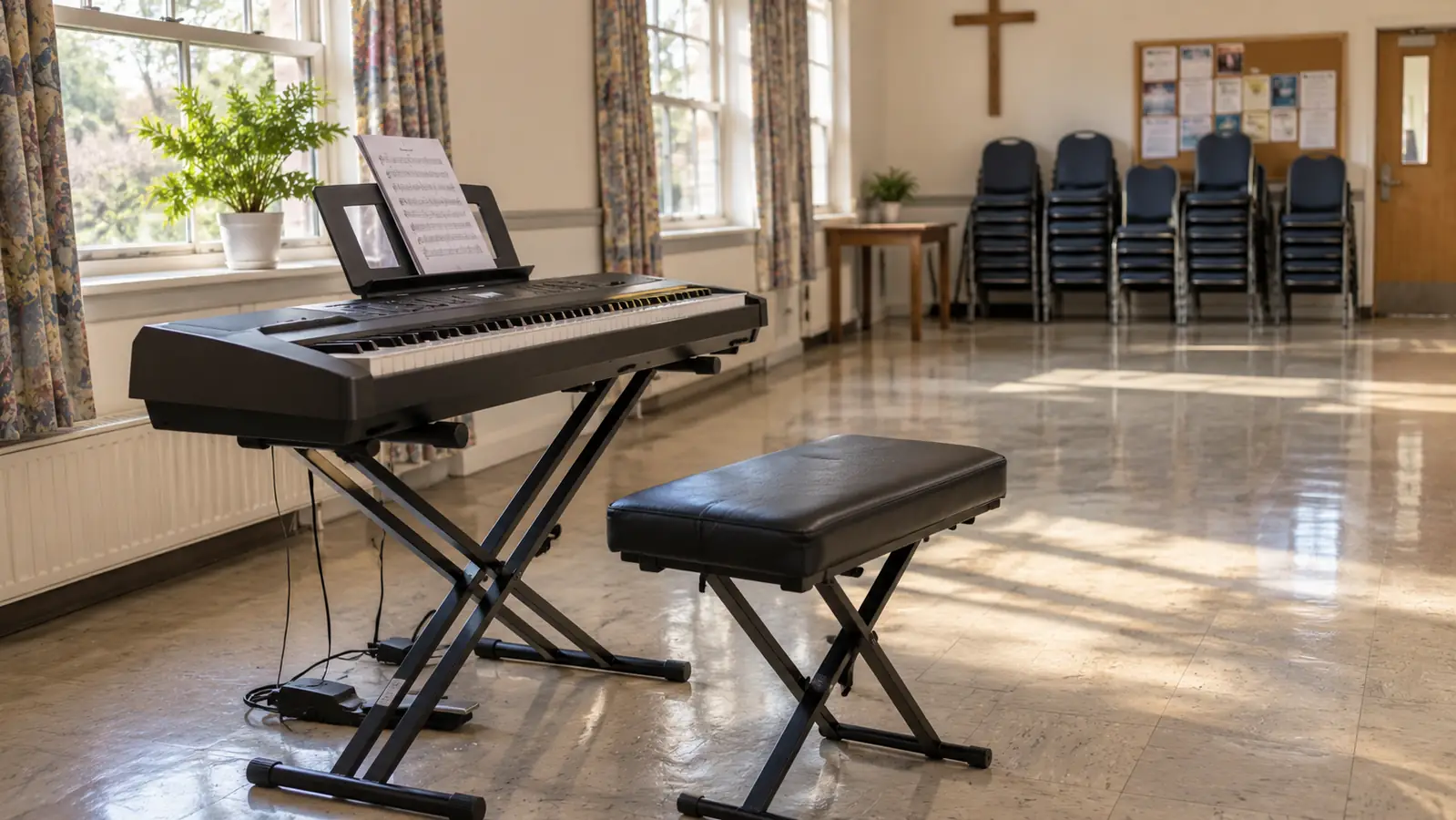
I have used it on the tile in my music room, on the low carpet in the fellowship hall, and on the wooden platform at church. It did not slide on any of them. That sounds like a small thing until you shift your weight mid phrase during an offertory and feel the whole bench skate an inch. Feet that grip let you play without bracing, and not bracing is half the battle for your back.
Twenty minutes into the service I used to be shifting around. Now I sit through the rehearsal after it and forget the bench is there.
It adjusts down for a nine year old without a stack of books
Kaia is small for nine. Before, she played sitting on a cushion on top of a dining chair, which meant her feet dangled and her wrists bent up at an angle. Now she sits at the lowest setting with her feet flat on the floor. Her teacher noticed the change in her hand position within a month. A child who is properly seated plays longer before getting squirmy, and that is really the whole point of a bench with settings.
At 7.5 pounds, you carry it with one hand
The bench weighs 7.5 pounds. I carry it out to the car with one hand and a bag of music in the other. Steel X frame, folds flat, light enough that nobody has an excuse for leaving it at home. For a player my age that matters more than it used to. The heaviest piece of gear in the car is the one that stays in the car.
Your wrists stay level, and your hands feel the difference
This is the part nobody tells you. Back pain at a keyboard is often a wrist and shoulder problem wearing a costume. Sit too low and your wrists break upward to reach the keys, your shoulders hike toward your ears, your neck compensates, and by the end of a long piece your lower back is doing work it never signed up for. Getting the seat height right fixes all of it at once, from the hands down to the hips.
One bench serves the house and the church hall
I move it between the music room and the fellowship hall most weeks. The frame has not loosened and the seat has not flattened or split at the seams. For a bench in this range, that is exactly what I wanted. Not something to admire, something to forget about. It has become furniture, which is the highest compliment I can pay a piece of music gear.
It removes the best excuse to skip practice
Here is the honest reason this bench changed my playing. When my setup is uncomfortable I practice for fifteen minutes and find a reason to stand up. When it is comfortable I look at the clock and an hour has gone. Leilani has commented on it more than once. A bench will not make you a better pianist. But it takes away one very good reason not to sit down, and for most of us that is the real obstacle.
What I'd Skip
I would skip the benches with a backrest. They look supportive and they quietly encourage you to lean back, which puts you farther from the keys and makes your arms do more work for every phrase. Piano posture is upright and slightly forward, not reclined. A backrest solves a problem you should be solving with height instead.
I would also skip anything continuous or hydraulic if you are only ever going to sit at one height in one room. Four settings is plenty for a household. My one honest complaint about this bench is that four settings are steps, not a dial, so if your ideal height lands between two of them you pick the closer one and live with the difference. Mine landed fine. Yours might not.
And I would skip the bench pad. The seat is already a thick cushion, and adding a pad on top raises you right back into the problem you just paid to solve.
If your back aches by the second hymn, it is probably the seat
The RockJam RJKBB100. Four height settings, a padded seat, 7.5 pounds, folds flat. Fix the height first and see what your back does before you buy anything else.
Amazon Check Today's Price on Amazon →