
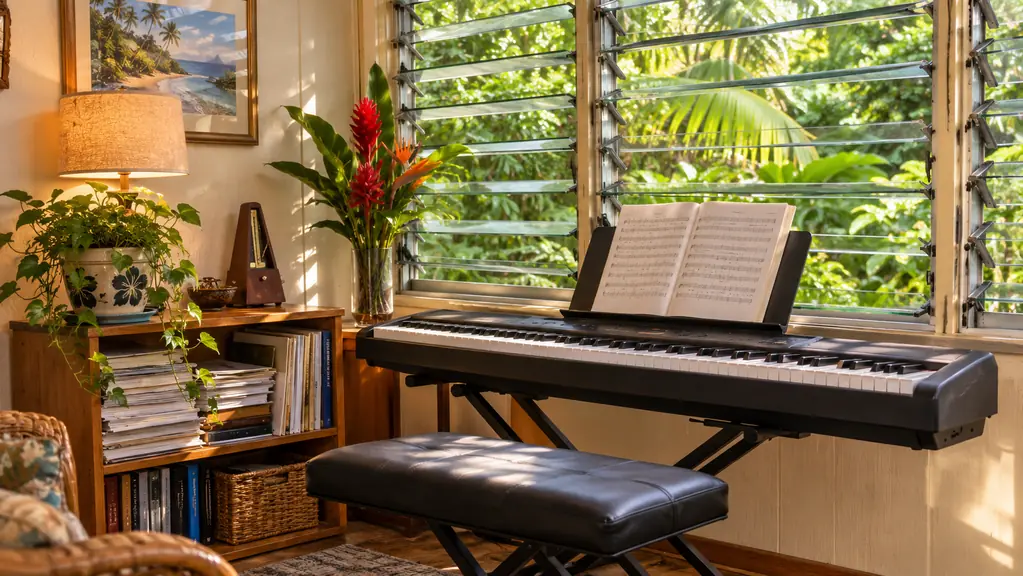
A keyboard bench is the one piece of gear in a piano setup that nobody thinks about until the lower back starts sending messages. I taught middle school music for thirty one years, and for most of that I sat on whatever the school owned, which was usually a folding chair with a hymnal stacked on it to fake the height. When I retired and turned the spare room off my lanai into a music room, I promised myself I would get this one thing right. So I bought the RockJam RJKBB100 adjustable padded bench, and I have practiced on it nearly every day since.
This is not a first week impressions piece. It is what I found after months of daily use in Kaneohe, where the trade winds help and the humidity does not. My music room sits off the lanai, the jalousie windows stay cracked, and everything in that room lives in air heavier and wetter than any mainland showroom. If you are wondering whether a folding bench holds up in that climate, or whether it is worth having at all when there is a free chair in the kitchen, that is what I want to answer. The RockJam bench has been my seat for my own morning practice, for gospel Sunday services at church, and for my granddaughter's lessons.
The Quick Verdict
Four honest height settings, a padded seat that stays comfortable past an hour, and a folding steel frame that has not loosened in months of humid air. Narrow enough that a broad player should sit on one first.
Amazon Check Today's Price →The bench that ended my folding chair years
Steel folding frame, four height settings, non slip feet, and a one year manufacturer warranty. This is the seat I practice on every morning in Kaneohe, and it has not asked anything of me since the day I set it up.
Amazon Check Today's Price on Amazon →How I've Used It
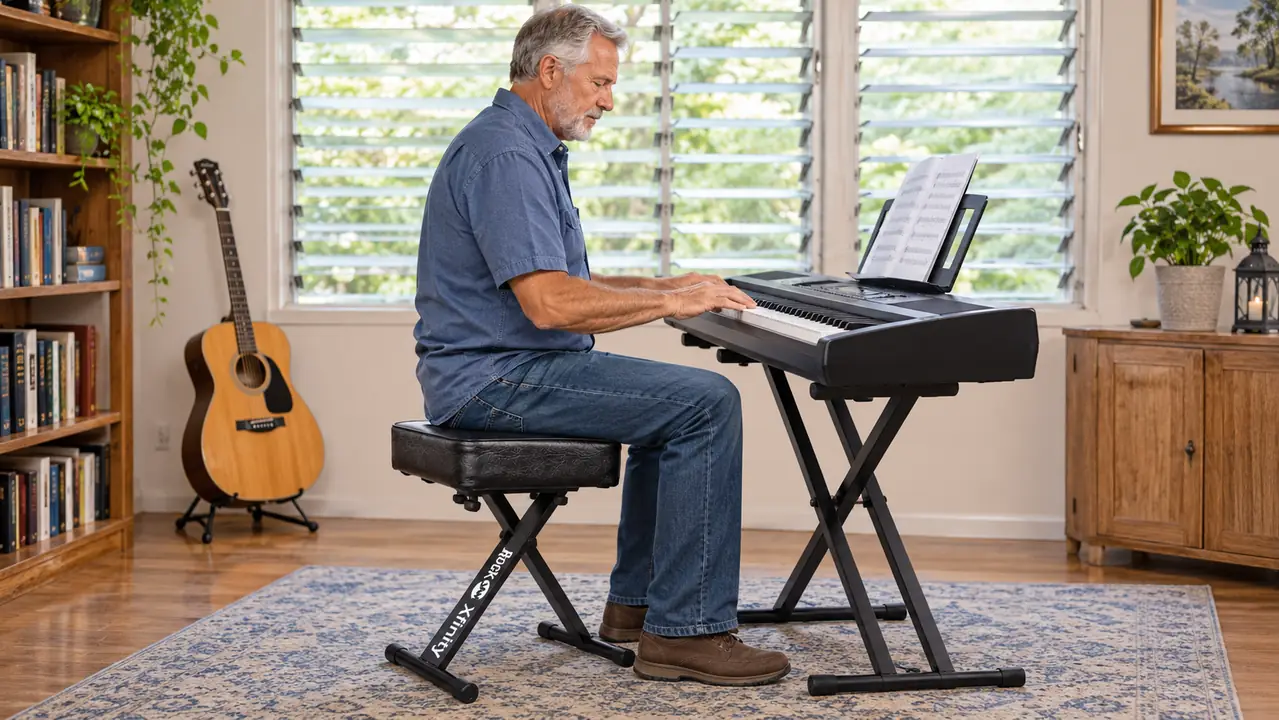
The bench sits in front of a digital keyboard most days, and in front of my mother's old upright on the days I want to hear real strings. I am 63 and about five foot nine, so I keep it at the top setting, which is 20.87 inches, and that puts my forearms level with the keys instead of sloping up to them. My wife Leilani is shorter and drops it down when she sits to play through a hymn. Neither of us has to hunt for anything, because moving between the four settings takes seconds and the bench stays where you set it. That sounds like a small convenience. It is the difference between a bench you adjust and a bench you leave alone because adjusting it is annoying.
What I did not expect was how much the seat height would change my own playing. Sitting on a chair that is too low makes you lean back and reach, and after twenty minutes your shoulders are doing work your fingers should be doing. At the right height I can run a full hour of scales and hymn arrangements without that ache settling between the shoulder blades. My teacher fifty years ago would tap the bench and say sit tall, and I finally understand what she was protecting.
Before this bench I tried the cheap fixes. I put a sofa cushion on the kitchen chair, which raised me about two inches and then slid forward every time I leaned into a chord. Then I stacked three hymnals under the cushion, which was better for height and worse for everything else, because a stack of books on a chair has a way of finding the floor at the worst moment. The RockJam bench did in one afternoon what a year of improvising could not.
I have also carried this thing around. It folds flat, it weighs 7.5 pounds, and it goes into the back of the car for Sunday service without me needing a second trip or a helping hand. At church I set it up on a wooden floor that has a slope to it, and the non slip feet have not walked on me once, even with me shifting my weight through the more energetic gospel numbers.
How It Held Up in Island Humidity
This is the part I wanted to know before I bought it and could not find a straight answer to. A folding steel frame and a padded seat living in a room with open windows, salt air and wet mornings is a real test. After months, here is what I can report. The frame has not rusted at the joints I can see, the folding action is still firm rather than sloppy, and the seat padding has not gone soft or taken a permanent dent where I sit. The seat surface has not cracked or split, which is more than I can say for a bench pad I owned years ago that went stiff and then opened up like a dry riverbed.
I do wipe it down. Once a week I take a barely damp cloth to the seat, dry it right away, and I keep the bench out of the direct line of the window when the afternoon sun swings around. That is my habit with everything in that room, including the upright, so I cannot tell you the bench would shrug off neglect. What I can tell you is that ordinary care in a humid room has been enough, and that the foam has not gone flat the way cheap cushions do.
The morning that taught me to keep it out of the window line was a Saturday in the rainy season, when I came in and found a fine damp film on the seat after leaving the jalousies open overnight. It wiped away with no mark left behind, but I moved the bench two feet back that same morning and it has lived there since.
The one part I keep an eye on is the folding mechanism, because anything that folds has a joint, and joints are where humidity and grit do their work. Mine still opens and closes the way it did in the first month, with that same firm resistance. If a joint ever does loosen, the bench carries a one year manufacturer warranty, which is a fair thing to have on a bench at this level.
Two inches of seat height is the difference between practicing for an hour and quitting at twenty minutes.
The Four Height Settings, and My Granddaughter
Kaia is nine and she is learning. When she started she needed the bench at its lowest setting, feet flat on the floor, and she could reach the keys without sliding forward off the seat. She is a little taller now and she is up a notch, and she will be at my setting sooner than I am ready for. Four settings is not an infinite range and I want to be plain about that. It covers a child, a shorter adult and a taller adult, and at each of those settings the bench sits solid without a rock or a shimmy.
Her lessons are Tuesday afternoons. On one of them she kept sliding forward toward the edge of the seat because I had left it at my setting, and her feet were dangling. I dropped it two notches, her feet came flat, and her playing changed inside a minute.
What four settings will not do is fine tune. If you land between notches, you take the one above or the one below and you learn to live with it. On the acoustic upright the top setting is right for me and the setting below is right for Leilani, so we are both covered. On the digital keyboard, which sits a touch lower, I use the third. There is plenty of range for a household. There is not enough range to dial in a fraction of an inch, and if that matters to you, it is worth knowing before you buy.
The Sunday Service Test
Church is the harder test, because nothing there is under my control. I play for the Sunday service, mostly gospel, and the piano at church sits on a floor that is older than I am. The bench goes in the car on Saturday night, comes out Sunday morning, and gets set up in under a minute. The height I use at home is the height I use there, because the setting does not drift in transit.
One Sunday the regular pianist was out and I played three services back to back, close to four hours in the seat with short breaks between them. My hands were tired at the end and my back was not, which was not the result I expected at 63.
Two hours of playing, standing up for the responsive reading, sitting back down, leaning into the last hymn. The seat has never been the thing that made me want the service to end. The narrowness is the only thing I notice on those mornings, and only when I turn sideways to reach a page. A wider seat would be kinder for that. It would also be a heavier bench to carry, and I carry this one a lot.
Comfort Over a Long Session
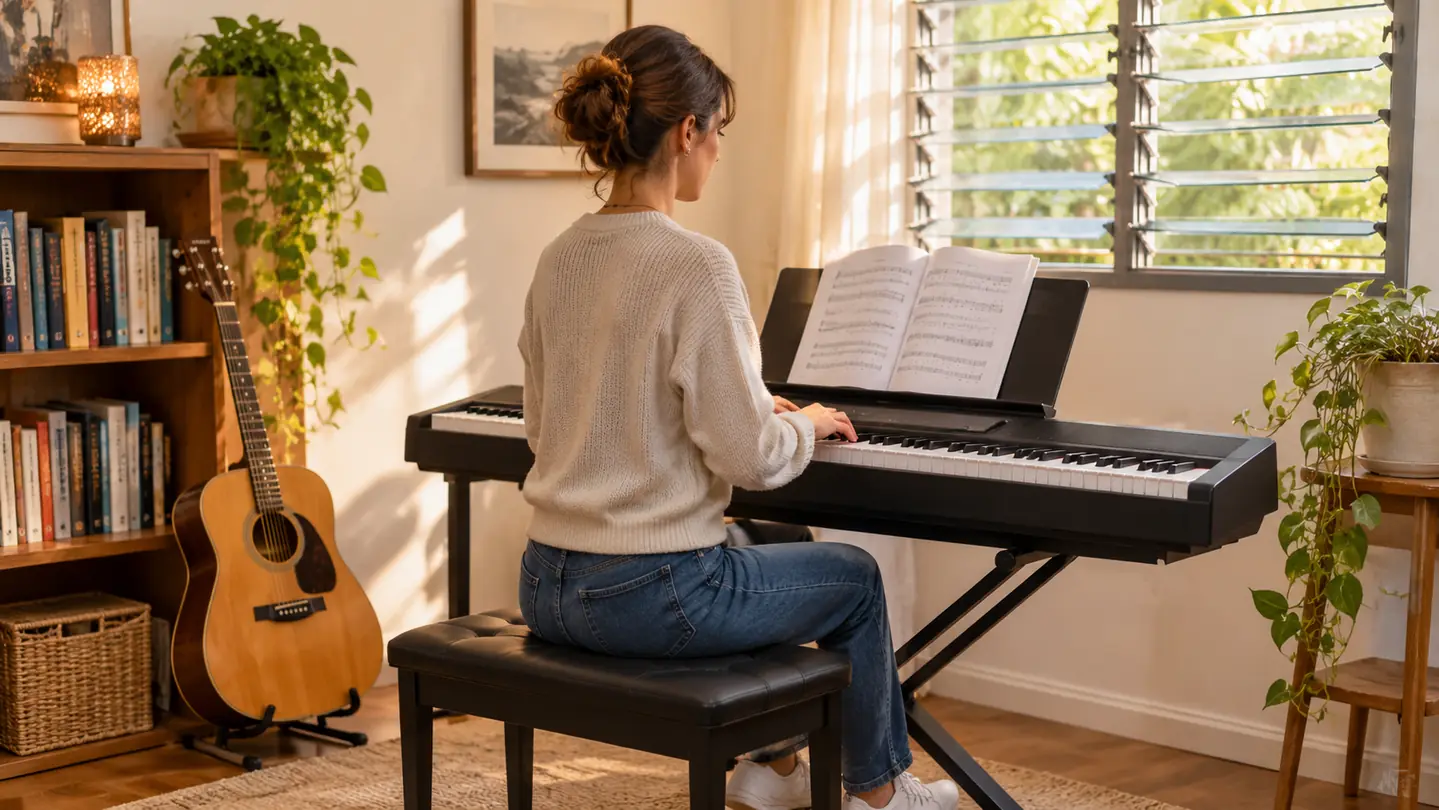
The padding is thick enough that I forget about it, which is the highest compliment I can pay a seat. I have done two hour practice blocks on it getting ready for Easter service and never once shifted because of pressure. The seat measures a little over 17 inches across and about 12 and a half inches deep, so a broad player should sit on one before committing. Leilani noticed the width more than I did.
One more thing about sitting. A bench without a back is not a chair and is not meant to be. If you want to lean back between pieces, this is not that bench. But leaning back is exactly what puts a pianist into a bad position anyway. The bench holds you upright and lets your feet do the supporting, which is how I was taught to sit at a piano a very long time ago.
What I Liked
- Four height settings cover a child, a shorter adult and a taller adult without wobble at any of them
- Padded seat stays comfortable through two hour practice blocks and has not flattened in humid air
- Folds flat and weighs 7.5 pounds, so it travels to church and back without help
- Non slip feet stay planted on a sloped wooden floor and on carpet
- Steel frame has not rusted or loosened in a room with open windows and salt air
- One year manufacturer warranty
Where It Falls Short
- Four settings is coarse, with no fine adjustment between notches
- Seat is narrow at a little over 17 inches across, which a larger player will feel
- There is a small amount of give in a folding frame compared with a solid wooden bench
- No backrest and no storage, so a metronome and a hymnal need somewhere else to live
- Not the piece of furniture a fixed wooden bench is, if looks in the room matter to you
Where It Falls Short
The honest list. First, it is a folding bench, so there is a touch of give in the frame compared with a solid wooden bench. It is not wobble and it is not a creak. It is the sense that you are sitting on a folding thing rather than a piece of furniture. Second, the seat is narrow. Third, four settings is coarse, and you will occasionally want the notch that does not exist. Fourth, there is no storage, so if you want a metronome, a pencil and a hymnal within reach, that is a shelf problem and not a bench problem.
I should also say what I compared it to before buying, because I did look around. I looked at a fixed wooden bench, which was handsome and heavy and would have needed a permanent spot in a room that already has an upright in it. I looked at a wooden adjustable bench, which was more furniture than I needed for a lanai room. And I looked at simply keeping the kitchen chair, which is what I did for a year. The chair was free and my back filed a complaint.
None of those are bad choices. I would tell a friend to buy a solid wooden bench if the bench never moves, one person sits on it, and it is the only thing in the room. For a room where a nine year old and a 63 year old share one instrument, and where the bench sometimes goes in the car on a Saturday night, adjustable and foldable is the practical answer. That is my whole reason for liking the RockJam bench. It solves the problem I actually had.
Who This Is For
This bench is for the household where more than one person plays. It is for the player who has been making do with a chair and knows in their shoulders that the height is wrong. It is for the church musician or the teacher who carries a seat to a service and sets up on a floor that is not level. It is for the grandparent whose granddaughter is going to grow three inches in the next two years. It suits a digital keyboard, a home setup or stage use, which is what the maker claims, and in my experience the claim holds.
Who Should Skip It
Skip it if you are a large framed player who wants a wide, deep seat, because you will feel those 17 inches by the end of a long session. Skip it if the bench never moves and never gets shared, because a solid bench will feel better underneath you and outlast all of us. Skip it if you want a backrest or a place to put your music. And skip it if you need fine height adjustment, because four steps is what it is and no amount of wanting changes that. None of that makes it a bad bench. It makes it the wrong bench for those four people, and they should know it before they order.
If your back has been filing complaints, start here
Four settings from a child's seat to an adult's, a padded seat I have taken through two hour practice blocks, and a folding steel frame that has held up in island humidity. Mine came with a one year manufacturer warranty.
Amazon Check Today's Price on Amazon →